WASSCE Chemistry · The Periodic Table and Periodicity
The periodic table: development, groups, periods and blocks
By the WASSCE Tutor team
Updated 12 November 2026 · 7 min read · Prepared against the WASSCE syllabus.
The periodic table is chemistry's most useful map. Knowing just an element's position tells you whether it is a metal, how many electrons it uses in bonding, the formula of its oxide and how it is likely to react. This lesson shows how the table was built and how it is organised.
Learning objectives
By the end of this lesson you should be able to:
- describe the contributions of Döbereiner, Newlands, Mendeleev and Moseley
- state the periodic law
- describe groups, periods and blocks, and name the main families of elements
- locate metals, non-metals and metalloids
- find an element's position from its atomic number or electron configuration
Development of the periodic table
| Scientist | Idea | Limitation |
|---|---|---|
| Döbereiner (1829) | Triads: groups of three similar elements in which the middle element's atomic mass is about the average of the other two | Worked for only a few groups |
| Newlands (1864) | Law of octaves: arranged by atomic mass, every eighth element had similar properties, like notes in music | Broke down after calcium |
| Mendeleev (1869) | Arranged elements by atomic mass in groups of similar properties; left gaps for undiscovered elements and predicted their properties | A few pairs (such as Ar and K) were out of order by mass |
| Moseley (1913) | Showed that atomic number (number of protons), not mass, is the true basis | (Gave the modern table) |
A Döbereiner triad. Calcium (40), strontium (88) and barium (137) are similar metals.
This is close to strontium's relative atomic mass of 87.6.
Mendeleev's boldest prediction was "eka-silicon", a missing element below silicon. When germanium was found in 1886, its mass, density and oxide formula matched his predictions closely, which convinced chemists his table was right.
Modern periodic law: the properties of elements are a periodic function of their atomic numbers.
Structure of the modern table
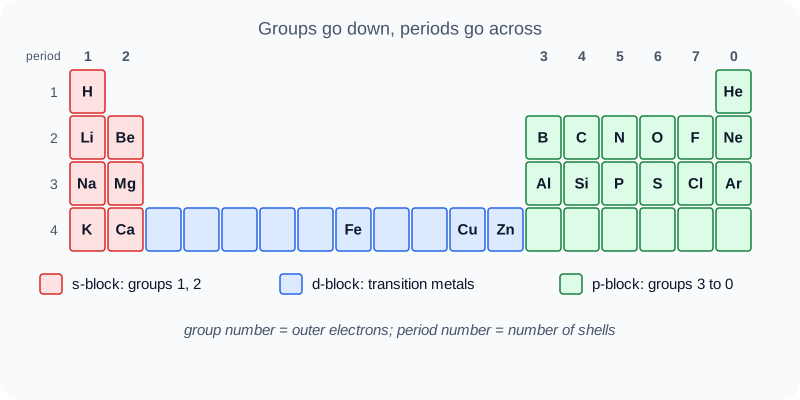
Figure 1. Groups, periods and blocks. WASSCE Tutor diagram.
- Groups are vertical columns. Elements in a group have the same number of outer electrons, so they have similar chemical properties.
- Periods are horizontal rows. Elements in a period have the same number of electron shells.
- Blocks are named after the sub-shell being filled: s-block (groups 1, 2), p-block (groups 3 to 0), d-block (transition metals) and f-block (lanthanides and actinides).
Families of elements
| Group | Name | Outer electrons | Examples | Character |
|---|---|---|---|---|
| 1 | Alkali metals | 1 | Li, Na, K | Very reactive metals; form M⁺ ions |
| 2 | Alkaline earth metals | 2 | Be, Mg, Ca | Reactive metals; form M²⁺ ions |
| 3 | Boron group | 3 | B, Al | Al forms Al³⁺ |
| 4 | Carbon group | 4 | C, Si | Mainly covalent bonding |
| 5 | Nitrogen group | 5 | N, P | Non-metals at the top |
| 6 | Oxygen group (chalcogens) | 6 | O, S | Form X²⁻ ions |
| 7 | Halogens | 7 | F, Cl, Br, I | Very reactive non-metals; form X⁻ ions |
| 0 (18) | Noble gases | 8 (He: 2) | He, Ne, Ar | Very unreactive |
| d-block | Transition metals | — | Fe, Cu, Zn | Coloured compounds; variable valency; catalysts |
Metals, non-metals and metalloids
- Metals are on the left and centre of the table, about three-quarters of all elements.
- Non-metals are at the top right, plus hydrogen.
- Metalloids (B, Si, Ge, As) lie along the staircase between them and have properties of both. Silicon is used in solar cells and computer chips.
Finding an element's position
| You know | Period | Group |
|---|---|---|
| Shell arrangement 2, 8, 6 | 3 shells → period 3 | 6 outer electrons → group 6 |
| Configuration [Ar] 4s¹ | n = 4 → period 4 | 1 outer electron → group 1 |
Element X has atomic number 17.
- Arrangement: 2, 8, 7.
- Three shells, so period 3; seven outer electrons, so group 7.
- X is a halogen (chlorine). It forms the ion X⁻ and the compound NaX with sodium.
Uses of the periodic table:
- predicting the properties of an element from its group
- predicting formulas of compounds (group 2 + group 7 gives MX₂)
- classifying elements as metals or non-metals
- understanding trends in reactivity (next lesson)
Many of Sierra Leone's mineral resources sit in particular parts of the table. Iron (Tonkolili, Marampa) and titanium (rutile) are d-block transition metals. Aluminium (bauxite) is in group 3. Gold is a d-block metal, and diamond is pure carbon from group 4.
Elements in the same group have similar properties, not elements in the same period. Across a period, properties change steadily from metal to non-metal.
Key points
- Döbereiner (triads), Newlands (octaves), Mendeleev (gaps and predictions) and Moseley (atomic number) built the table.
- Modern periodic law: properties are a periodic function of atomic number.
- Groups share outer electrons and properties; periods share the number of shells; blocks are s, p, d and f.
- Main families: alkali metals, alkaline earth metals, halogens, noble gases, transition metals.
- Find period from the number of shells and group from the number of outer electrons.
WASSCE examination focus
Expect to describe Mendeleev's contribution (gaps and predictions), to state the periodic law, to locate elements from atomic number or configuration, and to name groups and their characteristics. Questions often give an unknown letter, such as "element Y with Z = 12", and ask for its group, period and the formula of a compound.
Quick check
- State the modern periodic law.
- What did Mendeleev do that convinced chemists his table was right?
- Element Q has atomic number 12. Give its period, group and the formula of its chloride.
- Where are the non-metals found in the periodic table?
Answers:
- The properties of elements are a periodic function of their atomic numbers.
- He left gaps for undiscovered elements and correctly predicted their properties, e.g. germanium.
- 2, 8, 2: period 3, group 2; chloride QCl₂.
- At the top right of the table (plus hydrogen).
Keep going with the periodic table and periodicity
This is one of 2 lessons in The Periodic Table and Periodicity. Start free with the first lesson of every topic, then unlock them all, plus exam-style practice marked instantly and guided learning tools, from 25 NLe.
- Free account, no card needed
- Everything from 25 NLe
- No automatic renewal
More lessons in The Periodic Table and Periodicity
- Periodic trends: size, ionisation energy and electronegativity🔒