WASSCE Chemistry · The Mole Concept
The mole, molar mass and the Avogadro constant
By the WASSCE Tutor team
Updated 12 November 2026 · 7 min read · Prepared against the WASSCE syllabus.
Atoms are far too small to count one by one, so chemists count them in huge, fixed batches, just as traders count kola nuts by the hundred or eggs by the crate. The chemist's batch is the mole. Almost every calculation in WASSCE Chemistry passes through it, so this lesson is worth mastering.
Learning objectives
By the end of this lesson you should be able to:
- define the mole and the Avogadro constant
- calculate relative molecular mass and relative formula mass
- define molar mass and convert between mass and moles
- convert between moles and numbers of particles
- use the mole "bridge" to move between quantities
The mole and the Avogadro constant
- A mole is the amount of substance that contains as many particles (atoms, molecules, ions or electrons) as there are atoms in exactly 12 g of carbon-12.
- That number is the Avogadro constant, particles per mole.
One mole of anything contains particles:
- 1 mol of carbon atoms = C atoms
- 1 mol of water molecules = H₂O molecules
- 1 mol of sodium chloride contains Na⁺ ions and Cl⁻ ions
Always say which particle you mean: one mole of oxygen atoms (O) is not the same as one mole of oxygen molecules (O₂).
Relative molecular mass and formula mass
- Relative molecular mass (Mᵣ): the sum of the relative atomic masses of all the atoms in a molecule.
- Relative formula mass: the same idea for ionic compounds, which have no molecules.
Using H = 1, C = 12, O = 16, Na = 23, S = 32, Ca = 40, Cu = 64:
| Substance | Working | Mᵣ |
|---|---|---|
| H₂O | 2(1) + 16 | 18 |
| CO₂ | 12 + 2(16) | 44 |
| H₂SO₄ | 2(1) + 32 + 4(16) | 98 |
| CaCO₃ | 40 + 12 + 3(16) | 100 |
| Na₂CO₃ | 2(23) + 12 + 3(16) | 106 |
| CuSO₄·5H₂O | 64 + 32 + 4(16) + 5(18) | 250 |
Molar mass
The molar mass (M) of a substance is the mass of one mole of it, in g/mol (g mol⁻¹). It is numerically equal to the relative atomic, molecular or formula mass.
So the molar mass of water is 18 g/mol, of CO₂ 44 g/mol, of CaCO₃ 100 g/mol.
Mass and moles.
- How many moles are in 25 g of calcium carbonate? mol.
- What is the mass of 0.2 mol of sodium hydroxide, NaOH (M = 40)? g.
- 0.5 mol of a substance has a mass of 32 g. What is its molar mass? g/mol.
Moles and numbers of particles
Counting particles.
- How many molecules are in 0.5 mol of water?
- How many atoms are in that water? Each H₂O molecule has 3 atoms:
- What is the mass of carbon atoms?
The mole bridge
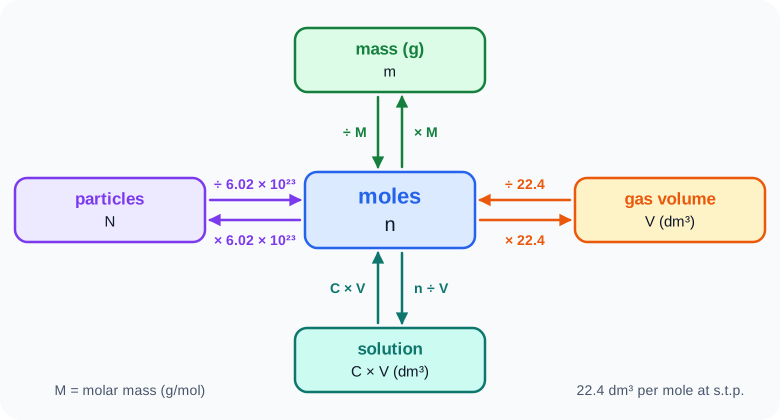
Figure 1. Every conversion passes through moles. WASSCE Tutor diagram.
To change one quantity into another, go through moles:
- mass → moles (÷ M) → particles (× L)
- mass → moles (÷ M) → gas volume (× 22.4 dm³) (next lesson)
- concentration and volume → moles (C × V) → mass (× M) (next lesson)
How many oxygen molecules are in 8 g of oxygen gas, O₂?
- Molar mass of O₂ = 32 g/mol.
- Moles: mol.
- Molecules: .
A trader selling sugar by the cup does not count the grains; the cup is a fixed "batch". Chemists do the same with the mole. One mole of table sugar, C₁₂H₂₂O₁₁ (M = 342 g/mol), is about 342 g, roughly a cupful, and holds sugar molecules.
Do not use 16 for the molar mass of oxygen gas. Oxygen gas is O₂, so its molar mass is 32 g/mol. The same applies to H₂ (2), N₂ (28) and Cl₂ (71).
Key points
- One mole contains 6.02 × 10²³ particles (the Avogadro constant), the number of atoms in 12 g of carbon-12.
- Mᵣ = sum of the relative atomic masses in the formula; molar mass has the same number in g/mol.
- and .
- Always state the particle (atoms, molecules, ions) and use the right formula (O₂, not O).
- Convert any quantity to moles first.
WASSCE examination focus
Expect to define the mole, to calculate Mᵣ (including hydrated salts), and to convert between mass, moles and numbers of particles. Questions often ask for the number of atoms or ions, not molecules, so read carefully and multiply by the number in the formula.
Quick check
- Calculate the relative molecular mass of ammonium nitrate, NH₄NO₃ (N = 14, H = 1, O = 16).
- How many moles are in 9.8 g of H₂SO₄?
- How many molecules are in 0.1 mol of carbon dioxide?
- What is the mass of 3.01 × 10²³ atoms of sodium (Na = 23)?
Answers:
- .
- mol.
- molecules.
- 0.5 mol × 23 = 11.5 g.
Keep going with the mole concept
This is one of 2 lessons in The Mole Concept. Start free with the first lesson of every topic, then unlock them all, plus exam-style practice marked instantly and guided learning tools, from 25 NLe.
- Free account, no card needed
- Everything from 25 NLe
- No automatic renewal
More lessons in The Mole Concept
- Molar volume of gases and concentration of solutions🔒