WASSCE Chemistry · The Halogens
Chlorine: preparation, properties and uses
By the WASSCE Tutor team
Updated 12 November 2026 · 8 min read · Prepared against the WASSCE syllabus.
Chlorine makes Freetown's tap water safe to drink, bleaches cloth and is the starting point for PVC pipes. It is also a poisonous gas that must be handled in a fume cupboard. This lesson covers the laboratory preparation of chlorine, how it is purified and collected, its test and its reactions, and its manufacture and uses.
Learning objectives
By the end of this lesson you should be able to:
- describe the laboratory preparation, purification and collection of chlorine
- describe the test for chlorine
- state the physical properties of chlorine
- describe and explain the reactions of chlorine with metals, hydrogen, water, alkalis and other reducing agents
- explain how chlorine bleaches
- state the industrial source and uses of chlorine
Laboratory preparation
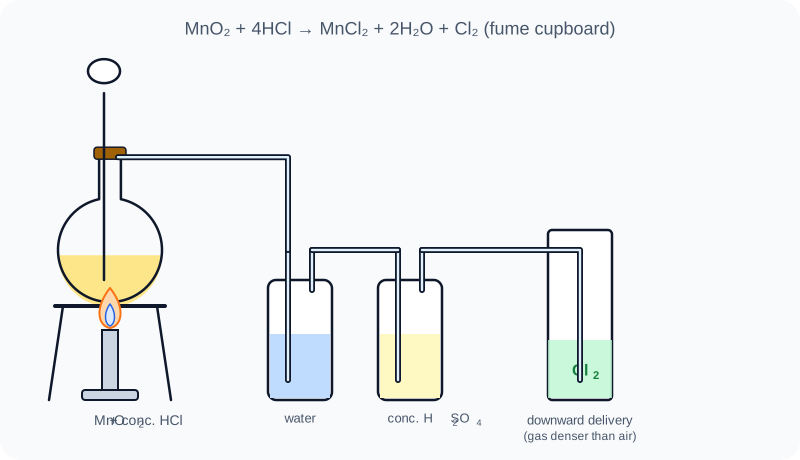
Figure 1. Preparing, purifying and collecting chlorine. WASSCE Tutor diagram.
Chlorine is made by oxidising concentrated hydrochloric acid with an oxidising agent.
With manganese(IV) oxide (heat needed):
With potassium manganate(VII) (no heat needed):
Purifying and drying:
- Pass the gas through water, which removes hydrogen chloride fumes (very soluble in water; chlorine is only fairly soluble).
- Then pass it through concentrated sulphuric acid, which dries it.
Collection: by downward delivery (upward displacement of air), because chlorine is about 2.5 times denser than air. It is not collected over water, because it dissolves in water.
Safety: chlorine is poisonous; it attacks the lungs. Prepare it only in a fume cupboard.
Test for chlorine
Damp blue litmus paper turns red, then is bleached white. The acidity comes from HCl and HOCl formed with water; the bleaching comes from HOCl.
Physical properties
| Property | Chlorine |
|---|---|
| Colour | Greenish-yellow gas |
| Smell | Choking, irritating |
| Density | About 2.5 times denser than air |
| Solubility | Fairly soluble in water, giving chlorine water |
| Toxicity | Poisonous |
| Boiling point | −34 °C; easily liquefied under pressure |
Chemical properties
Chlorine is a strong oxidising agent: it readily gains electrons, Cl₂ + 2e⁻ → 2Cl⁻.
1. With metals (heated), forming chlorides. With iron it gives iron(III) chloride, showing chlorine's oxidising strength:
2. With hydrogen, forming hydrogen chloride. The reaction is slow in the dark, explosive in sunlight:
3. With water, forming chlorine water, a mixture of hydrochloric acid and chloric(I) acid (hypochlorous acid):
In sunlight, chlorine water slowly gives off oxygen: 2HOCl → 2HCl + O₂.
4. With sodium hydroxide:
- Cold, dilute NaOH gives sodium chloride and sodium chlorate(I), the active ingredient of household bleach:
- Hot, concentrated NaOH gives sodium chlorate(V): 3Cl₂ + 6NaOH → 5NaCl + NaClO₃ + 3H₂O.
5. With reducing agents:
- Hydrogen sulphide: H₂S + Cl₂ → 2HCl + S (yellow deposit)
- Iron(II) salts: 2FeCl₂ + Cl₂ → 2FeCl₃ (green → yellow-brown)
- Ammonia: chlorine oxidises it, giving white fumes of NH₄Cl
- Bromides and iodides (displacement): Cl₂ + 2KBr → 2KCl + Br₂ (orange); Cl₂ + 2KI → 2KCl + I₂ (brown)
6. With hydrocarbons: substitution reactions (CH₄ + Cl₂ → CH₃Cl + HCl in light) and addition to alkenes (see organic chemistry). Turpentine bursts into flame in chlorine because chlorine removes its hydrogen.
How chlorine bleaches
Chlorine bleaches only when moist. With water it forms chloric(I) acid, which gives up oxygen to the dye and oxidises it to a colourless compound:
Dry chlorine does not bleach dry litmus. Because chlorine bleaching is oxidation, it is permanent.
Manufacture and uses
Chlorine is made industrially by the electrolysis of brine (concentrated sodium chloride solution), which also gives sodium hydroxide and hydrogen.
| Use | Detail |
|---|---|
| Water treatment | Kills bacteria in drinking water and swimming pools |
| Bleach | Sodium chlorate(I) bleaches cloth and paper pulp, and disinfects |
| Plastics | Making PVC (polyvinyl chloride) for pipes, cables and flooring |
| Hydrochloric acid | Burning hydrogen in chlorine |
| Solvents and pesticides | Chlorinated hydrocarbons |
| Medicines and disinfectants | Antiseptics such as TCP |
Household bleaches sold in Sierra Leone contain about 3–5% sodium chlorate(I). A few drops per litre of water, left for 30 minutes, kill most germs, which is why health workers recommend it during cholera outbreaks. Never mix bleach with acid toilet cleaners: the acid releases chlorine gas.
Chlorine is collected by downward delivery, not over water: it dissolves in water and is denser than air. Its test needs damp litmus paper: dry chlorine has no effect on dry litmus.
Key points
- Prepared by oxidising concentrated HCl with MnO₂ (heated) or KMnO₄; water removes HCl, concentrated H₂SO₄ dries it; collected by downward delivery in a fume cupboard.
- Test: damp blue litmus turns red then white.
- Greenish-yellow, choking, poisonous, denser than air.
- A strong oxidising agent: forms FeCl₃ with iron, displaces Br₂ and I₂, oxidises H₂S and Fe²⁺.
- Bleaches by oxidation via HOCl, and only when moist.
- Made by electrolysis of brine; used for water treatment, bleach, PVC, HCl.
WASSCE examination focus
Expect to describe the laboratory preparation of chlorine with a diagram, explaining the purpose of the water and sulphuric acid bottles and the method of collection. Questions also ask for the test, the reactions with water and sodium hydroxide, how chlorine bleaches, and its uses.
Quick check
- Why is the chlorine passed through water during its preparation?
- Why is chlorine collected by downward delivery?
- Write the equation for chlorine and cold dilute sodium hydroxide.
- Why does dry chlorine not bleach dry litmus paper?
Answers:
- To remove hydrogen chloride fumes.
- It is denser than air and dissolves in water.
- Cl₂ + 2NaOH → NaCl + NaOCl + H₂O.
- Bleaching needs water to form HOCl, which releases oxygen to oxidise the dye.
Keep going with the halogens
This is one of 2 lessons in The Halogens. Start free with the first lesson of every topic, then unlock them all, plus exam-style practice marked instantly and guided learning tools, from 25 NLe.
- Free account, no card needed
- Everything from 25 NLe
- No automatic renewal
More lessons in The Halogens
- The halogens as a group: trends and halides🔒