WASSCE Chemistry · States of Matter
The kinetic theory and the three states of matter
By the WASSCE Tutor team
Updated 12 November 2026 · 7 min read · Prepared against the WASSCE syllabus.
Why can you pour water but not a stone, and why does a little cooking gas fill a whole kitchen with its smell? The kinetic theory of matter answers both: all matter is made of particles in constant motion, and the state depends on how strongly the particles attract each other compared with how much energy they have.
Learning objectives
By the end of this lesson you should be able to:
- state the main ideas of the kinetic theory of matter
- describe the arrangement, movement and energy of particles in solids, liquids and gases
- explain the properties of each state using the kinetic theory
- describe evidence for moving particles: Brownian motion and diffusion
- relate temperature to the kinetic energy of particles
The kinetic theory of matter
- All matter is made of tiny particles (atoms, molecules or ions).
- The particles are in constant, random motion.
- There are forces of attraction between particles; the closer they are, the stronger the attraction.
- The particles have kinetic energy, which increases as the temperature rises.
- Collisions between particles are perfectly elastic for an ideal gas: no energy is lost overall.
The state of a substance depends on the balance between attractive forces (holding particles together) and kinetic energy (moving them apart).
The three states
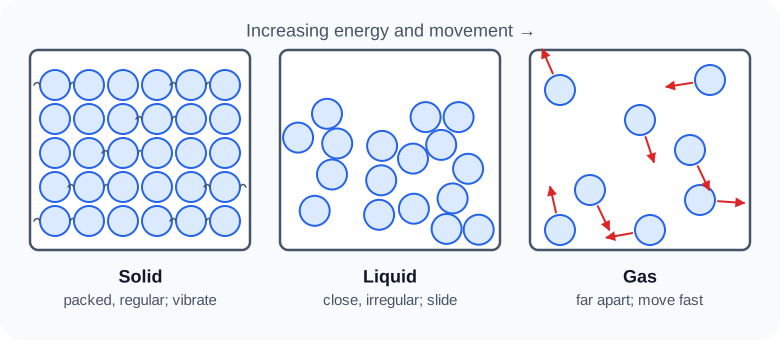
Figure 1. Particle arrangement in the three states. WASSCE Tutor diagram.
| Feature | Solid | Liquid | Gas |
|---|---|---|---|
| Arrangement | Closely packed, regular pattern | Close together, irregular | Far apart, random |
| Movement | Vibrate about fixed positions | Move around and slide past each other | Move quickly and freely in all directions |
| Forces between particles | Strongest | Weaker | Very weak (almost none) |
| Energy | Lowest | Higher | Highest |
| Shape | Fixed | Takes the shape of its container | Fills the whole container |
| Volume | Fixed | Fixed | Not fixed: fills any space |
| Compressibility | Almost incompressible | Almost incompressible | Easily compressed |
| Density | High | High | Low |
Explaining properties with the kinetic theory
- Solids keep their shape because strong forces hold particles in fixed positions; they can only vibrate.
- Liquids flow because particles can slide past each other, but stay close, so the volume is fixed.
- Gases can be compressed because there is a lot of empty space between their particles. That is why cooking gas can be stored as a liquid in a small cylinder under pressure.
- Gases exert pressure because their particles hit the walls of the container. More collisions per second, or harder collisions, mean higher pressure.
Evidence for moving particles
Brownian motion
When smoke particles in air, or pollen grains in water, are viewed under a microscope, they move in a random, jerky zigzag. They are being knocked about by invisible, fast-moving air or water molecules colliding with them unevenly. Robert Brown first saw this in 1827.
Diffusion
Diffusion is the spreading out of particles from a region of higher concentration to a region of lower concentration until they are evenly mixed.
- The smell of fried fish or perfume spreads across a room.
- A crystal of potassium manganate(VII) dropped in water slowly turns all the water purple without stirring.
- Diffusion is fastest in gases, slower in liquids and extremely slow in solids, because gas particles move fastest and have the most space.
Temperature and kinetic energy
The average kinetic energy of particles is proportional to the absolute (kelvin) temperature. Heating gives particles more energy:
- solids vibrate more and expand
- liquids move faster and evaporate more
- gases move faster and, in a closed container, exert more pressure
At absolute zero (0 K, −273 °C), particles would have the minimum possible energy.
Which particles move faster: those in air at 37 °C or at 7 °C?
Convert to kelvin: K and K. The air at 310 K has the higher average kinetic energy, so its particles move faster on average. Note that the kinetic energy is not five times larger, even though 37 is about five times 7: the comparison must be made in kelvin.
On a hot afternoon in Freetown, wet clothes on the line dry quickly. The water molecules have more kinetic energy, so more of them escape from the surface of the cloth. Wind carries the escaped molecules away, so fewer return. In the cooler rainy season, clothes take much longer to dry.
Particles in a solid are not still. They vibrate about fixed positions. Only at absolute zero would vibration be at a minimum.
Key points
- Kinetic theory: matter is made of particles in constant random motion, with attractions between them; kinetic energy rises with temperature.
- Solids: packed, regular, vibrate; fixed shape and volume. Liquids: close, irregular, slide; fixed volume. Gases: far apart, fast; no fixed shape or volume, compressible.
- Brownian motion and diffusion are evidence for moving particles.
- Diffusion is fastest in gases.
- Average kinetic energy is proportional to kelvin temperature: K = °C + 273.
WASSCE examination focus
Expect to state the kinetic theory, to compare the three states in arrangement, movement and energy, to explain properties such as compressibility using particles, and to describe Brownian motion and diffusion as evidence. Always explain in terms of particles: their spacing, movement and forces.
Quick check
- State two postulates of the kinetic theory of matter.
- Why are gases easily compressed while liquids are not?
- What causes Brownian motion?
- Convert −23 °C to kelvin.
Answers:
- Any two: matter is made of tiny particles; the particles are in constant random motion; there are attractive forces between them; their kinetic energy rises with temperature; collisions are elastic.
- Gas particles are far apart with much empty space between them; liquid particles are already close together.
- Uneven collisions of fast-moving, invisible molecules of air or water with the visible particles.
- K.
Keep going with states of matter
This is one of 2 lessons in States of Matter. Start free with the first lesson of every topic, then unlock them all, plus exam-style practice marked instantly and guided learning tools, from 25 NLe.
- Free account, no card needed
- Everything from 25 NLe
- No automatic renewal
More lessons in States of Matter
- Changes of state, heating curves and diffusion🔒