WASSCE Chemistry · Solutions and Solubility
Solutions, suspensions and colloids
By the WASSCE Tutor team
Updated 12 November 2026 · 8 min read · Prepared against the WASSCE syllabus.
Stir salt into water and it vanishes; stir in mud and it clouds the water, then slowly settles; stir in powdered milk and the mixture stays cloudy but never settles. These are the three kinds of mixture of a substance in a liquid: solutions, suspensions and colloids. This lesson explains how they differ and why colloids matter from cooking to water treatment.
Learning objectives
By the end of this lesson you should be able to:
- define solution, solute and solvent, and name common solvents and their uses
- distinguish saturated, unsaturated and supersaturated solutions
- distinguish true solutions, suspensions and colloids by their properties
- describe the Tyndall effect
- name the types of colloids, with examples, and describe coagulation
Solutions
- A solution is a uniform (homogeneous) mixture of two or more substances.
- The solute is the substance that dissolves; the solvent is the substance it dissolves in.
- A solution in water is an aqueous solution.
Salt solution: salt is the solute, water the solvent. Solutions are not only solids in liquids. Air is a solution of gases, soda water a gas in a liquid, and brass a solid solution of zinc in copper.
Solvents and their uses
| Solvent | Dissolves | Everyday use |
|---|---|---|
| Water | Salts, sugars, many acids and bases | Cooking, cleaning, medicines |
| Ethanol | Iodine, resins, perfume oils, some dyes | Tincture of iodine, perfumes, medicines |
| Propanone (acetone) | Nail varnish, grease, plastics | Nail-varnish remover |
| Kerosene / turpentine | Oil paint, grease, tar | Thinning paint, removing grease and tar |
| Trichloroethane / tetrachloroethene | Grease | Dry cleaning |
"Like dissolves like": ionic and polar substances dissolve in polar solvents such as water; non-polar substances (oils, fats, grease) dissolve in non-polar solvents such as kerosene.
Saturated, unsaturated and supersaturated solutions
- An unsaturated solution can dissolve more solute at that temperature.
- A saturated solution contains the maximum amount of solute that can dissolve at that temperature, with undissolved solute present.
- A supersaturated solution contains more solute than a saturated solution at that temperature. It is unstable: adding a tiny crystal (seeding) makes the excess crystallise out at once.
Testing for saturation: add a little more solute at the same temperature. If it does not dissolve, the solution is saturated.
Making a supersaturated solution: prepare a saturated solution of sodium thiosulphate (or sodium ethanoate) while hot, then let it cool undisturbed.
Solutions, suspensions and colloids
| Property | True solution | Colloid | Suspension |
|---|---|---|---|
| Particle size | Very small (below about 1 nm): ions and molecules | Intermediate (about 1–1000 nm) | Large (above about 1000 nm) |
| Appearance | Clear and transparent | Usually cloudy or translucent | Cloudy, opaque |
| Settles on standing? | No | No | Yes |
| Passes through filter paper? | Yes | Yes | No: residue left |
| Tyndall effect | No: beam invisible | Yes: beam visible | Particles may be seen |
| Examples | Salt solution, sugar solution | Milk, starch solution, fog, blood, gelatin | Muddy water, chalk in water, sand in water |
The Tyndall effect
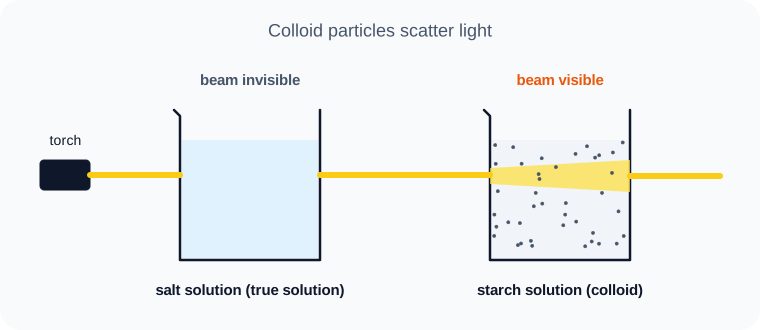
Figure 1. The Tyndall effect distinguishes a colloid from a true solution. WASSCE Tutor diagram.
The Tyndall effect is the scattering of light by colloid particles, which makes the path of a light beam visible in a colloid but not in a true solution.
You see the Tyndall effect when sunlight streams through dusty air in a room or through mist in the morning, and when car headlights shine through fog.
Types of colloids
A colloid has a dispersed phase (the particles) spread through a dispersion medium.
| Type | Dispersed phase in medium | Examples |
|---|---|---|
| Sol | Solid in liquid | Starch solution, paint, ink, blood |
| Gel | Liquid in solid | Jelly, gelatin, hair gel |
| Emulsion | Liquid in liquid | Milk, mayonnaise, palm-oil sauces, cream |
| Foam | Gas in liquid | Shaving foam, whipped cream, soap lather |
| Solid foam | Gas in solid | Foam rubber, bread, pumice |
| Aerosol | Liquid or solid in gas | Fog, mist, clouds (liquid); smoke, dust (solid) |
An emulsifying agent keeps an emulsion from separating. Soap emulsifies grease in water; egg yolk emulsifies oil in mayonnaise.
Coagulation of colloids
Colloid particles often carry the same electric charge, so they repel each other and stay dispersed. Adding ions of opposite charge cancels this and makes the particles clump and settle: this is coagulation.
- Alum (Al³⁺ ions) coagulates clay particles in water treatment.
- Blood clotting: ferric chloride or alum stops bleeding from small cuts by coagulating blood.
- Smoke precipitators in factories use electric charge to remove smoke particles.
- River deltas form where river clay (a colloid) meets the ions of sea water.
When fresh palm-oil soup or groundnut soup is stirred, the oil spreads through the water as tiny droplets, making an emulsion. If the soup is left to cool, the oil separates and floats to the top, because there is little emulsifier to hold it. Fog over the Freetown peninsula on cool mornings is an aerosol, and car headlights show its Tyndall effect.
Milk is not a true solution: it is a colloid (an emulsion of fat droplets in water). It passes through filter paper and does not settle, but it shows the Tyndall effect and looks cloudy.
Key points
- A solution is a uniform mixture of solute in solvent; "like dissolves like".
- Saturated = maximum solute at that temperature; supersaturated = more than that (unstable).
- True solution: tiny particles, clear, no settling, no Tyndall effect. Colloid: intermediate particles, Tyndall effect, no settling. Suspension: large particles, settles, filterable.
- Colloid types: sol, gel, emulsion, foam, aerosol.
- Coagulation by oppositely charged ions (alum) is used in water treatment.
WASSCE examination focus
Expect to distinguish solutions, colloids and suspensions in a table, to describe the Tyndall effect, to classify colloids (emulsion, aerosol, sol, gel, foam) with examples, and to define saturated and supersaturated solutions. Uses of solvents in stain removal also appear.
Quick check
- Name the solvent you would use to remove an oil-paint stain.
- How would you show that a solution is saturated?
- Give two differences between a colloid and a suspension.
- What type of colloid is (a) milk, (b) smoke?
Answers:
- Kerosene or turpentine.
- Add a little more solute at the same temperature; if it does not dissolve, the solution is saturated.
- Any two: colloid particles are smaller; colloids do not settle, suspensions do; colloids pass through filter paper, suspensions do not; colloids are often translucent, suspensions opaque.
- (a) Emulsion; (b) aerosol (solid in gas).
Keep going with solutions and solubility
This is one of 2 lessons in Solutions and Solubility. Start free with the first lesson of every topic, then unlock them all, plus exam-style practice marked instantly and guided learning tools, from 25 NLe.
- Free account, no card needed
- Everything from 25 NLe
- No automatic renewal
More lessons in Solutions and Solubility
- Solubility, solubility curves and crystallisation🔒