WASSCE Chemistry · Soaps, Detergents, and Oils
Fats, oils and saponification
By the WASSCE Tutor team
Updated 12 November 2026 · 7 min read · Prepared against the WASSCE syllabus.
Long before soap came in wrapped bars, people in West Africa made it by boiling palm oil with lye from plant ashes. The chemistry has not changed: a fat or oil is boiled with an alkali, and the ester splits into glycerol and soap. This lesson covers where fats and oils come from, how they are used, and how soap is made.
Learning objectives
By the end of this lesson you should be able to:
- name sources of fats and oils and describe how oils are extracted
- state the uses of fats and oils
- describe saponification with a word equation and a general equation
- describe the industrial and local manufacture of soap, including salting out
- explain the difference between sodium and potassium soaps
- calculate masses in saponification
Sources and extraction of fats and oils
Fats and oils are triglycerides: esters of glycerol with three long-chain fatty acids (see the Esters topic).
| Source | Examples |
|---|---|
| Plant seeds and fruits | Palm oil, palm kernel oil, coconut oil, groundnut oil, sesame (benniseed) oil, shea butter, cottonseed oil |
| Animals | Butter, lard (pig fat), tallow (beef fat), fish oil, cod-liver oil |
Extraction methods:
- Boiling (rendering) and skimming: fruits or animal fat are boiled in water; the oil floats and is skimmed off. This is the traditional method for palm oil.
- Pressing (expression): seeds or fruit pulp are crushed in a press (groundnuts, palm kernels).
- Solvent extraction: crushed seeds are soaked in a volatile organic solvent such as hexane, which dissolves the oil; the solvent is then distilled off and reused. This gives the highest yield.
Uses of fats and oils
- Food: cooking oils, margarine, butter; a concentrated energy source (about 37 kJ/g)
- Soap and detergent making
- Cosmetics: creams, lotions, hair oils (shea butter, coconut oil)
- Paints and varnishes: highly unsaturated "drying oils" such as linseed oil harden in air
- Fuel: biodiesel made from vegetable oils; oil lamps
- Lubricants and candles
Saponification
Saponification is the alkaline hydrolysis of a fat or oil. Boiling a fat or oil with sodium hydroxide (or potassium hydroxide) solution gives glycerol and soap, the sodium (or potassium) salt of a fatty acid.
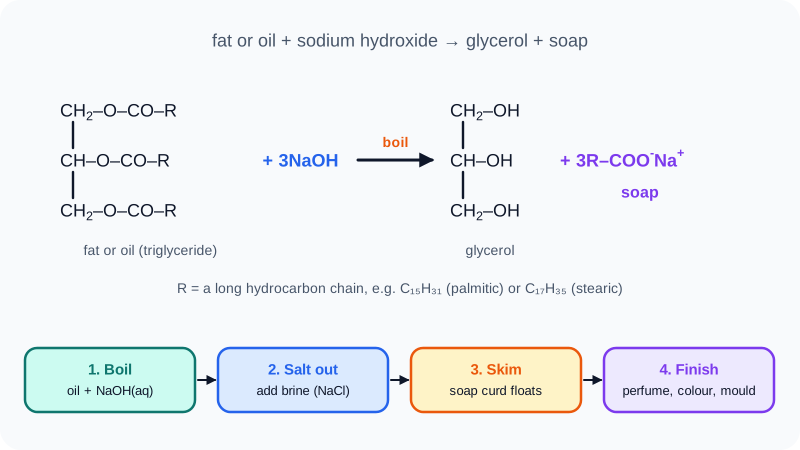
Figure 1. Saponification and the steps of soap making. WASSCE Tutor diagram.
For glyceryl tristearate (a fat made from stearic acid):
The products are sodium stearate (soap) and glycerol (propane-1,2,3-triol).
Manufacture of soap
- Boiling: the fat or oil is boiled with concentrated sodium hydroxide solution, stirring, until saponification is complete.
- Salting out: concentrated sodium chloride solution (brine) or solid salt is added. Soap is much less soluble in salt water, so it separates as a curd that floats on top.
- Separation: the soap curd is skimmed off. The liquid below contains glycerol, salt and excess alkali; glycerol is recovered from it.
- Finishing: the soap is washed, then perfume, colouring, antiseptics or fillers are added, and it is moulded and cut into bars.
By-product: glycerol is valuable. It is used in cosmetics, medicines, sweets and to make explosives (nitroglycerine).
| Soap type | Made with | Properties |
|---|---|---|
| Sodium soap | Sodium hydroxide (caustic soda) | Hard bar soap |
| Potassium soap | Potassium hydroxide (caustic potash) | Soft or liquid soap; shaving soap, liquid hand soap |
Soap from a fat. What mass of sodium stearate is formed when 89 g of glyceryl tristearate is saponified completely? (Mᵣ: glyceryl tristearate = 890; sodium stearate = 306)
- Moles of fat mol
- 1 mol of fat gives 3 mol of soap: soap mol
- Mass g
Traditional "black soap" (country soap) is still made in villages across Sierra Leone and West Africa. Ash from burnt cocoa pods, palm-bunch stalks or plantain peels is soaked in water; the liquid that drips through is a solution of potassium carbonate and hydroxide (potash lye). Boiled with palm oil or palm kernel oil, it saponifies the oil to a soft, dark potassium soap. Industrial soap factories do the same reaction with pure sodium hydroxide and salt out the soap with brine.
Salting out does not react with the soap. It simply makes the soap less soluble, so it separates from the glycerol solution. The salt is NaCl, not NaOH.
Key points
- Fats and oils come from plants (palm, groundnut, coconut, shea) and animals (butter, lard, tallow); oils are extracted by boiling and skimming, pressing or solvent extraction.
- Uses: food, soap, margarine, cosmetics, paints, biodiesel.
- Saponification: fat or oil + NaOH → glycerol + soap (sodium salt of a fatty acid).
- Soap making: boil with NaOH → salt out with brine → skim the curd → add perfume and colour; glycerol is a by-product.
- Sodium soaps are hard; potassium soaps are soft.
WASSCE examination focus
Expect to define saponification and write its equation, to describe the industrial preparation of soap (including the purpose of adding sodium chloride), to name the by-product (glycerol) and its uses, and to state sources and uses of fats and oils. Calculations on the mass of soap or alkali are occasionally set.
Quick check
- What is saponification?
- Why is sodium chloride added during soap making?
- Name the by-product of soap manufacture and give one use.
- Why is liquid soap usually made with potassium hydroxide?
Answers:
- The alkaline hydrolysis of a fat or oil to form glycerol and soap.
- To salt out the soap: soap is less soluble in brine, so it separates as a curd that can be skimmed off.
- Glycerol (propane-1,2,3-triol); used in cosmetics, medicines, sweets or explosives.
- Potassium soaps are softer and more soluble than sodium soaps.
Keep going with soaps, detergents, and oils
This is one of 2 lessons in Soaps, Detergents, and Oils. Start free with the first lesson of every topic, then unlock them all, plus exam-style practice marked instantly and guided learning tools, from 25 NLe.
- Free account, no card needed
- Everything from 25 NLe
- No automatic renewal
More lessons in Soaps, Detergents, and Oils
- Soaps and detergents: how they clean🔒