WASSCE Chemistry · Reactivity Series and Extraction of Metals
The reactivity series and properties of metals
By the WASSCE Tutor team
Updated 12 November 2026 · 8 min read · Prepared against the WASSCE syllabus.
Gold stays shiny for thousands of years, iron rusts within weeks and potassium bursts into flame in water. Placing metals in order of reactivity explains all of this, and predicts how each metal reacts and how it must be extracted. This lesson builds the reactivity series from experiments and uses it.
Learning objectives
By the end of this lesson you should be able to:
- state the general physical and chemical properties of metals
- arrange metals in a reactivity series from their reactions with water, acids and oxygen
- predict displacement reactions using the reactivity series
- relate the stability of metal compounds to the reactivity of the metal
- explain the position of carbon and hydrogen in the series
Properties of metals
Physical properties (most metals):
- shiny (lustrous) when freshly cut
- good conductors of heat and electricity
- malleable (can be hammered into sheets) and ductile (can be drawn into wires)
- high melting points and densities (sodium and potassium are exceptions)
- sonorous (ring when struck)
Chemical properties:
- form positive ions by losing electrons: M → M^n+ + ne⁻ (metals are reducing agents)
- form basic oxides (some amphoteric)
- the more reactive metals displace hydrogen from water or acids
Building the reactivity series
| Metal | Cold water | Steam | Dilute HCl | Burning in air |
|---|---|---|---|---|
| K | Violent; H₂ ignites (lilac flame) | Explosive | Explosive | Burns brightly |
| Na | Vigorous; floats, melts, darts around | Explosive | Explosive | Burns with yellow flame |
| Ca | Steady; sinks, fizzes | Vigorous | Vigorous | Burns with brick-red flame |
| Mg | Very slow | Burns brightly | Rapid | Burns with dazzling white flame |
| Al | No reaction (oxide layer) | Slow (when hot) | Moderate, after the oxide layer goes | Burns as powder |
| Zn | No reaction | Reacts when red hot | Moderate | Burns when strongly heated |
| Fe | Rusts slowly | Reacts when red hot (reversible) | Slow | Burns as wool or powder |
| Pb | No reaction | No reaction | Very slow | Forms oxide on heating |
| Cu | No reaction | No reaction | No reaction | Forms black oxide on heating; does not burn |
| Ag, Au | No reaction | No reaction | No reaction | No reaction |
From these results, the reactivity series (most reactive first):
K > Na > Ca > Mg > Al > (C) > Zn > Fe > Sn > Pb > (H) > Cu > Hg > Ag > Au
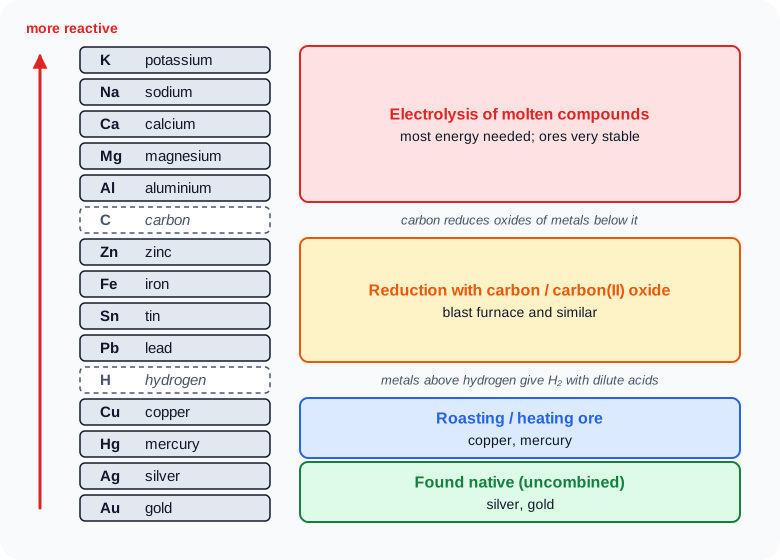
Figure 1. The reactivity series and how each metal is extracted. WASSCE Tutor diagram.
A useful order to memorise: "Please Send Charlie's Monkeys And Zebras In Large Hired Cages Making Sure Gorillas" for K, Na, Ca, Mg, Al, Zn, Fe, Pb, H, Cu, Hg, Ag, Au.
Carbon and hydrogen
The non-metals carbon and hydrogen are included as reference points:
- Carbon (between Al and Zn) can reduce the oxides of metals below it: zinc, iron, tin, lead, copper.
- Hydrogen (between Pb and Cu): metals above it displace hydrogen from dilute acids; metals below it (Cu, Ag, Au) do not.
Displacement reactions
A more reactive metal displaces a less reactive metal from a solution of its salt or from its oxide.
Iron nail in copper(II) sulphate solution.
The iron becomes coated with reddish-brown copper, and the blue solution turns pale green (Fe²⁺). Iron is above copper, so it loses electrons more readily: Fe → Fe²⁺ + 2e⁻ and Cu²⁺ + 2e⁻ → Cu.
Copper placed in iron(II) sulphate solution shows no reaction, because copper is less reactive than iron.
The thermite reaction: aluminium displaces iron from iron(III) oxide so violently that molten iron is produced. It is used to weld railway lines:
Reactivity and the stability of compounds
The more reactive a metal, the more stable its compounds, and the harder they are to break down.
| Compound | Reactive metals (K, Na) | Middle metals (Ca to Cu) | Least reactive (Ag, Au) |
|---|---|---|---|
| Oxide + heat | Stable | Stable (reduced by carbon if below Al) | Decomposes: 2Ag₂O → 4Ag + O₂ |
| Hydroxide + heat | Stable | → oxide + water: Cu(OH)₂ → CuO + H₂O | — |
| Carbonate + heat | Stable | → oxide + CO₂ | → metal + CO₂ + O₂ |
| Nitrate + heat | → nitrite + O₂ | → oxide + NO₂ + O₂ | → metal + NO₂ + O₂ |
So potassium must be extracted by electrolysis, while silver oxide decomposes just by heating, and gold is found as the free metal.
Artisanal miners in Sierra Leone find gold as tiny grains of the free metal in river gravels, because gold is so unreactive that it never combines with oxygen or sulphur. Iron, a more reactive metal, is never found free: at Tonkolili and Marampa it occurs as iron oxide ore, which must be chemically reduced to obtain the metal.
Aluminium is high in the series yet seems unreactive, for example in cooking pots. A thin, tough layer of aluminium oxide protects it. Remove the layer, by scratching it under mercury(II) chloride solution for instance, and aluminium reacts as vigorously as its position predicts.
Key points
- Metals are lustrous, conducting, malleable and ductile; they form positive ions and basic oxides.
- Reactivity series: K, Na, Ca, Mg, Al, (C), Zn, Fe, Sn, Pb, (H), Cu, Hg, Ag, Au.
- Reactions with water, steam, acids and oxygen become less vigorous down the series.
- A more reactive metal displaces a less reactive one (Fe + CuSO₄; thermite).
- Carbon reduces oxides of metals below it; metals above hydrogen react with dilute acids.
- The more reactive the metal, the more stable its compounds.
WASSCE examination focus
Expect to arrange metals in order from experimental observations, to predict and write equations for displacement reactions, to explain the positions of carbon and hydrogen, and to relate the effect of heat on compounds to the reactivity of the metal. The unusual behaviour of aluminium is often asked.
Quick check
- Name a metal that reacts with steam but only very slowly with cold water.
- What is seen when zinc is placed in copper(II) sulphate solution?
- Why does copper not react with dilute hydrochloric acid?
- Why is aluminium used for cooking pots even though it is a reactive metal?
Answers:
- Magnesium (or iron or zinc at red heat).
- Reddish-brown copper forms on the zinc and the blue colour fades.
- Copper is below hydrogen in the reactivity series, so it cannot displace hydrogen from the acid.
- It is protected by a thin, unreactive layer of aluminium oxide.
Keep going with reactivity series and extraction of metals
This is one of 2 lessons in Reactivity Series and Extraction of Metals. Start free with the first lesson of every topic, then unlock them all, plus exam-style practice marked instantly and guided learning tools, from 25 NLe.
- Free account, no card needed
- Everything from 25 NLe
- No automatic renewal
More lessons in Reactivity Series and Extraction of Metals
- Extraction of metals and alloys🔒