WASSCE Chemistry · Rate of Reaction
Measuring reaction rates and collision theory
By the WASSCE Tutor team
Updated 12 November 2026 · 7 min read · Prepared against the WASSCE syllabus.
Some reactions are over in a flash, like a match igniting; others take years, like iron rusting. Chemical kinetics studies how fast reactions go and why. This lesson defines the rate of reaction, shows how to measure it in the laboratory, how to read rate graphs, and introduces the collision theory that explains everything about rates.
Learning objectives
By the end of this lesson you should be able to:
- define the rate of a reaction and state its units
- describe methods of measuring reaction rates
- calculate average rates from experimental data
- interpret graphs of product formed against time
- state the collision theory and explain activation energy
What is the rate of a reaction?
The rate of a reaction is the change in the amount or concentration of a reactant or product per unit time.
The amount may be a mass, a gas volume or a concentration.
Typical units: mol dm⁻³ s⁻¹, cm³ s⁻¹ (gas volume) or g s⁻¹ (mass).
Measuring rates
Choose a property that changes as the reaction proceeds.
| Method | Example reaction | What you measure |
|---|---|---|
| Volume of gas given off | Marble chips + hydrochloric acid; magnesium + acid | Volume of gas in a gas syringe (or collected over water) at regular times |
| Loss of mass | Marble chips + acid in a flask on a balance (cotton-wool plug lets CO₂ escape) | Mass of the flask at regular times |
| Colour change | Iodine reactions; KMnO₄ decolourising | Time for a colour to appear or disappear |
| Precipitate formation | Sodium thiosulphate + hydrochloric acid gives sulphur | Time for a cross under the flask to disappear |
| Sampling and titration | Hydrolysis of an ester | Concentration of acid at intervals |
For the thiosulphate reaction,
the sulphur makes the solution cloudy. A shorter time for the cross to disappear means a faster reaction. The rate is taken as .
Rate graphs
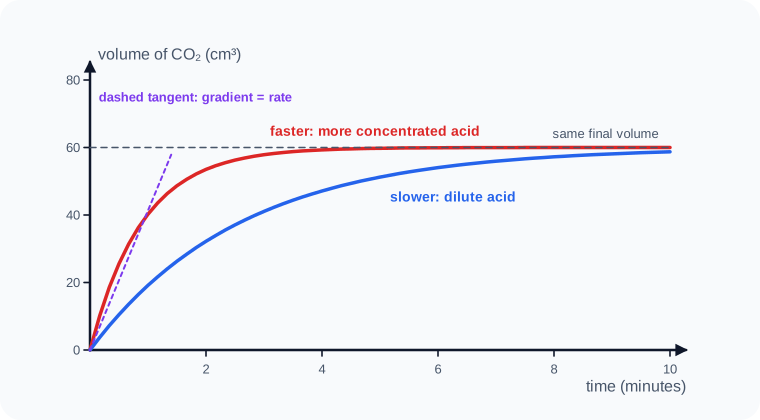
Figure 1. The gradient of the curve is the rate. WASSCE Tutor diagram.
- The gradient (slope) of the curve at any point is the rate at that time.
- The curve is steepest at the start, when the reactants are most concentrated, so the rate is fastest at the start.
- The curve becomes less steep as reactants are used up: the rate decreases.
- The curve becomes flat (horizontal) when the reaction stops, because one reactant (the limiting reactant) is used up.
- The final volume depends on the amount of limiting reactant, not on how fast it reacts.
Marble chips with hydrochloric acid.
| Time (s) | 0 | 30 | 60 | 90 | 120 | 150 |
|---|---|---|---|---|---|---|
| Volume of CO₂ (cm³) | 0 | 28 | 46 | 56 | 60 | 60 |
- Average rate in the first 30 s cm³/s.
- Average rate from 30 s to 60 s cm³/s.
- Average rate over the whole reaction (complete at 120 s) cm³/s.
The rate falls with time because the acid becomes less concentrated as it is used up.
The instantaneous rate at a particular time is found by drawing a tangent to the curve at that point and calculating its gradient.
Collision theory
Collision theory: for a reaction to occur, reactant particles must collide with each other, with enough energy (at least the activation energy, Ea) and in the correct orientation.
- Most collisions are not successful: the particles just bounce apart.
- Only collisions with energy ≥ Ea break bonds and lead to products. These are effective (successful) collisions.
- The rate depends on the number of effective collisions per second.
Anything that increases the frequency of collisions or the fraction of particles with energy ≥ Ea increases the rate. The next lesson uses this idea to explain every factor that affects rate.
Market traders know reaction rates from experience. Fish spoils quickly in the heat because the decay reactions caused by bacteria and enzymes speed up at higher temperatures. Ice, refrigeration, smoking and drying all slow those reactions down. Cutting cassava or yam into small pieces makes it cook faster, because more surface is exposed to the hot water.
The rate is not constant during a reaction. It is fastest at the start and slows down as reactants are used up. A steeper curve means a faster rate, not a larger final amount of product.
Key points
- Rate = change in amount or concentration ÷ time (e.g. cm³/s, mol dm⁻³ s⁻¹).
- Measure rates by gas volume, mass loss, colour change, precipitate (disappearing cross) or titration.
- On a graph of product against time, the gradient is the rate: fastest at the start, zero when the reaction stops.
- The final amount of product depends on the limiting reactant.
- Collision theory: particles must collide with energy ≥ activation energy and the right orientation.
WASSCE examination focus
Expect to describe how to measure the rate of a named reaction (with a labelled set-up), to calculate average rates from tables, to interpret rate graphs, and to state the collision theory. Explain why the curve levels off and why the rate is greatest at the start.
Quick check
- Define the rate of a reaction.
- Why does the rate of reaction between marble and acid decrease with time?
- 40 cm³ of gas is collected in the first 20 s. Find the average rate.
- State two conditions for a collision to lead to a reaction.
Answers:
- The change in the amount or concentration of a reactant or product per unit time.
- The reactants are used up, so their concentration falls and there are fewer collisions per second.
- cm³/s.
- The particles must collide with energy at least equal to the activation energy, and in the correct orientation.
Keep going with rate of reaction
This is one of 2 lessons in Rate of Reaction. Start free with the first lesson of every topic, then unlock them all, plus exam-style practice marked instantly and guided learning tools, from 25 NLe.
- Free account, no card needed
- Everything from 25 NLe
- No automatic renewal
More lessons in Rate of Reaction
- Factors that change the rate of a reaction🔒