WASSCE Chemistry · Proteins and Amino Acids
Amino acids and the peptide bond
By the WASSCE Tutor team
Updated 12 November 2026 · 7 min read · Prepared against the WASSCE syllabus.
Fish, beans, groundnuts and eggs are body-building foods because they are rich in proteins. Every protein, from the keratin in your hair to the enzymes in your stomach, is a long chain of small units called amino acids, joined by peptide bonds. This lesson covers amino acids and how they link together.
Learning objectives
By the end of this lesson you should be able to:
- state the elements present in proteins and name good food sources
- describe the general structure of an amino acid and name simple examples
- explain why amino acids are amphoteric
- distinguish essential and non-essential amino acids
- describe the formation of a peptide bond by condensation
- explain the terms dipeptide, polypeptide and protein
Proteins in food
Proteins contain carbon, hydrogen, oxygen and nitrogen, and often sulphur (and sometimes phosphorus). The nitrogen distinguishes them from carbohydrates and fats.
Good sources: fish, meat, eggs, milk, beans, groundnuts, soya, cowpeas (black-eyed beans), and leafy vegetables in smaller amounts.
Amino acids
An amino acid is an organic compound containing both an amino group (–NH₂) and a carboxyl group (–COOH). In the amino acids found in proteins, both groups are attached to the same carbon atom.
General formula: H₂N–CHR–COOH, where R is a side group that differs from one amino acid to another. About 20 different amino acids occur in proteins.
| Amino acid | R group | Formula |
|---|---|---|
| Glycine (aminoethanoic acid) | –H | H₂NCH₂COOH |
| Alanine (2-aminopropanoic acid) | –CH₃ | H₂NCH(CH₃)COOH |
| Serine | –CH₂OH | H₂NCH(CH₂OH)COOH |
| Cysteine | –CH₂SH (contains sulphur) | H₂NCH(CH₂SH)COOH |
Amino acids are amphoteric
The –COOH group is acidic and the –NH₂ group is basic, so amino acids react with both acids and bases:
- with an alkali: H₂NCH₂COOH + NaOH → H₂NCH₂COONa + H₂O
- with an acid: H₂NCH₂COOH + HCl → ClH₃NCH₂COOH (i.e. ⁺H₃NCH₂COOH Cl⁻)
In solid amino acids and in neutral solution, the H⁺ of the –COOH moves to the –NH₂ group, giving a zwitterion, ⁺H₃N–CHR–COO⁻. This ionic form explains why amino acids are crystalline solids with high melting points that dissolve in water.
Essential amino acids
- Essential amino acids cannot be made by the body and must come from food (for example lysine, leucine, valine, tryptophan; nine for adults).
- Non-essential amino acids can be made in the body from other amino acids.
- Animal proteins (fish, eggs, milk) contain all the essential amino acids. Single plant foods may lack some, so mixing cereals and legumes (rice and beans) gives a complete set.
The peptide bond
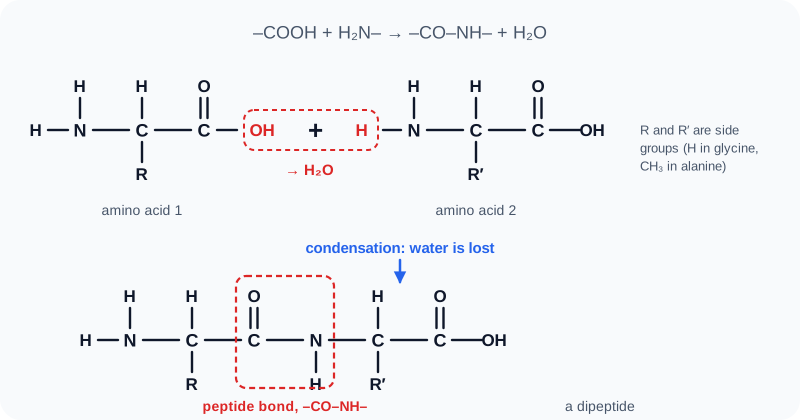
Figure 1. Two amino acids form a dipeptide by condensation. WASSCE Tutor diagram.
The –COOH of one amino acid reacts with the –NH₂ of another, losing a molecule of water (a condensation reaction). The new link, –CO–NH–, is the peptide bond (an amide link):
Two glycine molecules give the dipeptide glycylglycine.
| Term | Meaning |
|---|---|
| Dipeptide | Two amino acids joined by one peptide bond |
| Polypeptide | A chain of many amino acids (roughly up to 50) |
| Protein | One or more long polypeptide chains (often hundreds of amino acids) folded into a particular shape |
Proteins are therefore natural condensation polymers, with amino acids as the monomers. Because there are 20 amino acids and they can be arranged in any order, the number of possible proteins is enormous.
Water lost in forming a peptide. How many water molecules are released when 50 amino acids join into one polypeptide chain? What is the relative molecular mass of a dipeptide made from glycine (Mᵣ 75) and alanine (Mᵣ 89)?
- A chain of n amino acids has n − 1 peptide bonds, so 50 amino acids release 49 water molecules.
- Dipeptide: .
Kwashiorkor, a disease of young children who get enough starch but too little protein, causes swollen bellies, thin limbs and poor growth. In Sierra Leone, cheap protein sources such as bonga fish, groundnuts, beans and eggs, added to rice or cassava meals, provide the essential amino acids that starchy staples alone do not.
The peptide bond is –CO–NH–, formed from the carboxyl group of one amino acid and the amino group of the next. It is not formed between two –COOH groups or two –NH₂ groups.
Key points
- Proteins contain C, H, O, N (often S); the nitrogen sets them apart from carbohydrates and fats.
- Amino acids: H₂N–CHR–COOH, with an amino and a carboxyl group; about 20 occur in proteins (glycine R = H, alanine R = CH₃).
- Amino acids are amphoteric and exist as zwitterions.
- Essential amino acids must come from food.
- Amino acids join by condensation, losing water, to form peptide bonds (–CO–NH–); proteins are condensation polymers.
WASSCE examination focus
Expect to write the general formula of an amino acid and name the two functional groups, to show how a peptide bond forms (with structures and water lost), to explain the amphoteric nature of amino acids, and to identify proteins as natural polymers.
Quick check
- Which element is present in all proteins but not in carbohydrates?
- Name the two functional groups in an amino acid.
- Draw (in condensed form) the peptide bond.
- Why are amino acids described as amphoteric?
Answers:
- Nitrogen.
- The amino group (–NH₂) and the carboxyl group (–COOH).
- –CO–NH–.
- They contain an acidic carboxyl group and a basic amino group, so they react with both acids and bases.
Keep going with proteins and amino acids
This is one of 2 lessons in Proteins and Amino Acids. Start free with the first lesson of every topic, then unlock them all, plus exam-style practice marked instantly and guided learning tools, from 25 NLe.
- Free account, no card needed
- Everything from 25 NLe
- No automatic renewal
More lessons in Proteins and Amino Acids
- Proteins: structure, tests and denaturation🔒