WASSCE Chemistry · Practical Chemistry Skills
Tests for gases and ions (qualitative analysis)
By the WASSCE Tutor team
Updated 12 November 2026 · 9 min read · Prepared against the WASSCE syllabus.
In the WASSCE Chemistry practical paper, you are often given an unknown salt and asked to find out what it is. Qualitative analysis is detective work: each test either confirms or rules out an ion or gas. This lesson brings together the standard tests for gases, cations (positive ions) and anions (negative ions), and shows how to record and interpret them.
Learning objectives
By the end of this lesson you should be able to:
- describe tests for the common gases, with observations
- identify cations using flame tests and sodium hydroxide and ammonia solutions
- identify anions using dilute acids, silver nitrate, barium chloride and other reagents
- record tests, observations and inferences correctly
- identify an unknown salt from a series of test results
Tests for gases
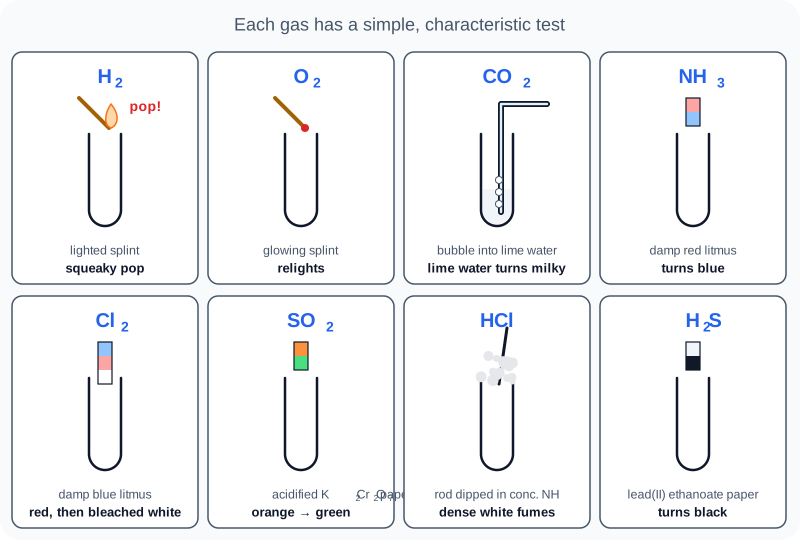
Figure 1. Tests for eight common gases. WASSCE Tutor diagram.
| Gas | Test | Positive result |
|---|---|---|
| Hydrogen, H₂ | Lighted splint | Burns with a squeaky pop |
| Oxygen, O₂ | Glowing splint | Relights the splint |
| Carbon(IV) oxide, CO₂ | Bubble through lime water | Lime water turns milky (white ppt of CaCO₃) |
| Ammonia, NH₃ | Damp red litmus; glass rod dipped in conc. HCl | Litmus turns blue; dense white fumes (NH₄Cl); pungent smell |
| Chlorine, Cl₂ | Damp blue litmus | Turns red, then bleached white; greenish-yellow gas |
| Sulphur(IV) oxide, SO₂ | Filter paper soaked in acidified K₂Cr₂O₇ | Orange → green; also decolourises acidified KMnO₄ |
| Hydrogen chloride, HCl | Glass rod dipped in conc. ammonia | Dense white fumes; turns damp blue litmus red |
| Hydrogen sulphide, H₂S | Lead(II) ethanoate paper | Turns black (PbS); smell of rotten eggs |
| Nitrogen(IV) oxide, NO₂ | Observe; damp blue litmus | Brown gas; litmus turns red |
| Water vapour | Anhydrous copper(II) sulphate; cobalt(II) chloride paper | White → blue; blue → pink |
Tests for cations
Flame tests
Clean a nichrome or platinum wire in concentrated HCl, dip it in the sample, and hold it in a non-luminous flame.
| Ion | Flame colour |
|---|---|
| Na⁺ | Golden yellow (persistent) |
| K⁺ | Lilac (view through blue glass) |
| Ca²⁺ | Brick-red |
| Cu²⁺ | Blue-green |
| Li⁺ | Crimson red |
| Ba²⁺ | Pale (apple) green |
Sodium hydroxide and ammonia solutions
Add the reagent drop by drop, then in excess.
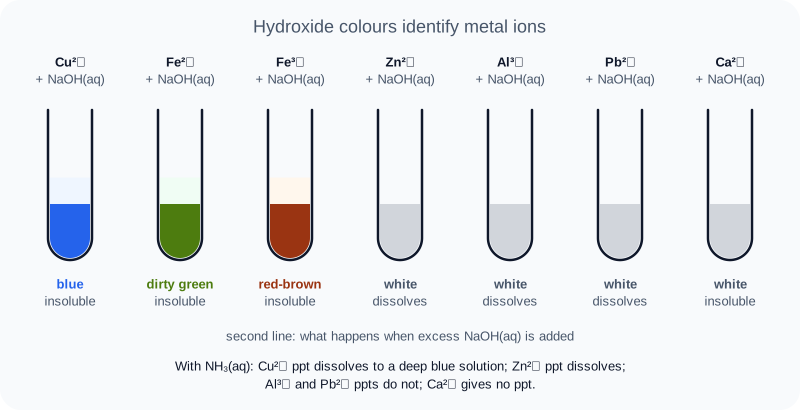
Figure 2. Hydroxide precipitates identify metal ions. WASSCE Tutor diagram.
| Ion | With NaOH(aq) | In excess NaOH | With NH₃(aq) | In excess NH₃ |
|---|---|---|---|---|
| Cu²⁺ | Blue ppt | Insoluble | Blue ppt | Dissolves: deep blue solution |
| Fe²⁺ | Dirty green ppt | Insoluble | Dirty green ppt | Insoluble |
| Fe³⁺ | Red-brown ppt | Insoluble | Red-brown ppt | Insoluble |
| Zn²⁺ | White ppt | Dissolves (colourless) | White ppt | Dissolves (colourless) |
| Al³⁺ | White ppt | Dissolves | White ppt | Insoluble |
| Pb²⁺ | White ppt | Dissolves | White ppt | Insoluble |
| Ca²⁺ | White ppt | Insoluble | No ppt | No ppt |
| NH₄⁺ | No ppt; on warming, ammonia is given off (turns damp red litmus blue) |
Telling Al³⁺ from Pb²⁺ (both white, soluble in excess NaOH, insoluble in excess NH₃): add potassium iodide or dilute HCl. Pb²⁺ gives a yellow ppt of PbI₂ (or a white ppt of PbCl₂); Al³⁺ gives none.
Tests for anions
| Ion | Test | Positive result |
|---|---|---|
| CO₃²⁻ (carbonate) | Add dilute HCl | Effervescence; gas turns lime water milky |
| SO₄²⁻ (sulphate) | Add dilute HCl, then BaCl₂ solution | White ppt (BaSO₄), insoluble in the acid |
| SO₃²⁻ (sulphite) | Warm with dilute HCl | SO₂ given off: acidified K₂Cr₂O₇ turns orange → green |
| Cl⁻ (chloride) | Add dilute HNO₃, then AgNO₃ solution | White ppt (AgCl), soluble in excess ammonia |
| Br⁻ (bromide) | Dilute HNO₃, then AgNO₃ | Cream ppt (AgBr), slightly soluble in ammonia |
| I⁻ (iodide) | Dilute HNO₃, then AgNO₃ | Yellow ppt (AgI), insoluble in ammonia |
| NO₃⁻ (nitrate) | Brown-ring test: add FeSO₄ solution, then pour conc. H₂SO₄ carefully down the side | Brown ring where the layers meet |
| NO₃⁻ (alternative) | Warm with NaOH and aluminium powder | Ammonia given off (turns damp red litmus blue) |
| S²⁻ (sulphide) | Add dilute HCl | H₂S: rotten-egg smell; lead(II) ethanoate paper turns black |
Why acidify first? The dilute acid removes carbonate and sulphite ions, which would also give white precipitates with Ba²⁺ or Ag⁺ and give a false result. Use HNO₃ (not HCl) before AgNO₃, because HCl would add chloride ions.
Recording results
In the practical examination, results are recorded in three columns:
| Test | Observation | Inference |
|---|---|---|
| Sample + NaOH(aq), drop by drop, then in excess | Blue precipitate, insoluble in excess | Cu²⁺ present |
| Sample solution + dilute HCl + BaCl₂(aq) | White precipitate | SO₄²⁻ present |
- Observation = what you see, hear or smell (colour, precipitate, gas, fizzing).
- Inference = what you conclude from it.
- Never write an inference in the observation column.
Identifying a salt. A green crystalline salt, X, dissolves in water. (i) With NaOH(aq) it gives a dirty green ppt, insoluble in excess, which turns brown on standing. (ii) Its solution, acidified with dilute HCl, gives a white ppt with BaCl₂(aq). Identify X.
- (i) Dirty green ppt, insoluble in excess, turning brown (oxidised to Fe(OH)₃): Fe²⁺.
- (ii) White ppt with acidified BaCl₂: SO₄²⁻.
X is iron(II) sulphate, FeSO₄ (the green crystals are FeSO₄·7H₂O).
School laboratories in Sierra Leone often have limited reagents, so practical candidates must make every test count. Read the question to see which ions are suggested; do the simplest, most decisive test first (for example NaOH for cations); add reagents drop by drop and then in excess; and write down exactly what you see, including "no visible reaction". Examiners award marks for accurate observations even when the inference is wrong.
"A white precipitate with NaOH" is not enough to identify a cation. You must say what happens in excess, and often test with ammonia as well: Zn²⁺, Al³⁺, Pb²⁺ and Ca²⁺ all give white precipitates at first.
Key points
- Gases: H₂ pop; O₂ relights glowing splint; CO₂ milky lime water; NH₃ red litmus blue; Cl₂ bleaches litmus; SO₂ dichromate orange → green.
- Cations: flame tests (Na yellow, K lilac, Ca brick-red, Cu blue-green) and NaOH/NH₃ (Cu²⁺ blue, Fe²⁺ green, Fe³⁺ red-brown, Zn²⁺/Al³⁺/Pb²⁺ white and amphoteric; NH₄⁺ gives NH₃ on warming).
- Anions: CO₃²⁻ fizzes with acid; SO₄²⁻ white ppt with acidified BaCl₂; Cl⁻/Br⁻/I⁻ white/cream/yellow ppt with acidified AgNO₃; NO₃⁻ brown ring.
- Record test, observation, inference in separate columns.
WASSCE examination focus
Expect to carry out and record tests on an unknown salt, to state observations and inferences for gases, cations and anions, to write ionic equations for precipitation reactions (for example Cu²⁺ + 2OH⁻ → Cu(OH)₂), and to identify the salt. This topic carries a large share of the practical paper marks.
Quick check
- How would you test for ammonia gas?
- A solution gives a white ppt with NaOH, soluble in excess, and a white ppt with NH₃, soluble in excess. Which ion is present?
- Why is the solution acidified with dilute nitric acid before adding silver nitrate?
- What is seen when a sulphate solution is acidified and barium chloride is added?
Answers:
- It turns damp red litmus paper blue (and forms white fumes with a rod dipped in concentrated HCl).
- Zn²⁺.
- To remove carbonate (and other) ions that would also give a precipitate with silver ions; nitric acid adds no chloride.
- A white precipitate of barium sulphate.
Keep going with practical chemistry skills
This is one of 2 lessons in Practical Chemistry Skills. Start free with the first lesson of every topic, then unlock them all, plus exam-style practice marked instantly and guided learning tools, from 25 NLe.
- Free account, no card needed
- Everything from 25 NLe
- No automatic renewal
More lessons in Practical Chemistry Skills
- Volumetric analysis and good practical technique🔒