WASSCE Chemistry · Polymers and Plastics
Polymers: addition and condensation polymerisation
By the WASSCE Tutor team
Updated 12 November 2026 · 7 min read · Prepared against the WASSCE syllabus.
Plastic buckets, water tanks, nylon fishing nets, polyester school shirts, rubber and even starch and proteins are all polymers: giant molecules built from thousands of small repeating units. This lesson explains the two ways in which small molecules join to make polymers: addition and condensation polymerisation.
Learning objectives
By the end of this lesson you should be able to:
- define monomer, polymer, polymerisation and degree of polymerisation
- describe addition polymerisation, with examples, equations and repeat units
- deduce the monomer from a polymer structure, and the polymer from a monomer
- describe condensation polymerisation, with nylon and Terylene as examples
- compare addition and condensation polymerisation
- name natural polymers and their monomers
Key terms
A monomer is a small molecule that can join with many others like it. A polymer is a very large molecule (a macromolecule) made of many monomer units joined together. Polymerisation is the process of joining monomers into a polymer.
The degree of polymerisation, n, is the number of monomer units in one polymer molecule:
Addition polymerisation
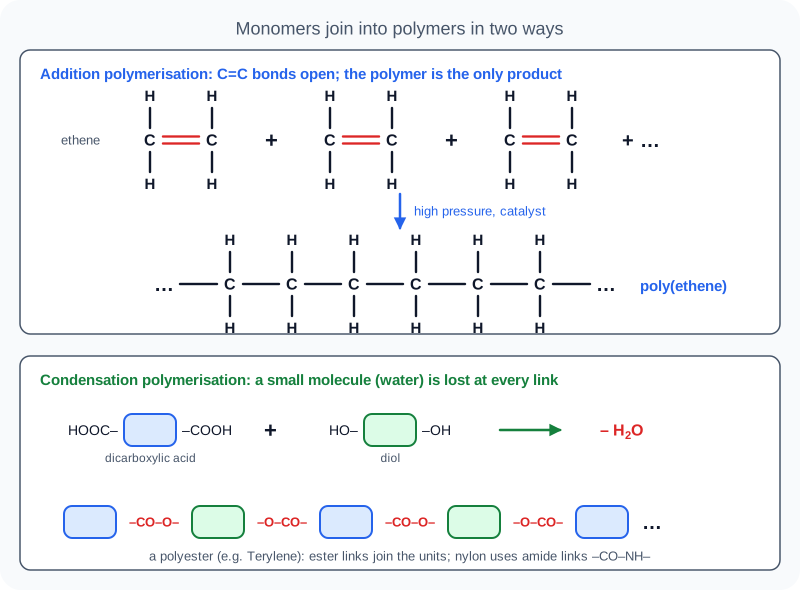
Figure 1. Addition and condensation polymerisation. WASSCE Tutor diagram.
Addition polymerisation is the joining of many unsaturated monomers (containing C=C) to form a polymer without the loss of any other molecule. The polymer is the only product, and it has the same empirical formula as the monomer.
The C=C double bonds open and the monomers link up into a saturated chain:
The part in brackets is the repeat unit. Conditions for poly(ethene): high pressure (about 1,000–2,000 atm) and 200 °C with a trace of oxygen as initiator (low-density poly(ethene)), or low pressure with a Ziegler–Natta catalyst (high-density poly(ethene)).
| Monomer | Polymer | Repeat unit | Uses |
|---|---|---|---|
| Ethene, CH₂=CH₂ | Poly(ethene), polythene | –CH₂–CH₂– | Plastic bags, bottles, buckets, water tanks |
| Propene, CH₂=CHCH₃ | Poly(propene) | –CH₂–CH(CH₃)– | Ropes, crates, chairs, carpets |
| Chloroethene, CH₂=CHCl | PVC, poly(chloroethene) | –CH₂–CHCl– | Water pipes, cable insulation, raincoats |
| Phenylethene (styrene), CH₂=CHC₆H₅ | Polystyrene | –CH₂–CH(C₆H₅)– | Packaging, food boxes, insulation |
| Tetrafluoroethene, CF₂=CF₂ | PTFE (Teflon) | –CF₂–CF₂– | Non-stick pans, plumber's tape |
| Methyl 2-methylpropenoate | Perspex | – | Safety glass, signs, car lights |
Finding the monomer from a polymer: take the two-carbon repeat unit and put a double bond between the two carbons. For example, –CH₂–CHCl– comes from CH₂=CHCl.
Condensation polymerisation
Condensation polymerisation is the joining of monomers, each with two reactive functional groups, with the loss of a small molecule (usually water or HCl) at every link.
Nylon (a polyamide): a diamine reacts with a dicarboxylic acid (or its acid chloride). Amide links, –CO–NH–, the same as peptide bonds, join the units:
With HOOC–R–COOH and H₂N–R′–NH₂ as the monomers, the repeat unit is –OC–R–CO–NH–R′–NH–, and two molecules of water are lost for each repeat unit.
Nylon 6,6 is made from hexanedioic acid and 1,6-diaminohexane. Uses: ropes, fishing nets, clothing, tooth brushes, gears.
Terylene (a polyester): a dicarboxylic acid (benzene-1,4-dicarboxylic acid) reacts with a diol (ethane-1,2-diol). Ester links, –CO–O–, join the units. Uses: clothing fibres (often mixed with cotton), bottles (PET), sails.
| Feature | Addition polymerisation | Condensation polymerisation |
|---|---|---|
| Monomers | Unsaturated (C=C) | Two functional groups each (–COOH, –OH, –NH₂) |
| By-product | None | Small molecule lost (H₂O or HCl) |
| Empirical formula | Same as the monomer | Different from the monomers |
| Links in chain | C–C bonds | Ester or amide links |
| Examples | Poly(ethene), PVC, polystyrene | Nylon, Terylene, proteins, starch |
Natural polymers
| Natural polymer | Monomer | Type |
|---|---|---|
| Starch, cellulose, glycogen | Glucose | Condensation |
| Proteins (wool, silk, enzymes) | Amino acids | Condensation (peptide links) |
| Natural rubber | Isoprene (2-methylbuta-1,3-diene) | Addition |
| DNA | Nucleotides | Condensation |
Degree of polymerisation. A sample of PVC has a relative molecular mass of 62,500. How many monomer units does each chain contain? (C = 12, H = 1, Cl = 35.5)
- Mᵣ of CH₂=CHCl
Fishing communities from Tombo to Shenge use nylon nets and ropes. Nylon, a condensation polymer, is strong, light and does not rot in sea water the way older cotton or raffia nets did. That durability has a downside: lost "ghost nets" keep trapping fish and turtles for years.
In addition polymerisation, no small molecule is lost. If an equation shows water forming, the polymerisation is condensation, not addition.
Key points
- Monomers join to form polymers; n = Mᵣ(polymer) ÷ Mᵣ(monomer).
- Addition: C=C monomers join with no by-product: ethene → poly(ethene), propene → poly(propene), chloroethene → PVC, styrene → polystyrene.
- Condensation: monomers with two functional groups join, losing water at each link: nylon (amide links), Terylene (ester links).
- Natural polymers: starch, cellulose (glucose), proteins (amino acids), rubber (isoprene).
WASSCE examination focus
Expect to define addition and condensation polymerisation with examples, to draw repeat units and deduce monomers, to write equations for the formation of poly(ethene) and PVC, to calculate degree of polymerisation, and to name natural polymers and their monomers.
Quick check
- What is the monomer of PVC?
- State one difference between addition and condensation polymerisation.
- Name the link that joins the units in nylon.
- A poly(ethene) sample has Mᵣ = 56,000. Find n. (C = 12, H = 1)
Answers:
- Chloroethene, CH₂=CHCl.
- Addition polymerisation gives no by-product; condensation polymerisation loses a small molecule such as water at each link (or: addition monomers have C=C, condensation monomers have two functional groups).
- The amide (peptide) link, –CO–NH–.
- Mᵣ of C₂H₄ = 28; n = 56,000 ÷ 28 = 2,000.
Keep going with polymers and plastics
This is one of 2 lessons in Polymers and Plastics. Start free with the first lesson of every topic, then unlock them all, plus exam-style practice marked instantly and guided learning tools, from 25 NLe.
- Free account, no card needed
- Everything from 25 NLe
- No automatic renewal
More lessons in Polymers and Plastics
- Plastics, rubber and fibres: uses and disposal🔒