WASSCE Chemistry · Petroleum and Petrochemicals
Petroleum: origin and fractional distillation
By the WASSCE Tutor team
Updated 12 November 2026 · 8 min read · Prepared against the WASSCE syllabus.
Crude oil comes out of the ground as a thick, dark, smelly liquid that is almost useless as it is. A refinery turns it into cooking gas, petrol, kerosene, diesel, lubricating oil and road tar. The key step is fractional distillation, which sorts the thousands of hydrocarbons in crude oil by their boiling points.
Learning objectives
By the end of this lesson you should be able to:
- describe the origin and composition of petroleum and natural gas
- explain how crude oil is found and extracted
- describe the fractional distillation of crude oil
- name the main fractions, their carbon ranges and uses
- describe how the properties of fractions change with chain length
Origin and composition
Petroleum (crude oil) formed over millions of years from the remains of tiny marine plants and animals (plankton). When they died they sank into mud on the sea floor. Layers of sediment buried them; heat and pressure, without air, slowly changed them into oil and natural gas. The oil and gas moved upwards through porous rock until trapped under a layer of impermeable (cap) rock.
Because it took millions of years to form, petroleum is a non-renewable (finite) resource, a fossil fuel.
Composition: crude oil is a mixture of hundreds of hydrocarbons, mainly:
- alkanes (straight and branched chains)
- cycloalkanes (ring alkanes)
- aromatic hydrocarbons (benzene rings)
- small amounts of sulphur, nitrogen and oxygen compounds (the sulphur becomes SO₂ when the fuel burns)
Natural gas is found with or above oil. It is mainly methane (70–95%), with ethane, propane and butane.
Finding and extracting crude oil
- Geologists survey rock layers (seismic surveys) to find likely traps.
- Wells are drilled, on land or offshore from rigs and drilling ships.
- At first, gas pressure pushes the oil up; later it is pumped, or water or gas is injected to force it out.
- The crude oil goes by pipeline or tanker to a refinery.
Fractional distillation of crude oil
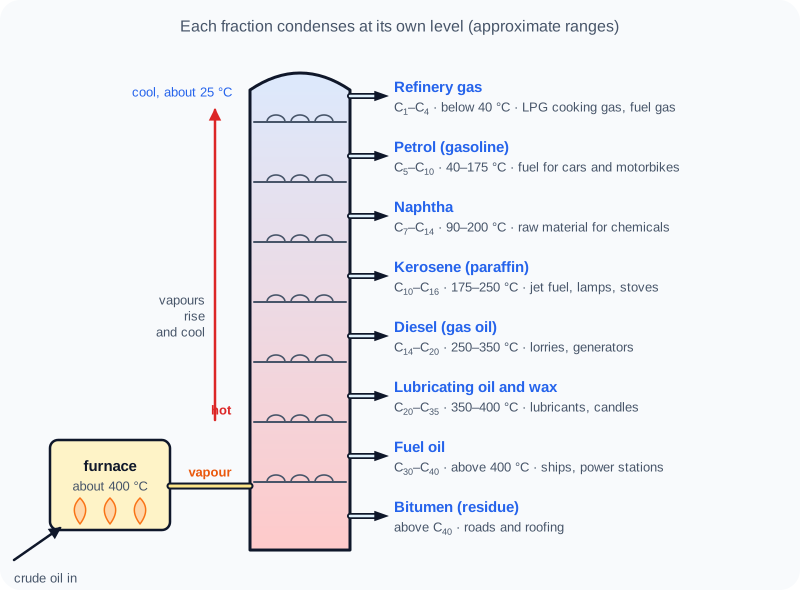
Figure 1. A fractionating column separates crude oil into fractions. WASSCE Tutor diagram.
- Crude oil is heated in a furnace to about 400 °C, so most of it vaporises.
- The vapour enters near the bottom of a tall fractionating column, which is hot at the bottom and cool at the top.
- Vapours rise through holes (bubble caps) in a series of trays.
- Each substance condenses on the tray where the temperature falls below its boiling point. Small molecules (low boiling points) rise high; large molecules condense low down.
- Each liquid collected is a fraction: a mixture of hydrocarbons with similar boiling points and similar numbers of carbon atoms.
- The thick residue that does not vaporise is removed from the bottom.
A fraction is a mixture of hydrocarbons with boiling points in a narrow range, collected at one level of the fractionating column.
The fractions and their uses
| Fraction | Carbon atoms | Boiling range | Main uses |
|---|---|---|---|
| Refinery gas | C₁–C₄ | Below 40 °C | Liquefied petroleum gas (LPG) for cooking; fuel gas |
| Petrol (gasoline) | C₅–C₁₀ | 40–175 °C | Fuel for cars and motorbikes |
| Naphtha | C₇–C₁₄ | 90–200 °C | Raw material for chemicals and plastics (cracking) |
| Kerosene (paraffin) | C₁₀–C₁₆ | 175–250 °C | Jet fuel; lamps and stoves |
| Diesel oil (gas oil) | C₁₄–C₂₀ | 250–350 °C | Lorries, buses, generators, tractors |
| Lubricating oil and wax | C₂₀–C₃₅ | 350–400 °C | Engine oil, grease; candles, polish |
| Fuel oil | C₃₀–C₄₀ | Above 400 °C | Ships, power stations, factory boilers |
| Bitumen (residue) | Above C₄₀ | Residue | Road surfaces, roofing felt, waterproofing |
Ranges overlap and vary between refineries; learn the order and the uses.
How properties change down the column
| Going down the column (bigger molecules) | Reason |
|---|---|
| Boiling point rises | Stronger van der Waals forces between larger molecules |
| Viscosity rises (thicker, flows less easily) | Long chains tangle together |
| Colour darkens (colourless to black) | More complex, larger molecules |
| Harder to ignite; smokier flame | Less volatile; higher proportion of carbon |
Which fraction? A fraction contains molecules with 12–15 carbon atoms and boils at about 200 °C. Name it and give one use.
It lies between petrol (C₅–C₁₀) and diesel (C₁₄–C₂₀): it is kerosene, used as aircraft (jet) fuel or in lamps and stoves.
Sierra Leone has no working oil field yet, although offshore exploration wells drilled since 2009 have found oil. Almost all fuel is imported already refined and stored at depots in Freetown, where the country once had a small refinery at Kissy. Petrol, diesel and kerosene pumped at local filling stations are fractions from refineries abroad. Neighbouring Nigeria and Ghana produce and refine crude oil.
Fractional distillation is a physical process: it separates hydrocarbons already present in crude oil, without changing them. Cracking (next lesson) is the chemical process that breaks large molecules into smaller ones.
Key points
- Petroleum formed from buried marine organisms under heat and pressure; it is a non-renewable fossil fuel and a mixture of hydrocarbons.
- Fractional distillation separates crude oil by boiling point: the column is hot at the bottom and cool at the top.
- Fractions, top to bottom: refinery gas, petrol, naphtha, kerosene, diesel, lubricating oil, fuel oil, bitumen.
- Down the column: higher boiling point, more viscous, darker, harder to ignite.
WASSCE examination focus
Expect to explain how crude oil is separated (with a labelled diagram of the column), to name fractions and give their uses, to state how properties change with chain length, and to explain the origin of petroleum. Matching fractions to uses and boiling ranges is common in objective questions.
Quick check
- Why is petroleum called a non-renewable resource?
- Why does petrol collect higher up the column than diesel?
- Name the fraction used for surfacing roads.
- State two properties that increase as the size of hydrocarbon molecules increases.
Answers:
- It took millions of years to form and cannot be replaced once used.
- Petrol molecules are smaller, with lower boiling points, so they rise to cooler parts of the column before condensing.
- Bitumen.
- Any two: boiling point, viscosity, darkness of colour, difficulty of ignition (smokiness of flame).
Keep going with petroleum and petrochemicals
This is one of 2 lessons in Petroleum and Petrochemicals. Start free with the first lesson of every topic, then unlock them all, plus exam-style practice marked instantly and guided learning tools, from 25 NLe.
- Free account, no card needed
- Everything from 25 NLe
- No automatic renewal
More lessons in Petroleum and Petrochemicals
- Cracking, octane rating and petrochemicals🔒