WASSCE Chemistry · Particulate Nature of Matter
Matter: particles, elements, compounds and mixtures
By the WASSCE Tutor team
Updated 12 November 2026 · 7 min read · Prepared against the WASSCE syllabus.
Everything around you, from the air you breathe to the rice in your bowl, is matter. Chemists explain the behaviour of matter by imagining it made of tiny particles: atoms, molecules and ions. This lesson introduces those particles and the three ways they come together: as elements, compounds and mixtures.
Learning objectives
By the end of this lesson you should be able to:
- define matter and describe the evidence that it is made of particles
- distinguish atoms, molecules and ions
- distinguish elements, compounds and mixtures, and metals from non-metals
- state the differences between compounds and mixtures
- distinguish physical changes from chemical changes
Matter and its particles
Matter is anything that has mass and occupies space (has volume). It exists as solid, liquid or gas.
The particulate theory of matter says matter is made of very small particles that are always moving.
Evidence for particles:
- Diffusion: the smell of fried fish or perfume spreads through a room, because particles move and mix.
- Dissolving: sugar "disappears" in tea because its particles spread out between the water particles.
- Brownian motion: pollen grains or smoke specks jiggle randomly, pushed by invisible moving particles.
| Particle | Definition | Examples |
|---|---|---|
| Atom | The smallest particle of an element that can take part in a chemical reaction | Na, Fe, C |
| Molecule | The smallest particle of an element or compound that can exist on its own, made of two or more atoms joined together | O₂, H₂, H₂O, CO₂ |
| Ion | An atom or group of atoms carrying an electric charge | Na⁺, Cl⁻, SO₄²⁻, NH₄⁺ |
Elements, compounds and mixtures
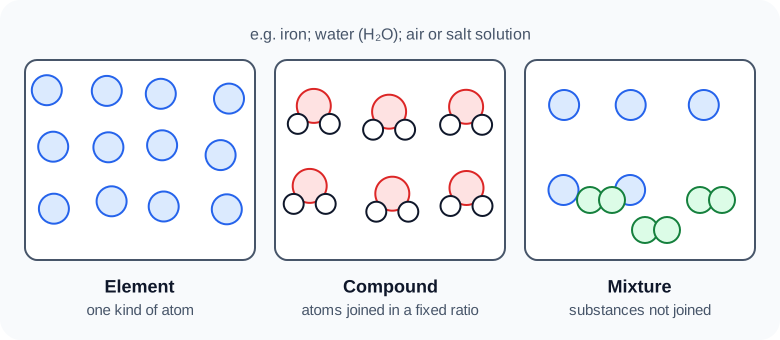
Figure 1. Elements, compounds and mixtures at the particle level. WASSCE Tutor diagram.
- An element is a substance that cannot be split into simpler substances by chemical means. It contains only one kind of atom.
- A compound is a substance formed when two or more elements are chemically combined in a fixed ratio by mass.
- A mixture contains two or more substances not chemically combined, in any proportion.
Metals and non-metals
| Metals | Non-metals |
|---|---|
| Shiny (lustrous) | Usually dull |
| Good conductors of heat and electricity | Poor conductors (except graphite) |
| Malleable and ductile | Brittle when solid |
| Usually high melting points | Usually low melting points |
| Sonorous (ring when struck) | Not sonorous |
| Form basic oxides | Form acidic or neutral oxides |
| Form positive ions | Form negative ions (or share electrons) |
| Examples: Fe, Al, Cu, Na, Au | Examples: C, O, N, S, Cl |
Some elements, such as silicon, have properties of both and are called metalloids.
Compounds and mixtures compared
| Compound | Mixture |
|---|---|
| Elements chemically combined | Substances not chemically combined |
| Fixed composition (water is always 2 H : 1 O) | Variable composition (any amount of salt in water) |
| Properties differ from those of its elements | Each part keeps its own properties |
| Separated only by chemical means | Separated by physical means (filtration, distillation) |
| Formation usually gives out or takes in heat | Usually little or no heat change on mixing |
| Sharp, fixed melting and boiling points | Melts and boils over a range |
Iron and sulphur. Iron filings and yellow sulphur powder are mixed.
- Mixture: a magnet pulls out the iron, and both keep their properties.
- Heated: the mixture glows and forms black iron(II) sulphide, FeS, a compound.
- After heating: a magnet no longer picks out the iron, the product is not yellow, and it reacts with dilute acid to give hydrogen sulphide, which smells of rotten eggs. Iron alone gives hydrogen, which has no smell.
The new properties show a chemical change has made a compound.
Physical and chemical changes
| Physical change | Chemical change |
|---|---|
| No new substance forms | New substance(s) form |
| Usually easily reversed | Usually not easily reversed |
| Mass of substance unchanged | Total mass is conserved, but substances change |
| Little energy change | Often large energy change (heat, light) |
| Examples: melting ice, dissolving salt, boiling water, magnetising iron, crushing stones | Examples: burning charcoal, rusting, cooking an egg, fermenting palm wine, souring of milk |
Making gari involves both kinds of change. Grating and pressing the cassava are physical changes. Fermentation, which sours the pulp and breaks down poisonous cyanide compounds, is a chemical change. Roasting dries it (physical) and partly cooks the starch (chemical).
Dissolving is a physical change, even though the solid "disappears". Evaporating the water gets the salt back unchanged. Students often wrongly call it a chemical change.
Key points
- Matter has mass and occupies space; it is made of moving particles: atoms, molecules and ions.
- Elements have one kind of atom; compounds have elements chemically combined in a fixed ratio; mixtures are not chemically combined.
- Metals are shiny conductors that form positive ions and basic oxides; non-metals form negative ions and acidic oxides.
- Physical changes make no new substance; chemical changes make new substances.
WASSCE examination focus
A favourite question is "State four differences between a compound and a mixture"; another is classifying changes as physical or chemical with reasons. Expect to define atom, molecule and ion with examples, and to compare metals with non-metals.
Quick check
- Define a molecule and give one example.
- Is air an element, a compound or a mixture? Give a reason.
- Give two differences between a compound and a mixture.
- Is the rusting of iron a physical or a chemical change? Why?
Answers:
- The smallest particle of a substance that can exist on its own, made of two or more atoms joined together, e.g. O₂ or H₂O.
- A mixture: its gases are not chemically combined and its composition varies.
- Any two: chemically combined or not; fixed or variable composition; properties differ from or match the components; separated by chemical or physical means; sharp or range of melting point.
- Chemical: a new substance (hydrated iron(III) oxide) forms and the change is not easily reversed.
Keep going with particulate nature of matter
This is one of 2 lessons in Particulate Nature of Matter. Start free with the first lesson of every topic, then unlock them all, plus exam-style practice marked instantly and guided learning tools, from 25 NLe.
- Free account, no card needed
- Everything from 25 NLe
- No automatic renewal
More lessons in Particulate Nature of Matter
- Separating mixtures and testing for purity🔒