WASSCE Chemistry · Oxygen and Air
Oxygen: preparation, properties and oxides
By the WASSCE Tutor team
Updated 12 November 2026 · 7 min read · Prepared against the WASSCE syllabus.
Oxygen keeps every fire burning and every living cell breathing. It is the most abundant element in the earth's crust and makes up about a fifth of the air. This lesson covers the laboratory and industrial preparation of oxygen, its test and properties, the oxides it forms, and its uses in hospitals, welding and steelmaking.
Learning objectives
By the end of this lesson you should be able to:
- describe the laboratory preparation of oxygen, with equations and a diagram
- describe the test for oxygen
- state the physical and chemical properties of oxygen
- classify oxides as acidic, basic, amphoteric, neutral, peroxide or mixed
- describe the industrial production of oxygen from liquid air
- state the uses of oxygen
Laboratory preparation
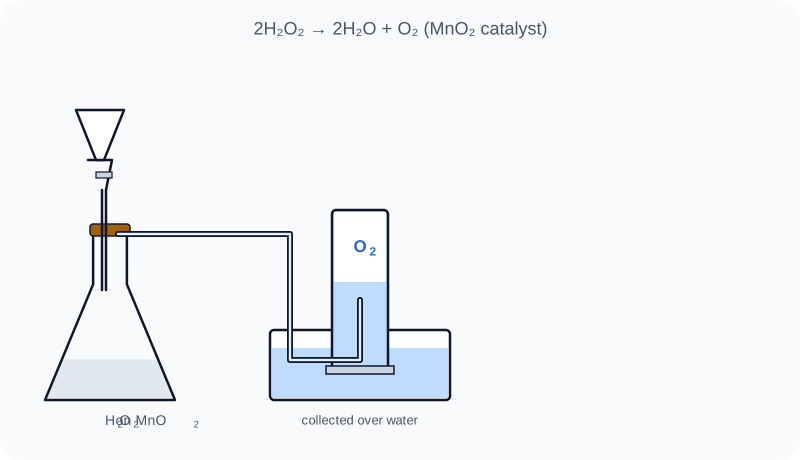
Figure 1. Preparing oxygen from hydrogen peroxide. WASSCE Tutor diagram.
Method 1 (no heating): decomposing hydrogen peroxide with manganese(IV) oxide as catalyst:
Method 2: heating potassium chlorate(V) with a little manganese(IV) oxide as catalyst:
Other sources: heating potassium manganate(VII), or sodium or potassium nitrate (which gives a little oxygen).
Collection: over water, because oxygen is only slightly soluble. It can be dried with concentrated sulphuric acid and collected by downward delivery (it is slightly denser than air).
Proving MnO₂ is a catalyst. Weigh 1.0 g of manganese(IV) oxide and add it to hydrogen peroxide. Oxygen bubbles off rapidly. When the fizzing stops, filter off the black solid, wash, dry and weigh it again: still 1.0 g. Add it to fresh hydrogen peroxide: it again causes rapid decomposition. So it speeds up the reaction without being used up.
Test for oxygen
A glowing splint placed in the gas relights (bursts into flame). No other common gas does this.
Physical properties
| Property | Oxygen |
|---|---|
| Colour, smell, taste | Colourless, odourless, tasteless |
| Density | Slightly denser than air |
| Solubility in water | Slightly soluble (enough for fish to breathe) |
| Boiling point | −183 °C (liquid oxygen is pale blue) |
| Effect on litmus | Neutral |
Chemical properties
Oxygen supports combustion and reacts with most elements, especially when heated, forming oxides.
| Element | Observation | Equation | Oxide |
|---|---|---|---|
| Magnesium | Burns with a dazzling white flame; white ash | 2Mg + O₂ → 2MgO | Basic |
| Sodium | Burns with a yellow flame | 4Na + O₂ → 2Na₂O | Basic |
| Iron (wool) | Burns with sparks | 3Fe + 2O₂ → Fe₃O₄ | Mixed oxide |
| Carbon (charcoal) | Glows red | C + O₂ → CO₂ | Acidic |
| Sulphur | Burns with a blue flame; choking gas | S + O₂ → SO₂ | Acidic |
| Phosphorus | Burns with a bright yellow flame; white smoke | P₄ + 5O₂ → P₄O₁₀ | Acidic |
Classes of oxides
| Class | Behaviour | Examples |
|---|---|---|
| Basic oxides (metals) | React with acids to form salts and water; soluble ones form alkalis | Na₂O, CaO, MgO, CuO |
| Acidic oxides (non-metals) | React with alkalis; dissolve in water to form acids | CO₂, SO₂, SO₃, P₄O₁₀, NO₂ |
| Amphoteric oxides | React with both acids and alkalis | ZnO, Al₂O₃, PbO |
| Neutral oxides | React with neither | CO, NO, N₂O, H₂O |
| Peroxides | Contain the O–O bond; give H₂O₂ with dilute acid | Na₂O₂, BaO₂ |
| Mixed (compound) oxides | Behave as a mixture of two oxides | Pb₃O₄ (red lead), Fe₃O₄ |
Industrial production: fractional distillation of liquid air
- Air is filtered to remove dust.
- Carbon(IV) oxide and water vapour are removed (they would freeze and block the pipes).
- The air is compressed and cooled repeatedly until it liquefies at about −200 °C.
- The liquid air is fractionally distilled. Nitrogen (boiling point −196 °C) boils off first at the top of the column. Oxygen (−183 °C) stays as a liquid at the bottom. Argon is collected separately.
Uses of oxygen
| Use | Detail |
|---|---|
| Medicine | Oxygen cylinders and concentrators for patients with breathing difficulty, pneumonia, COVID-19 |
| Welding and cutting | Oxy-acetylene flame (about 3000 °C) |
| Steelmaking | Blown into molten iron to burn off carbon and other impurities |
| Breathing apparatus | Divers, mountaineers, fire-fighters, astronauts |
| Rocket fuel | Liquid oxygen as the oxidiser |
| Sewage and water treatment | Speeds up the breakdown of waste by bacteria |
During the COVID-19 pandemic, Sierra Leone expanded oxygen plants at major hospitals to supply medical oxygen. Many of these plants separate oxygen from air using special filters (pressure swing adsorption) rather than liquid air. Oxygen cylinders must be kept away from oil, grease and flames, because oxygen makes anything burn far more fiercely.
Oxygen does not burn: it supports burning. The test is that a glowing splint relights, not that the gas catches fire.
Key points
- Lab preparation: 2H₂O₂ → 2H₂O + O₂ (MnO₂ catalyst) or heating KClO₃ with MnO₂; collected over water.
- Test: relights a glowing splint.
- Oxygen supports combustion; metals form basic oxides and non-metals acidic oxides.
- Oxides: basic, acidic, amphoteric, neutral, peroxide, mixed.
- Industrially from fractional distillation of liquid air (N₂ boils off first).
- Uses: medicine, welding, steelmaking, breathing apparatus, rockets.
WASSCE examination focus
Expect to describe the preparation of oxygen with a labelled diagram and equation, to show that MnO₂ is a catalyst, to classify oxides with examples, and to describe the fractional distillation of liquid air. Questions often give burning reactions and ask you to name and classify the oxide formed.
Quick check
- Write an equation for the preparation of oxygen from hydrogen peroxide.
- What is the test for oxygen?
- Classify each oxide: CaO, SO₂, ZnO, CO.
- Why does nitrogen boil off before oxygen in the fractional distillation of liquid air?
Answers:
- 2H₂O₂ → 2H₂O + O₂ (MnO₂ catalyst).
- It relights a glowing splint.
- CaO basic; SO₂ acidic; ZnO amphoteric; CO neutral.
- Nitrogen has a lower boiling point (−196 °C) than oxygen (−183 °C).
Keep going with oxygen and air
This is one of 2 lessons in Oxygen and Air. Start free with the first lesson of every topic, then unlock them all, plus exam-style practice marked instantly and guided learning tools, from 25 NLe.
- Free account, no card needed
- Everything from 25 NLe
- No automatic renewal
More lessons in Oxygen and Air
- Air: composition, combustion, rusting and pollution🔒