WASSCE Chemistry · Nitrogen and Its Compounds
Nitrogen and ammonia
By the WASSCE Tutor team
Updated 12 November 2026 · 9 min read · Prepared against the WASSCE syllabus.
Nitrogen makes up 78% of the air, yet plants cannot use it directly: it is one of the least reactive gases. Turning nitrogen into ammonia, and ammonia into fertilisers, feeds billions of people. This lesson covers nitrogen and its unreactivity, the laboratory preparation and properties of ammonia, and its industrial manufacture by the Haber process.
Learning objectives
By the end of this lesson you should be able to:
- describe the occurrence, preparation, properties and uses of nitrogen
- explain why nitrogen is unreactive
- describe the laboratory preparation, drying and collection of ammonia
- describe the tests for ammonia and its physical and chemical properties
- describe the Haber process and explain its conditions
- state the uses of ammonia
Nitrogen
Occurrence: about 78% of air by volume; combined in proteins, nitrates and ammonium salts.
Preparation:
- Industrially: by fractional distillation of liquid air (nitrogen boils at −196 °C, before oxygen at −183 °C).
- In the laboratory: by warming a solution of ammonium chloride and sodium nitrite (which together give ammonium nitrite):
Properties:
- colourless, odourless and tasteless
- slightly less dense than air
- only slightly soluble in water
- neutral to litmus
- does not burn and does not support combustion
Why nitrogen is so unreactive: the two atoms in N₂ are joined by a triple bond (N≡N), one of the strongest bonds known (945 kJ/mol). A lot of energy is needed to break it. Nitrogen reacts only under special conditions:
- with hydrogen (Haber process): N₂ + 3H₂ ⇌ 2NH₃
- with oxygen in lightning or hot car engines: N₂ + O₂ → 2NO
- with burning magnesium: 3Mg + N₂ → Mg₃N₂
Uses of nitrogen:
- making ammonia (fertilisers)
- food packaging: keeps food fresh by excluding oxygen
- liquid nitrogen (−196 °C) for freezing food, storing semen and vaccines, removing warts
- an inert atmosphere in welding, oil tanks and electric bulbs
Ammonia: laboratory preparation
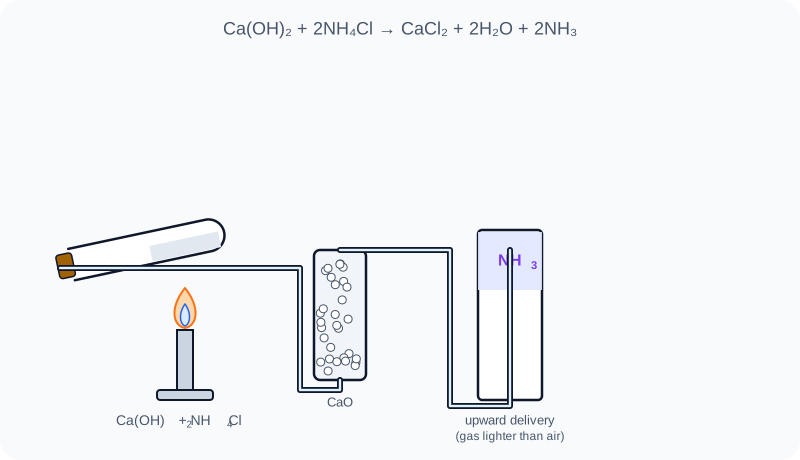
Figure 1. Preparing ammonia. WASSCE Tutor diagram.
Heat any ammonium salt with an alkali. Usually a mixture of calcium hydroxide (slaked lime) and ammonium chloride is used:
- The test tube slopes slightly downwards at the mouth, so that water formed does not run back onto the hot glass and crack it.
- Drying agent: calcium oxide (quicklime). Concentrated sulphuric acid and calcium chloride cannot be used: ammonia, an alkaline gas, reacts with them.
- Collection: upward delivery (downward displacement of air), because ammonia is lighter than air. It is not collected over water, because it is extremely soluble.
Tests for ammonia
- It turns damp red litmus paper blue. Ammonia is the only common alkaline gas.
- It forms dense white fumes of ammonium chloride with a glass rod dipped in concentrated hydrochloric acid.
- It has a sharp, pungent smell (as in stale urine).
Properties of ammonia
Physical:
- colourless gas with a pungent smell
- lighter than air
- extremely soluble in water: 1 volume of water dissolves about 700 volumes of ammonia (shown by the fountain experiment, where the fountain turns red litmus blue)
- easily liquefied (boiling point −33 °C)
Chemical:
1. Weak alkali in water: NH₃ + H₂O ⇌ NH₄⁺ + OH⁻. The solution is "ammonia solution" or "ammonium hydroxide".
2. Neutralises acids, forming ammonium salts (many are fertilisers):
3. Precipitates metal hydroxides from solutions of metal salts. With excess ammonia, some redissolve:
| Metal ion | With a little NH₃(aq) | With excess NH₃(aq) |
|---|---|---|
| Cu²⁺ | Pale blue precipitate | Dissolves: deep blue solution, [Cu(NH₃)₄]²⁺ |
| Zn²⁺ | White precipitate | Dissolves: colourless solution |
| Fe²⁺ | Green precipitate | Insoluble |
| Fe³⁺ | Red-brown precipitate | Insoluble |
| Al³⁺, Pb²⁺ | White precipitate | Insoluble |
4. Reducing agent: it reduces hot copper(II) oxide to copper:
5. Burns in oxygen (not in air) with a yellowish-green flame: 4NH₃ + 3O₂ → 2N₂ + 6H₂O.
The Haber process
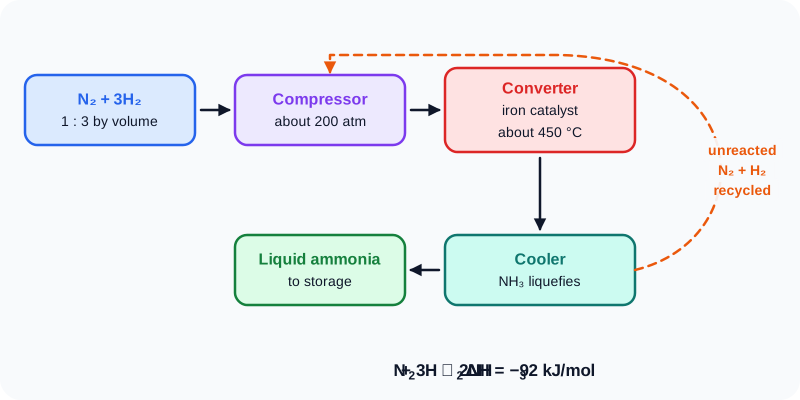
Figure 2. Manufacturing ammonia by the Haber process. WASSCE Tutor diagram.
- Raw materials: nitrogen from liquid air; hydrogen from natural gas and steam.
- Conditions: about 450 °C, about 200 atm, iron catalyst.
- Ammonia is removed by cooling it to a liquid, and the unreacted gases are recycled.
- These are compromise conditions. A lower temperature would give a higher yield but too slowly; a higher pressure would increase the yield but cost too much. The equilibrium topic explains this using Le Chatelier's principle.
Uses of ammonia
- Fertilisers: ammonium nitrate, ammonium sulphate, urea, ammonium phosphate. This is the main use.
- Making nitric acid (Ostwald process).
- Household cleaners (dilute ammonia removes grease).
- Refrigerant in large cold stores and ice plants.
- Making nylon, explosives and dyes.
Groundnuts, beans and cowpeas grown across Sierra Leone are legumes. Their roots carry nodules containing nitrogen-fixing bacteria, which turn nitrogen from the air into ammonium compounds the plant can use. That is why farmers rotate rice or maize with groundnuts: the legumes naturally enrich the soil with nitrogen, saving fertiliser.
Ammonia is dried with calcium oxide, not concentrated sulphuric acid or calcium chloride. Ammonia is alkaline, so it would react with the acid, and it forms a compound with calcium chloride.
Key points
- Nitrogen is 78% of air and very unreactive because of its N≡N triple bond; used for ammonia, food packaging and liquid-nitrogen freezing.
- Ammonia is made in the laboratory from Ca(OH)₂ + 2NH₄Cl, dried with CaO and collected by upward delivery.
- Tests: turns damp red litmus blue; white fumes with HCl.
- Ammonia is very soluble (fountain), a weak alkali, forms ammonium salts, precipitates metal hydroxides, gives a deep blue solution with Cu²⁺, and reduces CuO.
- Haber process: N₂ + 3H₂ ⇌ 2NH₃; 450 °C, 200 atm, iron catalyst; mainly used for fertilisers.
WASSCE examination focus
Expect to describe the laboratory preparation of ammonia (explaining the drying agent and method of collection), to give tests and properties including the fountain experiment, to describe the Haber process with conditions, and to explain why nitrogen is unreactive. The reaction of ammonia with copper(II) ions is often tested.
Quick check
- Why is nitrogen so unreactive?
- Why is ammonia not dried with concentrated sulphuric acid?
- Give one test for ammonia and its result.
- State the conditions used in the Haber process.
Answers:
- Its two atoms are joined by a very strong triple bond that needs a lot of energy to break.
- Ammonia is alkaline and would react with the acid.
- It turns damp red litmus blue (or gives dense white fumes with concentrated HCl).
- About 450 °C, about 200 atm and an iron catalyst.
Keep going with nitrogen and its compounds
This is one of 2 lessons in Nitrogen and Its Compounds. Start free with the first lesson of every topic, then unlock them all, plus exam-style practice marked instantly and guided learning tools, from 25 NLe.
- Free account, no card needed
- Everything from 25 NLe
- No automatic renewal
More lessons in Nitrogen and Its Compounds
- Nitric acid, nitrates and the nitrogen cycle🔒