WASSCE Chemistry · Introduction to Organic Chemistry
Organic chemistry: homologous series and functional groups
By the WASSCE Tutor team
Updated 12 November 2026 · 6 min read · Prepared against the WASSCE syllabus.
More than ninety per cent of all known compounds contain carbon: the fuels in cars and kitchens, plastics, medicines, soap, palm oil and every molecule in your body. Organic chemistry is the chemistry of carbon compounds. Its huge size becomes manageable once you learn to sort compounds into families called homologous series, each defined by a functional group.
Learning objectives
By the end of this lesson you should be able to:
- define organic chemistry and name the main sources of organic compounds
- explain why carbon forms so many compounds
- define a homologous series and state its characteristics
- identify the functional groups of the main homologous series
- distinguish molecular, empirical, structural and displayed formulas
- distinguish saturated and unsaturated, aliphatic and aromatic compounds
What organic chemistry is
Organic chemistry is the study of the compounds of carbon, except a few simple ones (carbon oxides, carbonates, hydrogencarbonates and cyanides), which are treated as inorganic.
Sources of organic compounds:
- petroleum (crude oil) and natural gas: the main source today
- coal
- plants and animals: oils and fats (palm oil), sugar, starch, cellulose, proteins, rubber
- synthesis in laboratories and factories
Why carbon forms so many compounds
- Tetravalency: carbon has four outer electrons and forms four covalent bonds.
- Catenation: carbon atoms join to each other in long chains, branches and rings, more than any other element.
- Multiple bonds: carbon forms single, double and triple bonds (C–C, C=C, C≡C).
- Bonds with other elements: strong bonds with hydrogen, oxygen, nitrogen, halogens and sulphur.
- Isomerism: the same formula can have several different structures.
Homologous series
A homologous series is a family of organic compounds with the same functional group and general formula, in which each member differs from the next by a CH₂ group.
Characteristics of a homologous series:
- All members have the same general formula (e.g. alkanes CₙH₂ₙ₊₂).
- Successive members differ by –CH₂– (relative molecular mass 14).
- They have the same functional group, so similar chemical properties.
- Physical properties change gradually (boiling point and density rise with chain length).
- They can be prepared by similar methods.
A functional group is the atom or group of atoms that gives a homologous series its characteristic chemical properties.
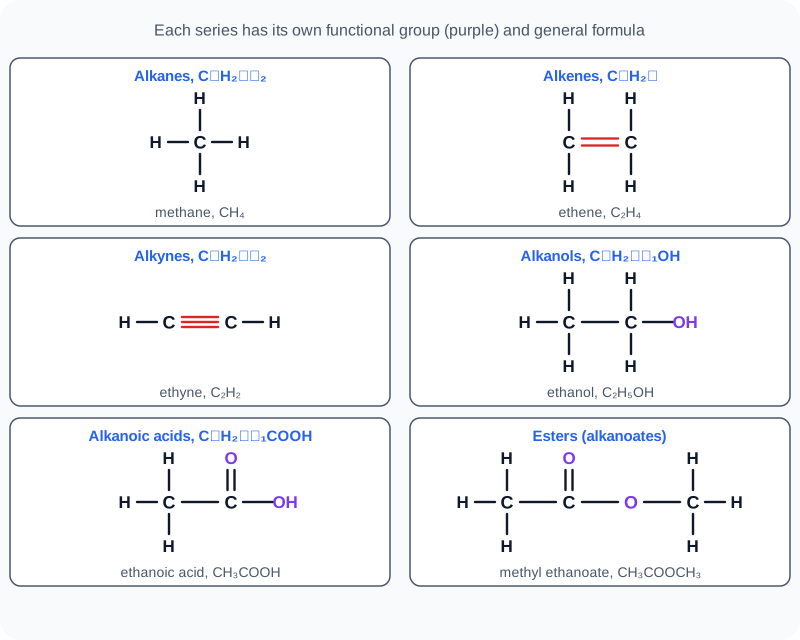
Figure 1. The first member of six homologous series. WASSCE Tutor diagram.
| Series | Functional group | General formula | First member |
|---|---|---|---|
| Alkanes | C–C (single bonds only) | CₙH₂ₙ₊₂ | Methane, CH₄ |
| Alkenes | C=C | CₙH₂ₙ | Ethene, C₂H₄ |
| Alkynes | C≡C | CₙH₂ₙ₋₂ | Ethyne, C₂H₂ |
| Alkanols (alcohols) | –OH (hydroxyl) | CₙH₂ₙ₊₁OH | Methanol, CH₃OH |
| Alkanoic acids | –COOH (carboxyl) | CₙH₂ₙ₊₁COOH | Methanoic acid, HCOOH |
| Alkanoates (esters) | –COO– | RCOOR′ | Methyl methanoate |
| Halogenoalkanes | –X (Cl, Br, I) | CₙH₂ₙ₊₁X | Chloromethane, CH₃Cl |
Types of formula
| Formula | Shows | Ethanol |
|---|---|---|
| Molecular | Actual number of each atom | C₂H₆O |
| Empirical | Simplest whole-number ratio | C₂H₆O (here the same) |
| Structural (condensed) | How atoms are grouped | CH₃CH₂OH |
| Displayed | Every atom and every bond | H–C–C–O–H with all H's drawn (Figure 1) |
Classifying organic compounds
| Saturated | Unsaturated |
|---|---|
| Only single C–C bonds | At least one C=C or C≡C bond |
| Alkanes | Alkenes, alkynes |
| Undergo substitution | Undergo addition; decolourise bromine water |
- Aliphatic compounds have open chains (alkanes, alkenes, alkanols).
- Aromatic compounds contain a benzene ring (C₆H₆), a stable ring of six carbon atoms. Benzene compounds are found in dyes, drugs and plastics.
Palm oil, used in nearly every Sierra Leonean kitchen, is a mixture of organic compounds called triglycerides (esters). Its red colour comes from carotene, another organic compound and the source of vitamin A. Through soap making, margarine and biodiesel, it links organic chemistry to local industry.
Not every carbon compound is organic. Carbon(IV) oxide, carbonates and cyanides are studied as inorganic compounds.
Key points
- Organic chemistry is the chemistry of carbon compounds (except oxides, carbonates and cyanides).
- Carbon forms millions of compounds through tetravalency, catenation, multiple bonds and isomerism.
- A homologous series has the same general formula and functional group, members differing by CH₂, with similar chemical and gradually changing physical properties.
- Functional groups: C=C (alkenes), C≡C (alkynes), –OH (alkanols), –COOH (alkanoic acids), –COO– (esters).
- Saturated = single bonds only (substitution); unsaturated = C=C or C≡C (addition).
WASSCE examination focus
Expect to define a homologous series and list its characteristics, to name functional groups and identify the series of given compounds, to give general formulas, and to explain why carbon forms so many compounds. Writing displayed formulas correctly earns marks in many organic questions.
Quick check
- State three characteristics of a homologous series.
- What is the functional group of the alkanols?
- Write the general formula of the alkenes.
- Distinguish saturated from unsaturated hydrocarbons.
Answers:
- Any three: same general formula; same functional group; successive members differ by CH₂; similar chemical properties; gradual change in physical properties; similar methods of preparation.
- The hydroxyl group, –OH.
- CₙH₂ₙ.
- Saturated hydrocarbons have only single C–C bonds; unsaturated ones contain at least one C=C or C≡C bond.
Keep going with introduction to organic chemistry
This is one of 2 lessons in Introduction to Organic Chemistry. Start free with the first lesson of every topic, then unlock them all, plus exam-style practice marked instantly and guided learning tools, from 25 NLe.
- Free account, no card needed
- Everything from 25 NLe
- No automatic renewal
More lessons in Introduction to Organic Chemistry
- Naming organic compounds, isomerism and purification🔒