WASSCE Chemistry · Industrial Chemical Processes
The chemical industry: siting, raw materials and safety
By the WASSCE Tutor team
Updated 12 November 2026 · 8 min read · Prepared against the WASSCE syllabus.
Chemistry becomes industry when a reaction that works in a test tube is scaled up to make tonnes of product, safely and at a profit. This lesson looks at the chemical industry: why it matters to a country like Sierra Leone, where its raw materials come from, how factories are sited and run, and how they are kept safe and clean.
Learning objectives
By the end of this lesson you should be able to:
- explain the importance of the chemical industry to national development
- classify chemical industries and name their raw materials
- explain the factors that determine where a chemical plant is sited
- distinguish batch and continuous processes
- explain how costs are kept down, including recycling and energy saving
- describe hazards, pollution and how they are controlled
Importance of the chemical industry
- Provides essential products: fertilisers, medicines, soap, cement, paints, plastics, fuels and clean water.
- Creates jobs, directly and in supporting businesses.
- Adds value to local raw materials instead of exporting them unprocessed.
- Earns or saves foreign exchange through exports and fewer imports.
- Supports agriculture (fertilisers, pesticides) and health (drugs, disinfectants).
- Develops skills and technology.
Types of chemical industry
| Type | Examples |
|---|---|
| Heavy chemicals (made in huge amounts) | Sulphuric acid, ammonia, sodium hydroxide, chlorine, cement |
| Fine chemicals (small amounts, high purity) | Medicines, dyes, flavours, perfumes |
| Petrochemicals | Fuels, plastics, solvents from crude oil |
| Agro-allied industries | Soap, palm-oil processing, brewing, food processing |
| Metallurgical | Iron and steel, aluminium |
Raw materials
| Source | Raw materials | Products |
|---|---|---|
| Air | Nitrogen, oxygen, argon | Ammonia, fertilisers, medical oxygen |
| Water and sea water | Water, salt, magnesium | Chlorine, sodium hydroxide, magnesium |
| Crude oil and natural gas | Hydrocarbons | Fuels, plastics, hydrogen, fertilisers |
| Rocks and minerals | Limestone, iron ore, bauxite, rutile, sulphur, salt | Cement, iron, aluminium, pigments, sulphuric acid |
| Plants and animals | Palm oil, sugar cane, cassava, cotton, rubber | Soap, ethanol, starch, textiles, tyres |
Siting a chemical plant
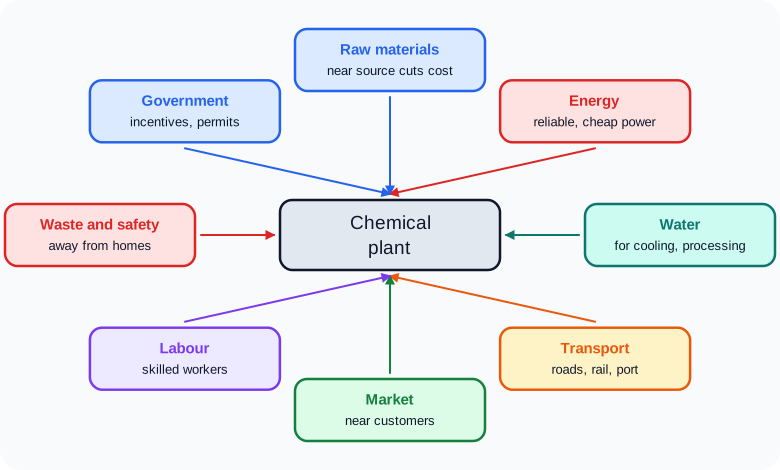
Figure 1. Factors in choosing where to build a chemical plant. WASSCE Tutor diagram.
| Factor | Why it matters |
|---|---|
| Raw materials | Bulky raw materials are costly to move; build near the source (a cement plant near limestone) |
| Energy | A reliable, cheap supply of electricity or fuel (aluminium smelters need huge amounts) |
| Water | For cooling, processing and as a raw material |
| Transport | Roads, rail and ports to bring in materials and send out products |
| Market | Being near customers cuts delivery costs, especially for bulky or fragile products |
| Labour | Skilled and unskilled workers available nearby |
| Land | Enough flat, affordable land for the plant and future expansion |
| Waste disposal and safety | Away from homes; somewhere waste can be treated |
| Government policy | Tax incentives, permits, environmental rules |
Where should a cement factory be built? Cement uses large tonnages of limestone and clay, and needs a great deal of fuel and electricity. Its product is heavy and cheap, so transport costs matter.
- Best site: near a limestone deposit, with clay nearby, a reliable power supply, a good road or rail link, and close to the cities that buy cement.
- If the country has little limestone (as in Sierra Leone), a grinding plant near a port can import clinker and grind it with gypsum close to the market.
How processes are run
| Batch process | Continuous process |
|---|---|
| Product made in separate batches | Raw materials fed in and product removed all the time |
| Flexible; good for small amounts and many products | Efficient for huge amounts of one product |
| More labour; plant stands idle between batches | Highly automated; fewer workers per tonne |
| Examples: medicines, dyes, brewing, soap | Examples: Haber process, Contact process, oil refining |
Keeping costs down
- Choose conditions that balance rate and yield (the compromise conditions of the Haber and Contact processes).
- Use catalysts to save energy and time.
- Recycle unreacted materials (unreacted N₂ and H₂ in the Haber process).
- Use waste heat from exothermic reactions to heat other stages or generate electricity.
- Sell by-products (chlorine and hydrogen from the chlor-alkali industry; slag from blast furnaces).
- Run continuous processes at full capacity.
Safety and pollution
Hazards: fire and explosion (flammable gases and dust), poisonous gases (Cl₂, NH₃, CO, H₂S), corrosive chemicals, high pressures and temperatures.
Pollution: smoke and gases into the air; acid and toxic waste into rivers; solid waste and dust; noise.
Control measures:
- Strict safety rules, training and protective equipment.
- Plants sited away from homes, with emergency plans.
- Treating waste before release (neutralising acids, removing heavy metals).
- Scrubbers and filters on chimneys to remove SO₂ and dust.
- Recycling and reducing waste.
- Monitoring and laws, enforced by environmental agencies.
In Sierra Leone, new industrial projects need an environmental impact assessment and a licence from the Environment Protection Agency (EPA-SL). The agency checks how a plant will handle its waste, emissions and safety before it can operate. This matters most for mining, fuel storage and chemical works near rivers and towns.
The "best" site is a balance of factors, not just "near raw materials". An aluminium smelter is built near cheap electricity, even far from bauxite mines, because energy is its biggest cost.
Key points
- The chemical industry provides essential products, jobs, foreign exchange and adds value to raw materials.
- Raw materials come from air, water, crude oil and gas, minerals, plants and animals.
- Siting depends on raw materials, energy, water, transport, market, labour, land, waste and safety, and government.
- Batch processes suit small amounts; continuous processes suit large tonnages.
- Costs are cut by catalysts, recycling, using waste heat and selling by-products.
- Hazards and pollution are controlled by siting, safety rules, waste treatment, scrubbers and environmental laws.
WASSCE examination focus
Expect to state the importance of the chemical industry, to explain factors for siting a named plant (fertiliser, cement, aluminium), to distinguish batch from continuous processes, and to describe pollution and safety measures. Link each factor to the needs of the particular industry.
Quick check
- Give three factors that affect the siting of a chemical plant.
- Why are aluminium smelters built near cheap electricity?
- Give one difference between batch and continuous processes, with an example of each.
- Give two ways a factory can reduce the pollution it causes.
Answers:
- Any three: raw materials, energy, water, transport, market, labour, land, waste disposal and safety, government policy.
- Electrolysis of alumina uses enormous amounts of electricity, which is the biggest cost.
- Batch processes make separate batches (medicines); continuous processes run non-stop (Haber process).
- Any two: treat waste before release; scrubbers or filters on chimneys; recycling; proper siting; obeying environmental laws.
Keep going with industrial chemical processes
This is one of 2 lessons in Industrial Chemical Processes. Start free with the first lesson of every topic, then unlock them all, plus exam-style practice marked instantly and guided learning tools, from 25 NLe.
- Free account, no card needed
- Everything from 25 NLe
- No automatic renewal
More lessons in Industrial Chemical Processes
- Local chemical industries: soap, cement, brewing and salt🔒