WASSCE Chemistry · Hydrogen
Hydrogen: preparation, properties and uses
By the WASSCE Tutor team
Updated 12 November 2026 · 8 min read · Prepared against the WASSCE syllabus.
Hydrogen is the lightest and most abundant element in the universe: the sun is mostly hydrogen. On earth it is found mainly combined, in water and in fuels. This lesson covers how hydrogen is prepared and tested in the laboratory, its properties and its many uses, from making fertilisers to turning palm oil into margarine.
Learning objectives
By the end of this lesson you should be able to:
- describe the laboratory preparation of hydrogen, with an equation and a labelled diagram
- explain the choice of method of collection and drying
- describe the test for hydrogen
- state the physical and chemical properties of hydrogen
- explain why hydrogen is a reducing agent
- state the uses of hydrogen
Occurrence
- Free: very little in the atmosphere, because it is so light that it escapes; found in volcanic gases.
- Combined: in water (11% hydrogen by mass), in acids, in hydrocarbons (natural gas, petroleum) and in all living things.
Laboratory preparation
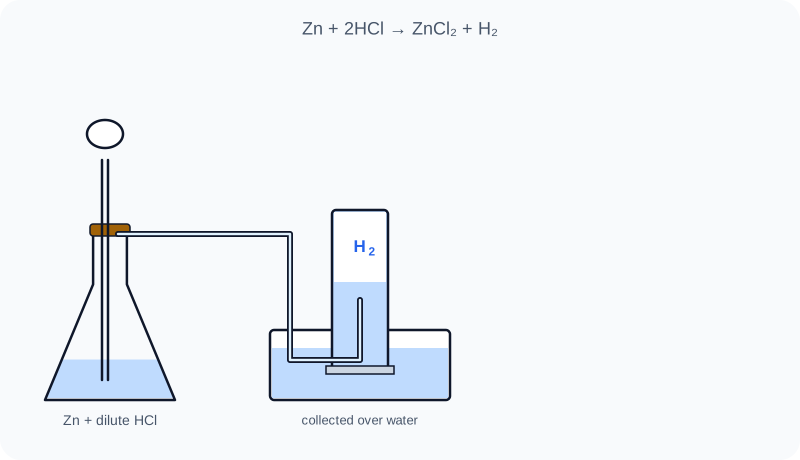
Figure 1. Preparing hydrogen from zinc and dilute acid. WASSCE Tutor diagram.
Hydrogen is prepared by the action of a dilute acid on a moderately reactive metal, usually granulated zinc with dilute hydrochloric or sulphuric acid:
Notes on the method:
- Granulated (impure) zinc reacts faster than pure zinc. A few drops of copper(II) sulphate solution speed it up further (copper acts as a catalyst).
- Nitric acid is not used: it is an oxidising agent and gives oxides of nitrogen instead of hydrogen.
- Sodium and potassium are not used: they react explosively. Copper does not react at all, because it is below hydrogen in the reactivity series.
- Let the first portions of gas escape: they are mixed with air, and a hydrogen–air mixture explodes when lit.
Collection:
- Over water, because hydrogen is only slightly soluble in water.
- Or by upward delivery (downward displacement of air), because it is much lighter than air.
Drying: pass the gas through concentrated sulphuric acid or fused calcium chloride, then collect by upward delivery (not over water, which would make it wet again).
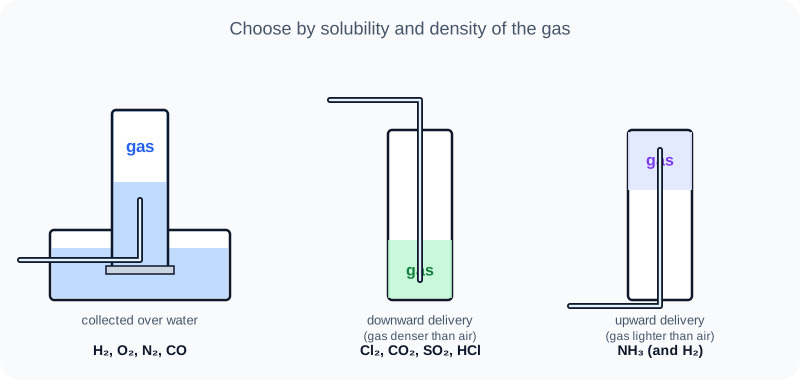
Figure 2. Choosing how to collect a gas. WASSCE Tutor diagram.
| Method | Use for | Examples |
|---|---|---|
| Over water | Gases insoluble or slightly soluble in water | H₂, O₂, N₂, CO |
| Downward delivery (upward displacement of air) | Gases denser than air | Cl₂, CO₂, SO₂, HCl |
| Upward delivery (downward displacement of air) | Gases lighter than air | NH₃, H₂ |
| Gas syringe | Measuring volumes accurately | Any gas |
Test for hydrogen
Bring a lighted splint to the mouth of a test tube of the gas: hydrogen burns with a squeaky "pop". The pop is a small explosion of hydrogen with the air in the tube.
Physical properties
| Property | Hydrogen |
|---|---|
| Colour, smell, taste | Colourless, odourless, tasteless |
| Density | Lightest of all gases (about 1/14 the density of air) |
| Solubility in water | Only slightly soluble |
| Boiling point | −253 °C |
| Effect on litmus | Neutral |
Chemical properties
1. Burns in air or oxygen with a pale blue, almost invisible flame, forming water. Mixtures with air explode when lit.
Hydrogen does not support the combustion of other substances: a burning splint is put out inside the jar.
2. Reducing agent. Hydrogen removes oxygen from the oxides of metals below zinc in the reactivity series:
The black copper(II) oxide turns reddish-brown (copper), and droplets of water form. Hydrogen is oxidised; copper(II) oxide is reduced. Oxides of more reactive metals (Al₂O₃, MgO, ZnO) are not reduced by hydrogen.
3. With non-metals:
- Nitrogen (Haber process): N₂ + 3H₂ ⇌ 2NH₃
- Chlorine: H₂ + Cl₂ → 2HCl (explosive in sunlight)
- Sulphur (heated): H₂ + S → H₂S
4. With very reactive metals, forming ionic hydrides: 2Na + H₂ → 2NaH. Here hydrogen forms the H⁻ ion, like a halogen.
Uses of hydrogen
| Use | Reason |
|---|---|
| Haber process (ammonia for fertilisers) | Combines with nitrogen |
| Hydrogenation of vegetable oils to make margarine | Adds across C=C bonds (nickel catalyst), turning liquid oils into solid fats |
| Manufacture of hydrochloric acid | Burns in chlorine |
| Rocket fuel (liquid hydrogen) | Very high energy per kilogram; product is only water |
| Fuel cells | Produce electricity cleanly from hydrogen and oxygen |
| Oxy-hydrogen flame | Very hot flame for welding and cutting |
| Extraction of metals | Reduces some metal oxides (e.g. tungsten) |
| Weather balloons (in the past) | Very light (now mostly helium, which does not burn) |
Some margarine and shortening sold in Sierra Leone is made from palm oil that has been partly hydrogenated: hydrogen gas is passed through the hot oil with a nickel catalyst. The hydrogen adds to some C=C double bonds, raising the melting point so the fat is solid at room temperature.
Hydrogen burns but does not support combustion. A lighted splint gives a "pop" at the mouth of the tube (the gas burning), but a burning splint pushed right into a jar of hydrogen goes out.
Key points
- Prepared from granulated zinc and dilute HCl or H₂SO₄: Zn + 2HCl → ZnCl₂ + H₂. Not with HNO₃, Na, K or Cu.
- Collected over water (slightly soluble) or by upward delivery (very light); dried with concentrated H₂SO₄ or CaCl₂.
- Test: burns with a squeaky pop.
- Lightest gas; burns to form water; a reducing agent (CuO → Cu); forms hydrides with reactive metals.
- Uses: ammonia, margarine, HCl, rocket fuel, fuel cells.
WASSCE examination focus
Expect to describe and draw the laboratory preparation of hydrogen, to explain the method of collection and drying, to give the test, and to write equations showing hydrogen as a reducing agent. Questions often ask why nitric acid or sodium cannot be used.
Quick check
- Write an equation for the preparation of hydrogen from zinc and dilute sulphuric acid.
- Why is hydrogen collected over water?
- Describe what is seen when hydrogen is passed over heated copper(II) oxide.
- Give two uses of hydrogen.
Answers:
- Zn + H₂SO₄ → ZnSO₄ + H₂.
- It is only slightly soluble in water.
- The black solid turns reddish-brown (copper) and droplets of water form.
- Any two: making ammonia, hydrogenating oils (margarine), making HCl, rocket fuel, fuel cells, welding.
Keep going with hydrogen
This is one of 2 lessons in Hydrogen. Start free with the first lesson of every topic, then unlock them all, plus exam-style practice marked instantly and guided learning tools, from 25 NLe.
- Free account, no card needed
- Everything from 25 NLe
- No automatic renewal
More lessons in Hydrogen
- Hydrogen in industry and its compounds🔒