WASSCE Chemistry · Gas Laws
Boyle's law, Charles' law and the general gas equation
By the WASSCE Tutor team
Updated 12 November 2026 · 8 min read · Prepared against the WASSCE syllabus.
A bicycle pump gets harder to push as the air inside is squeezed; a car tyre's pressure rises after a long drive in the sun; a balloon left in a cold room shrinks. Gases follow simple, predictable laws linking their pressure, volume and temperature. This lesson covers Boyle's law, Charles' law, the pressure law and the equations that combine them.
Learning objectives
By the end of this lesson you should be able to:
- state the units of pressure and convert between them
- state and apply Boyle's law, Charles' law and the pressure law
- explain each law using the kinetic theory
- use the general gas equation and convert volumes to s.t.p.
- use the ideal gas equation PV = nRT
Pressure and its units
Gas pressure is caused by gas particles colliding with the walls of their container.
| Unit | Standard atmospheric pressure |
|---|---|
| millimetres of mercury (mmHg) | 760 mmHg |
| atmosphere (atm) | 1 atm |
| pascal (Pa) = N/m² | 101 325 Pa ≈ 101 kPa |
Standard temperature and pressure (s.t.p.): 0 °C (273 K) and 760 mmHg (1 atm).
All gas-law calculations use temperature in kelvin: .
Boyle's law
Boyle's law: the volume of a fixed mass of gas is inversely proportional to its pressure, provided the temperature is constant.
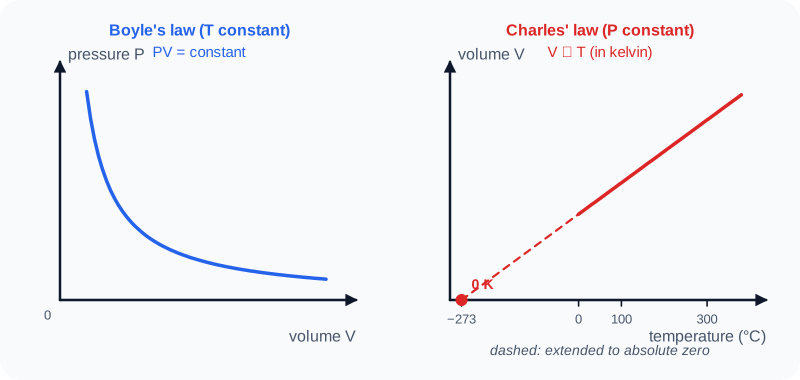
Figure 1. Boyle's law (left) and Charles' law (right). WASSCE Tutor diagram.
Kinetic explanation: if the volume is halved, the same particles are packed into half the space, so they hit the walls twice as often, and the pressure doubles.
200 cm³ of a gas is at 750 mmHg. What is its volume at 1500 mmHg, at the same temperature?
Doubling the pressure halves the volume.
Charles' law
Charles' law: the volume of a fixed mass of gas is directly proportional to its absolute (kelvin) temperature, provided the pressure is constant.
Extending the Charles' law graph backwards, the volume would reach zero at −273 °C. This temperature is absolute zero (0 K), the starting point of the kelvin scale.
Kinetic explanation: heating gives particles more kinetic energy. They hit the walls harder and more often, so the gas expands until the pressure falls back to its original value.
A gas occupies 300 cm³ at 27 °C. Find its volume at 127 °C, at constant pressure.
K, K.
Note that the volume does not become 300 × 127 ÷ 27. Always use kelvin.
The pressure law
Pressure law (Gay-Lussac's law of pressures): the pressure of a fixed mass of gas is directly proportional to its absolute temperature, provided the volume is constant.
A tyre is at 200 kPa at 27 °C. After a long drive its temperature is 57 °C. What is the new pressure, if the volume is unchanged?
The general gas equation
Combining the three laws:
It is used to correct gas volumes to s.t.p., so that volumes measured on different days can be compared.
A gas occupies 500 cm³ at 27 °C and 700 mmHg. Find its volume at s.t.p.
, , K; , K.
The ideal gas equation
where P is pressure in Pa, V is volume in m³, n is the number of moles, T is temperature in K and R is the molar gas constant, 8.314 J mol⁻¹ K⁻¹.
What pressure is exerted by 0.5 mol of gas in a 10 dm³ container at 27 °C?
V = 10 dm³ = 0.010 m³; T = 300 K.
Ideal and real gases. The gas laws assume an ideal gas: particles with no volume and no attractions between them. Real gases behave almost ideally at high temperature and low pressure. They deviate at high pressure (particle volume matters) and low temperature (attractions matter, and gases liquefy).
Gas cylinders used for cooking in Sierra Leone carry warnings not to leave them in the sun. By the pressure law, the pressure inside rises as the temperature rises, and a hot cylinder can leak or burst. Tyres are best checked when cool, before a journey.
Never put temperatures in °C into the gas laws. Charles' law and the pressure law work only with kelvin, because 0 °C is not "zero energy". Convert first: K = °C + 273.
Key points
- s.t.p.: 273 K and 760 mmHg (1 atm, 101 kPa).
- Boyle's law: at constant temperature.
- Charles' law: at constant pressure; absolute zero is −273 °C.
- Pressure law: at constant volume.
- General gas equation: . Ideal gas equation: .
- Always use kelvin.
WASSCE examination focus
Every WASSCE Chemistry paper has a gas-law calculation. Expect to state Boyle's and Charles' laws, to calculate new volumes or pressures, to correct volumes to s.t.p., and to explain the laws with the kinetic theory. Write the formula, substitute with units and convert °C to K first.
Quick check
- State Boyle's law.
- A gas has a volume of 60 cm³ at 2 atm. What is its volume at 3 atm, at constant temperature?
- A gas occupies 250 cm³ at 77 °C. Find its volume at 7 °C, at constant pressure.
- What is absolute zero in °C?
Answers:
- The volume of a fixed mass of gas is inversely proportional to its pressure at constant temperature.
- cm³.
- K, K: cm³.
- −273 °C.
Keep going with gas laws
This is one of 2 lessons in Gas Laws. Start free with the first lesson of every topic, then unlock them all, plus exam-style practice marked instantly and guided learning tools, from 25 NLe.
- Free account, no card needed
- Everything from 25 NLe
- No automatic renewal
More lessons in Gas Laws
- Gases in reactions: Gay-Lussac, Avogadro, Graham and Dalton🔒