WASSCE Chemistry · Energy Changes in Reactions
Exothermic and endothermic reactions
By the WASSCE Tutor team
Updated 12 November 2026 · 8 min read · Prepared against the WASSCE syllabus.
Charcoal glowing in a coal pot gives out heat; an instant cold pack in a first-aid kit takes heat in. Almost every chemical reaction involves an energy change, usually as heat. This lesson explains exothermic and endothermic reactions, enthalpy changes, energy profile diagrams, and how to measure heats of reaction in the laboratory.
Learning objectives
By the end of this lesson you should be able to:
- distinguish exothermic and endothermic reactions, with examples
- define enthalpy change (ΔH) and use its sign convention
- draw and interpret energy profile diagrams, including activation energy
- define standard enthalpies of combustion, formation, neutralisation and solution
- calculate enthalpy changes from experimental data using q = mcΔT
Exothermic and endothermic reactions
| Exothermic | Endothermic |
|---|---|
| Gives out heat to the surroundings | Takes in heat from the surroundings |
| Surroundings get warmer | Surroundings get colder |
| ΔH is negative | ΔH is positive |
| Products have less energy than reactants | Products have more energy than reactants |
| Combustion of fuels (charcoal, kerosene, cooking gas); respiration; neutralisation; rusting; dissolving NaOH or concentrated H₂SO₄ in water | Photosynthesis; thermal decomposition of CaCO₃; dissolving ammonium nitrate or ammonium chloride in water; melting and boiling |
Enthalpy change
The enthalpy change (ΔH) of a reaction is the heat energy given out or taken in at constant pressure, measured in kJ/mol (kJ mol⁻¹). It is negative for exothermic and positive for endothermic reactions.
A thermochemical equation shows ΔH with the balanced equation and state symbols:
Energy profile diagrams
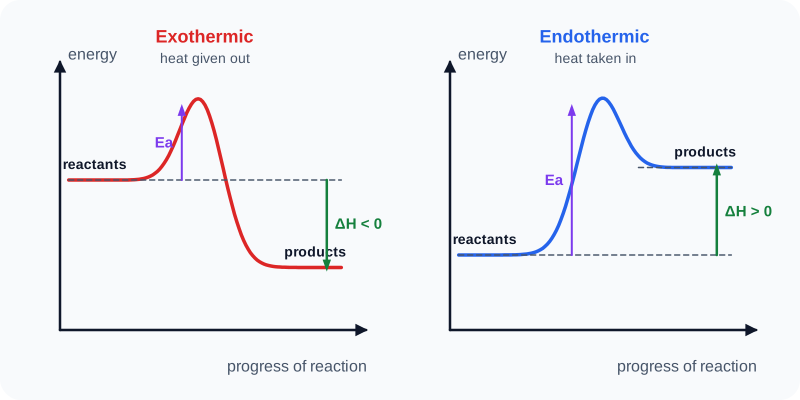
Figure 1. Energy profiles of exothermic and endothermic reactions. WASSCE Tutor diagram.
Activation energy (Ea) is the minimum energy that colliding particles must have for a reaction to take place.
Even exothermic reactions need energy to start. A match must be struck, and charcoal must be lit, to provide the activation energy. Once started, the heat given out keeps the reaction going.
Standard enthalpy changes
Standard conditions are 25 °C (298 K) and 1 atm, with substances in their normal states.
| Enthalpy change | Definition | Example |
|---|---|---|
| Combustion, ΔH°c | Heat given out when 1 mole of a substance burns completely in oxygen | C(s) + O₂ → CO₂; ΔH = −394 kJ/mol |
| Formation, ΔH°f | Heat change when 1 mole of a compound forms from its elements in their standard states | ½H₂ + ½Cl₂ → HCl; ΔH = −92 kJ/mol |
| Neutralisation | Heat given out when an acid and a base react to form 1 mole of water | H⁺ + OH⁻ → H₂O; ΔH = −57.3 kJ/mol |
| Solution | Heat change when 1 mole of a substance dissolves in a large amount of water | NH₄NO₃(s) → NH₄NO₃(aq); ΔH positive |
The heat of neutralisation of any strong acid by any strong base is about −57.3 kJ/mol, because the reaction is always H⁺ + OH⁻ → H₂O. With a weak acid or base it is less exothermic, because some energy is used to ionise the weak acid fully.
Measuring enthalpy changes
Heat absorbed by water:
- m = mass of water (or solution) in g (1 cm³ of water ≈ 1 g)
- c = specific heat capacity of water, 4.2 J g⁻¹ °C⁻¹
- ΔT = temperature change in °C
Then , where n is the number of moles reacted.
Heat of neutralisation. 50 cm³ of 1.0 mol/dm³ HCl is mixed with 50 cm³ of 1.0 mol/dm³ NaOH in a plastic cup. The temperature rises by 6.8 °C.
- Mass of solution g.
- J kJ.
- Moles of water formed mol.
- kJ/mol.
Heat of combustion of ethanol. A spirit lamp burning 0.46 g of ethanol (M = 46) heats 200 g of water in a copper can by 15 °C.
- J kJ.
- Moles of ethanol mol.
- kJ/mol.
The data-book value is −1367 kJ/mol. The experimental value is lower because of heat lost to the air and the can, and incomplete combustion (soot on the can).
Improving accuracy: insulate the container (plastic cup with lid), shield the flame from draughts, put the can close to the flame, stir, and record the highest temperature reached.
Choosing a cooking fuel is an enthalpy question. Charcoal, firewood and kerosene used in Sierra Leonean kitchens all burn exothermically. Their heats of combustion per gram, and how efficiently a stove transfers that heat to the pot, decide how much fuel a family must buy. Improved clay or metal stoves waste less heat than open three-stone fires, so they save fuel and reduce smoke.
A negative ΔH means heat is given out (exothermic), even though the temperature of the surroundings rises. Do not confuse the sign of ΔH with the direction of the temperature change.
Key points
- Exothermic: heat given out, ΔH negative (combustion, neutralisation, respiration). Endothermic: heat taken in, ΔH positive (photosynthesis, decomposition of CaCO₃).
- Activation energy is the minimum energy needed for a reaction; it appears as the peak of the energy profile.
- Standard enthalpies: combustion, formation, neutralisation (−57.3 kJ/mol for strong acid + strong base), solution.
- q = mcΔT with c = 4.2 J g⁻¹ °C⁻¹; ΔH = −q ÷ n.
WASSCE examination focus
Expect to classify reactions as exothermic or endothermic, to draw energy profiles labelled with Ea and ΔH, to define standard enthalpies, and to calculate ΔH from temperature-change data. Questions often ask why experimental values are lower than data-book values.
Quick check
- Is the thermal decomposition of calcium carbonate exothermic or endothermic?
- What is activation energy?
- Why is the heat of neutralisation of all strong acids by strong bases about the same?
- 25 cm³ of acid and 25 cm³ of alkali (each 2.0 mol/dm³) react and the temperature rises by 13.6 °C. Find ΔH of neutralisation.
Answers:
- Endothermic.
- The minimum energy colliding particles must have for a reaction to occur.
- In every case the reaction is H⁺ + OH⁻ → H₂O.
- J; moles of water ; kJ/mol.
Keep going with energy changes in reactions
This is one of 2 lessons in Energy Changes in Reactions. Start free with the first lesson of every topic, then unlock them all, plus exam-style practice marked instantly and guided learning tools, from 25 NLe.
- Free account, no card needed
- Everything from 25 NLe
- No automatic renewal
More lessons in Energy Changes in Reactions
- Hess's law, bond energies and spontaneity🔒