WASSCE Chemistry · Empirical and Molecular Formulas
Empirical formulas from experimental data
By the WASSCE Tutor team
Updated 12 November 2026 · 7 min read · Prepared against the WASSCE syllabus.
How do chemists know that water is H₂O and rust contains Fe₂O₃? Not by looking at the molecules, but by measuring masses and turning them into a mole ratio. The simplest whole-number ratio of atoms in a compound is its empirical formula. This lesson shows how to find it from percentages and from experimental masses.
Learning objectives
By the end of this lesson you should be able to:
- define the empirical formula of a compound
- calculate an empirical formula from percentage composition
- calculate an empirical formula from experimental masses
- handle mole ratios that are not whole numbers
- describe an experiment to find the formula of magnesium oxide
What an empirical formula is
The empirical formula of a compound is the simplest whole-number ratio of the atoms of each element in it.
| Compound | Molecular formula | Empirical formula |
|---|---|---|
| Glucose | C₆H₁₂O₆ | CH₂O |
| Ethane | C₂H₆ | CH₃ |
| Hydrogen peroxide | H₂O₂ | HO |
| Benzene | C₆H₆ | CH |
| Water | H₂O | H₂O |
For ionic compounds such as NaCl and MgO, the formula is always an empirical formula, because there are no molecules.
The method
| Step | Action |
|---|---|
| 1 | Write the mass or percentage of each element |
| 2 | Divide each by its relative atomic mass, giving moles |
| 3 | Divide every answer by the smallest one |
| 4 | If needed, multiply to get whole numbers |
| 5 | Write the formula |
A compound contains 40.0% carbon, 6.7% hydrogen and 53.3% oxygen. Find its empirical formula. (C = 12, H = 1, O = 16)
| C | H | O | |
|---|---|---|---|
| % (or mass in 100 g) | 40.0 | 6.7 | 53.3 |
| ÷ Aᵣ | 40.0 ÷ 12 = 3.33 | 6.7 ÷ 1 = 6.7 | 53.3 ÷ 16 = 3.33 |
| ÷ smallest (3.33) | 1 | 2.0 | 1 |
Empirical formula: CH₂O.
Ratios that are not whole numbers
If the ratio comes out as about 1.5, multiply everything by 2; about 1.33 or 1.67, multiply by 3; about 1.25, multiply by 4. A value such as 1.98 or 2.03 is just experimental error: round it to 2.
An oxide of iron contains 70% iron and 30% oxygen. Find its empirical formula. (Fe = 56, O = 16)
| Fe | O | |
|---|---|---|
| % | 70 | 30 |
| ÷ Aᵣ | 70 ÷ 56 = 1.25 | 30 ÷ 16 = 1.875 |
| ÷ smallest (1.25) | 1 | 1.5 |
| × 2 | 2 | 3 |
Empirical formula: Fe₂O₃ (iron(III) oxide, the main part of rust and of iron ore).
From experimental masses
You can use masses directly instead of percentages.
2.8 g of iron combines completely with 1.6 g of sulphur. Find the formula of the product. (Fe = 56, S = 32)
- Fe: mol
- S: mol
- Ratio 1 : 1, so the formula is FeS.
A hydrocarbon contains 85.7% carbon and 14.3% hydrogen.
- C: ; H:
- Ratio: ;
Empirical formula: CH₂ (the empirical formula of all alkenes).
Experiment: the formula of magnesium oxide
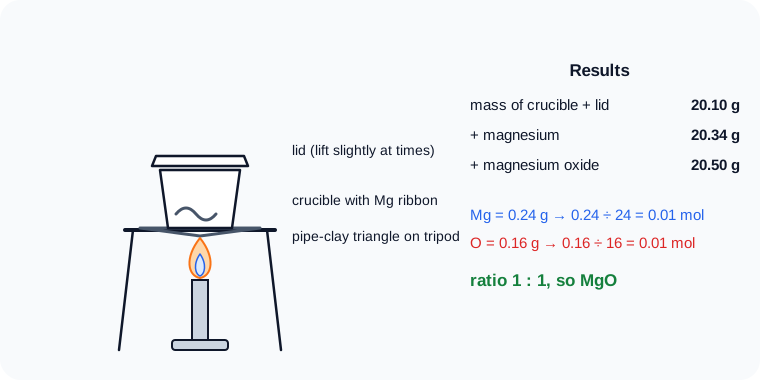
Figure 1. Finding the formula of magnesium oxide by heating magnesium. WASSCE Tutor diagram.
Method:
- Weigh a clean, dry crucible and lid.
- Add a coil of cleaned magnesium ribbon and weigh again.
- Heat strongly, lifting the lid slightly from time to time to let air in while keeping the white smoke of magnesium oxide inside.
- When the magnesium stops glowing, heat strongly for a few more minutes, then cool and weigh.
- Repeat heating, cooling and weighing until the mass is constant (heating to constant mass), to be sure all the magnesium has reacted.
Results: crucible + lid = 20.10 g; with magnesium = 20.34 g; with magnesium oxide = 20.50 g.
- Mass of magnesium g → mol
- Mass of oxygen g → mol
- Ratio 1 : 1, so the formula is MgO.
Sources of error: some magnesium oxide smoke escapes when the lid is lifted (making the oxygen mass too low); not all the magnesium reacts; some magnesium reacts with nitrogen in the air to form magnesium nitride.
Iron ore mined at Tonkolili is mainly haematite, Fe₂O₃. Using the empirical formula, 112 g of iron is combined with 48 g of oxygen in every 160 g of pure haematite, so pure ore is 70% iron by mass. Mining companies use exactly this kind of calculation to judge the grade of their ore.
Do not round a ratio such as 1 : 1.5 to 1 : 2. That would give FeO₂ instead of Fe₂O₃. Multiply to the nearest whole-number ratio instead.
Key points
- The empirical formula is the simplest whole-number ratio of atoms in a compound.
- Method: mass or % → ÷ Aᵣ → ÷ smallest → whole numbers.
- Ratios near 1.5, 1.33 or 1.25 must be multiplied by 2, 3 or 4.
- The magnesium oxide experiment needs heating to constant mass, lifting the lid to let in air.
WASSCE examination focus
Every year WASSCE asks for an empirical formula from percentage composition or masses. Set out the calculation in a table, show the ÷ Aᵣ and ÷ smallest steps, and watch for ratios that need multiplying. Practical questions may ask why the crucible is heated to constant mass.
Quick check
- Define empirical formula.
- A compound contains 52.2% C, 13.0% H and 34.8% O. Find its empirical formula.
- 0.48 g of magnesium forms 0.80 g of oxide. Find the formula of the oxide.
- Why is the crucible heated to constant mass?
Answers:
- The simplest whole-number ratio of the atoms of each element in a compound.
- C 4.35, H 13.0, O 2.175 → 2 : 6 : 1, so C₂H₆O.
- Mg 0.02 mol; O mol; 1 : 1, so MgO.
- To make sure all the magnesium has reacted.
Keep going with empirical and molecular formulas
This is one of 2 lessons in Empirical and Molecular Formulas. Start free with the first lesson of every topic, then unlock them all, plus exam-style practice marked instantly and guided learning tools, from 25 NLe.
- Free account, no card needed
- Everything from 25 NLe
- No automatic renewal
More lessons in Empirical and Molecular Formulas
- Molecular formulas, percentage composition and water of crystallisation🔒