WASSCE Chemistry · Electronic Configuration
Shells, sub-shells and orbitals
By the WASSCE Tutor team
Updated 12 November 2026 · 7 min read · Prepared against the WASSCE syllabus.
Why does sodium react violently with water while neon reacts with nothing? The answer lies in how each atom's electrons are arranged. This lesson builds the picture step by step: from simple shells to the sub-shells and orbitals that WASSCE expects you to use.
Learning objectives
By the end of this lesson you should be able to:
- describe electron shells and state the maximum number of electrons in each
- write the shell arrangements of the first 20 elements
- name the s, p, d and f sub-shells and the number of orbitals and electrons in each
- describe the shapes of s and p orbitals
- state the order in which sub-shells are filled
Electron shells
Bohr pictured electrons moving in fixed energy levels (shells) around the nucleus, labelled K, L, M, N or . Shells nearer the nucleus have lower energy and fill first.
Maximum number of electrons in a shell :
| Shell | n | Maximum electrons |
|---|---|---|
| K | 1 | |
| L | 2 | |
| M | 3 | |
| N | 4 |
For the first 20 elements, fill the shells 2, 8, 8, 2.
| Elements 1 to 10 | Elements 11 to 20 |
|---|---|
| H (1): 1 | Na (11): 2, 8, 1 |
| He (2): 2 | Mg (12): 2, 8, 2 |
| Li (3): 2, 1 | Al (13): 2, 8, 3 |
| Be (4): 2, 2 | Si (14): 2, 8, 4 |
| B (5): 2, 3 | P (15): 2, 8, 5 |
| C (6): 2, 4 | S (16): 2, 8, 6 |
| N (7): 2, 5 | Cl (17): 2, 8, 7 |
| O (8): 2, 6 | Ar (18): 2, 8, 8 |
| F (9): 2, 7 | K (19): 2, 8, 8, 1 |
| Ne (10): 2, 8 | Ca (20): 2, 8, 8, 2 |
The electrons in the outermost shell are the valence electrons. They decide how an atom reacts. Atoms with a full outer shell (He, Ne, Ar) are very unreactive.
Sub-shells and orbitals
Each shell is divided into sub-shells, labelled s, p, d and f. Each sub-shell contains orbitals.
An orbital is a region of space around the nucleus where there is a high probability of finding an electron. Each orbital holds a maximum of two electrons.
| Sub-shell | Number of orbitals | Maximum electrons |
|---|---|---|
| s | 1 | 2 |
| p | 3 | 6 |
| d | 5 | 10 |
| f | 7 | 14 |
| Shell | Sub-shells present | Electrons |
|---|---|---|
| n = 1 | 1s | 2 |
| n = 2 | 2s, 2p | 2 + 6 = 8 |
| n = 3 | 3s, 3p, 3d | 2 + 6 + 10 = 18 |
| n = 4 | 4s, 4p, 4d, 4f | 2 + 6 + 10 + 14 = 32 |
Shapes of orbitals
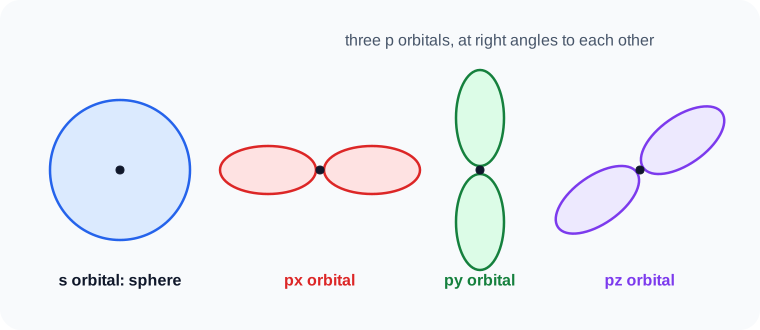
Figure 1. The shapes of s and p orbitals. WASSCE Tutor diagram.
- An s orbital is spherical.
- The three p orbitals (pₓ, p_y, p_z) are dumbbell-shaped, at right angles to each other.
- d orbitals have more complex shapes; you need not draw them.
Quantum numbers (in brief)
Each electron is described by four quantum numbers:
| Quantum number | Symbol | Describes |
|---|---|---|
| Principal | n | The main shell (1, 2, 3 …) and its energy |
| Azimuthal (subsidiary) | l | The sub-shell: l = 0 (s), 1 (p), 2 (d), 3 (f) |
| Magnetic | mₗ | The orientation of the orbital (e.g. pₓ, p_y, p_z) |
| Spin | mₛ | The direction of spin: +½ or −½ |
The order of filling: the Aufbau principle
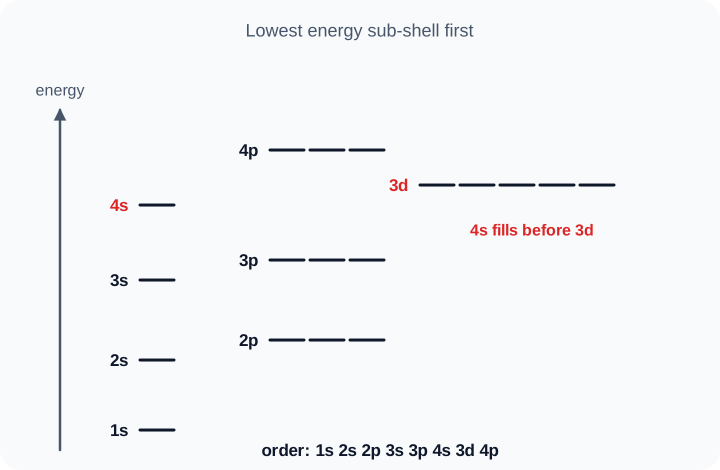
Figure 2. Sub-shells fill in order of increasing energy. WASSCE Tutor diagram.
Aufbau ("building-up") principle: electrons occupy the lowest-energy orbitals available first.
Order of filling: 1s, 2s, 2p, 3s, 3p, 4s, 3d, 4p, 5s, 4d …
The 4s sub-shell has lower energy than 3d, so it fills first. That is why potassium is 2, 8, 8, 1 and not 2, 8, 9.
Writing configurations with sub-shells.
- Na (11):
- Cl (17):
- K (19):
Check by adding the superscripts: for Cl, 2 + 2 + 6 + 2 + 5 = 17.
The superscript tells you the number of electrons, not the number of orbitals. 2p⁵ means five electrons in the 2p sub-shell, spread over its three orbitals.
Key points
- Shell n holds at most 2n² electrons; the first 20 elements fill as 2, 8, 8, 2.
- Valence electrons in the outer shell decide chemical behaviour.
- Sub-shells s, p, d, f have 1, 3, 5, 7 orbitals holding 2, 6, 10, 14 electrons; each orbital holds two electrons.
- s orbitals are spherical; p orbitals are dumbbell-shaped.
- Aufbau order: 1s 2s 2p 3s 3p 4s 3d 4p.
WASSCE examination focus
Expect to write electron arrangements of elements 1 to 20 in shells and in s, p, d notation, to state the maximum electrons in a shell or sub-shell, to sketch s and p orbitals, and to explain why 4s fills before 3d.
Quick check
- What is the maximum number of electrons in the M shell?
- Write the electron arrangement of aluminium (Z = 13) in shells and in sub-shells.
- How many orbitals are in a d sub-shell?
- Why does the 19th electron of potassium go into 4s, not 3d?
Answers:
- .
- Shells 2, 8, 3; sub-shells .
- Five.
- The 4s sub-shell is lower in energy than 3d, so it fills first (Aufbau principle).
Keep going with electronic configuration
This is one of 2 lessons in Electronic Configuration. Start free with the first lesson of every topic, then unlock them all, plus exam-style practice marked instantly and guided learning tools, from 25 NLe.
- Free account, no card needed
- Everything from 25 NLe
- No automatic renewal
More lessons in Electronic Configuration
- Writing electron configurations: Aufbau, Pauli and Hund🔒