WASSCE Chemistry · Electrolysis
Electrolysis: electrolytes, electrodes and products
By the WASSCE Tutor team
Updated 12 November 2026 · 7 min read · Prepared against the WASSCE syllabus.
Aluminium for cooking pots, chlorine for treating water, the shiny chrome on a motorbike and the pure copper in electric wire all depend on electrolysis: using electricity to drive a chemical change. This lesson explains how electrolysis works and how to predict the products at each electrode.
Learning objectives
By the end of this lesson you should be able to:
- define electrolysis, electrolyte, non-electrolyte, anode and cathode
- distinguish strong electrolytes, weak electrolytes and non-electrolytes
- explain the movement of ions and the reactions at each electrode
- explain the factors that decide which ion is discharged
- predict and explain the products of electrolysis of common electrolytes
Key terms
- Electrolysis: the decomposition of an electrolyte by passing a direct current through it.
- Electrolyte: a compound that conducts electricity when molten or in aqueous solution and is decomposed by it. Its ions carry the current.
- Non-electrolyte: a substance that does not conduct in any state (sugar, ethanol, kerosene).
- Anode: the electrode joined to the positive terminal. Anions move to it.
- Cathode: the electrode joined to the negative terminal. Cations move to it.
| Type | Ionisation | Examples |
|---|---|---|
| Strong electrolyte | Completely ionised | Strong acids (HCl, H₂SO₄), alkalis (NaOH), most salts (NaCl, CuSO₄) |
| Weak electrolyte | Partly ionised; conducts poorly | Ethanoic acid, aqueous ammonia, water |
| Non-electrolyte | No ions | Sugar solution, ethanol, kerosene |
Metallic conduction is a flow of electrons; the metal is not changed. Electrolytic conduction is a flow of ions, and chemical changes happen at the electrodes.
How electrolysis works
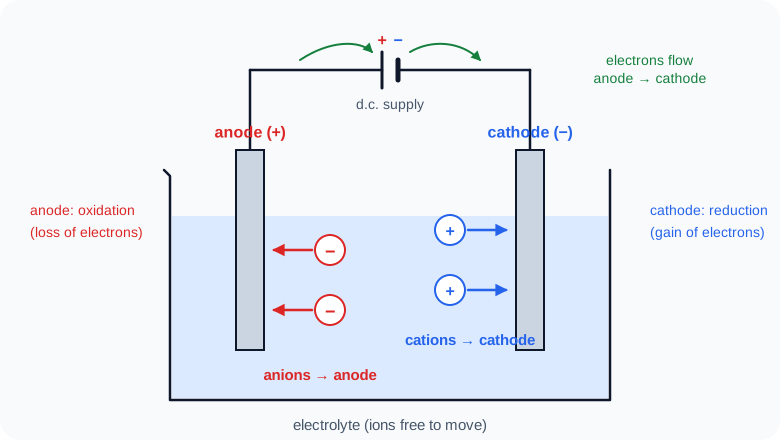
Figure 1. Ions move to the oppositely charged electrodes. WASSCE Tutor diagram.
- At the cathode: cations gain electrons, which is reduction: Cu²⁺ + 2e⁻ → Cu.
- At the anode: anions lose electrons, which is oxidation: 2Cl⁻ → Cl₂ + 2e⁻.
Inert electrodes (graphite or platinum) only carry the current. Active electrodes (such as copper) can themselves take part in the reaction.
Which ion is discharged? (preferential discharge)
In aqueous solutions there are several ions at each electrode, including H⁺ and OH⁻ from water. Which one is discharged depends on three factors.
1. Position in the electrochemical series. Ions lower in the series are discharged more easily.
| Cations (at the cathode) | Anions (at the anode) |
|---|---|
| K⁺, Ca²⁺, Na⁺, Mg²⁺, Al³⁺, Zn²⁺, Fe²⁺, Pb²⁺, H⁺, Cu²⁺, Ag⁺ | SO₄²⁻, NO₃⁻, OH⁻, Cl⁻, Br⁻, I⁻ |
| ← harder to discharge … easier to discharge → | ← harder to discharge … easier to discharge → |
So, in dilute solutions, metals above hydrogen (Na, K, Ca, Mg) are not discharged; hydrogen is given off instead. Sulphate and nitrate are not discharged; OH⁻ gives oxygen instead.
2. Concentration. A much more concentrated ion can be discharged in preference. In concentrated sodium chloride solution, Cl⁻ is discharged (giving chlorine) rather than OH⁻.
3. Nature of the electrode. With copper electrodes, the copper anode itself dissolves instead of any anion being discharged.
Products of common electrolyses
| Electrolyte (electrodes) | At the cathode | At the anode | What remains |
|---|---|---|---|
| Molten lead(II) bromide (graphite) | Lead: Pb²⁺ + 2e⁻ → Pb | Bromine: 2Br⁻ → Br₂ + 2e⁻ | — |
| Acidified water (platinum) | Hydrogen: 2H⁺ + 2e⁻ → H₂ | Oxygen: 4OH⁻ → 2H₂O + O₂ + 4e⁻ | Acid becomes more concentrated |
| Dilute NaCl (graphite) | Hydrogen | Oxygen | Effectively water is electrolysed |
| Concentrated NaCl (brine) (graphite) | Hydrogen | Chlorine | Sodium hydroxide solution |
| CuSO₄ (graphite or platinum) | Copper deposited | Oxygen | Solution becomes acidic (H₂SO₄); blue colour fades |
| CuSO₄ (copper electrodes) | Copper deposited | Copper anode dissolves: Cu → Cu²⁺ + 2e⁻ | Colour unchanged: concentration stays the same |
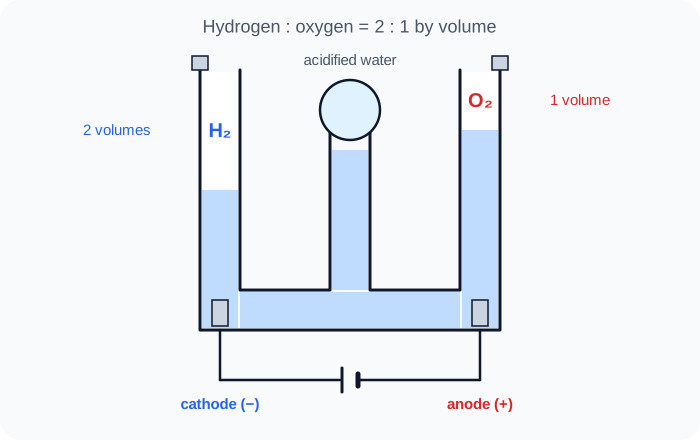
Figure 2. Electrolysis of acidified water gives hydrogen and oxygen in a 2 : 1 ratio. WASSCE Tutor diagram.
Why do dilute and concentrated sodium chloride give different gases at the anode?
Both solutions contain Cl⁻ and OH⁻ ions at the anode.
- In dilute solution, OH⁻ is lower in the series and is discharged: oxygen forms.
- In concentrated solution, Cl⁻ ions greatly outnumber OH⁻, so Cl⁻ is discharged: chlorine forms.
At the cathode, H⁺ (from water) is discharged in both, not Na⁺, because sodium is far above hydrogen in the series. Na⁺ and OH⁻ ions are left behind as sodium hydroxide.
Many motorbike and car parts sold in Freetown are chrome- or nickel-plated to stop rust and give a shine, using electrolysis. Even the zinc coating on galvanised roofing sheets can be applied by electrolysis (electrogalvanising) as well as by hot-dipping.
Cations go to the cathode (negative) and anions go to the anode (positive). Remember: reduction at the cathode, oxidation at the anode (both "c" and both vowels).
Key points
- Electrolysis decomposes an electrolyte using d.c.; ions carry the current.
- Anode (+): anions are oxidised (lose electrons). Cathode (−): cations are reduced (gain electrons).
- Which ion is discharged depends on position in the series, concentration and the electrode.
- Products: acidified water → H₂ and O₂ (2 : 1); brine → H₂, Cl₂ and NaOH; CuSO₄ with inert electrodes → Cu and O₂; with copper electrodes → copper transferred from anode to cathode.
WASSCE examination focus
Expect to define electrolysis and the electrodes, to predict and explain products at each electrode (with half-equations) for molten salts, acidified water, brine and copper(II) sulphate, and to explain preferential discharge. Many questions compare inert and copper electrodes in CuSO₄.
Quick check
- What is an electrolyte?
- Name the products at each electrode when molten lead(II) bromide is electrolysed.
- Why is sodium not formed at the cathode when sodium chloride solution is electrolysed?
- What happens to the colour of copper(II) sulphate solution when it is electrolysed with graphite electrodes? Why?
Answers:
- A compound that conducts electricity when molten or dissolved, and is decomposed by it.
- Lead at the cathode; bromine at the anode.
- H⁺ ions are lower in the electrochemical series than Na⁺, so they are discharged more easily; hydrogen forms instead.
- The blue colour fades, because Cu²⁺ ions are removed as copper at the cathode and are not replaced.
Keep going with electrolysis
This is one of 2 lessons in Electrolysis. Start free with the first lesson of every topic, then unlock them all, plus exam-style practice marked instantly and guided learning tools, from 25 NLe.
- Free account, no card needed
- Everything from 25 NLe
- No automatic renewal
More lessons in Electrolysis
- Faraday's laws and uses of electrolysis🔒