WASSCE Chemistry · Chemistry and the Environment
Air pollution, the greenhouse effect and acid rain
By the WASSCE Tutor team
Updated 12 November 2026 · 9 min read · Prepared against the WASSCE syllabus.
On a still morning in Freetown, the air at a busy junction carries exhaust from poda-podas, smoke from charcoal stoves and fumes from generators. Chemistry explains what these pollutants are, where they come from and what they do: from a headache caused by carbon(II) oxide to the global problems of climate change, acid rain and the ozone hole.
Learning objectives
By the end of this lesson you should be able to:
- define pollution and name the main air pollutants and their sources
- describe the effects of carbon(II) oxide, sulphur(IV) oxide, nitrogen oxides, particulates and lead
- explain the greenhouse effect and its link to global warming
- describe how acid rain forms, its effects and how it can be reduced
- explain how CFCs damage the ozone layer
- describe ways of controlling air pollution
Pollution and pollutants
Pollution is the release into the environment of substances or energy (pollutants) in amounts that harm living things or damage property and the environment.
| Pollutant | Main sources | Effects |
|---|---|---|
| Carbon(II) oxide, CO | Incomplete combustion of fuels: vehicles, generators, charcoal stoves in closed rooms | Combines with haemoglobin, stopping blood carrying oxygen; headache, dizziness, death |
| Sulphur(IV) oxide, SO₂ | Burning fuels that contain sulphur (coal, diesel, fuel oil); smelting sulphide ores | Irritates eyes and lungs, worsens asthma; acid rain |
| Nitrogen oxides, NOₓ | Vehicle engines (N₂ and O₂ combine at high temperature); lightning | Lung irritation; acid rain; photochemical smog |
| Particulates (soot, smoke, dust) | Diesel engines, open burning, charcoal, quarries, Harmattan dust | Lung disease, blackens buildings |
| Unburnt hydrocarbons | Vehicles, fuel evaporation | Smog; some cause cancer |
| Lead compounds | Old leaded petrol, lead paint, battery recycling | Damage the brain and nerves, especially in children |
| CFCs | Old refrigerators, air conditioners, aerosols | Destroy the ozone layer |
| Carbon(IV) oxide, methane | Burning fossil fuels, deforestation; cattle, rice fields, rubbish dumps | Greenhouse effect, global warming |
The greenhouse effect and global warming
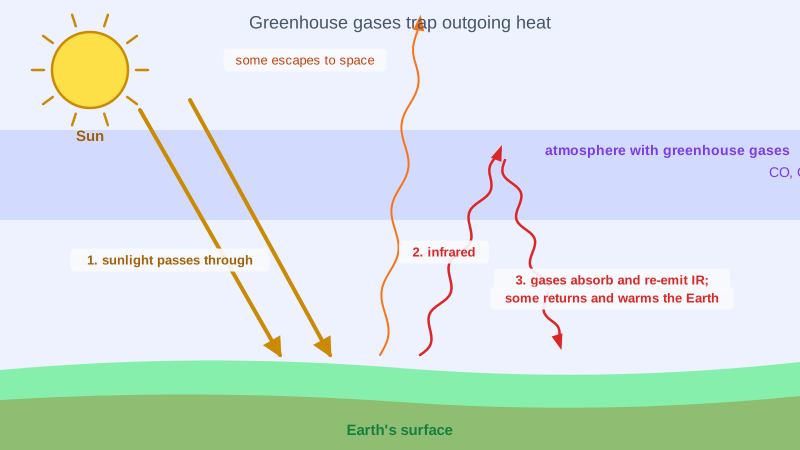
Figure 1. Greenhouse gases trap outgoing heat. WASSCE Tutor diagram.
- Sunlight (mainly visible and short-wave radiation) passes through the atmosphere and warms the Earth's surface.
- The warm surface gives out infrared (long-wave) radiation.
- Greenhouse gases, mainly CO₂, methane, water vapour, nitrogen(I) oxide and CFCs, absorb much of this infrared and re-emit it, some back towards the Earth.
- This natural greenhouse effect keeps the Earth about 33 °C warmer than it would be otherwise; without it, the Earth would be frozen.
Global warming: burning fossil fuels and cutting down forests have raised the CO₂ concentration of the air from about 280 ppm before 1800 to over 420 ppm today. More heat is trapped, and the average temperature of the Earth is rising.
Effects of global warming:
- rising sea levels (ice melts and warm water expands), flooding coastal towns
- more extreme weather: heavier rains, floods, droughts, storms
- changing rainfall patterns that damage farming and food supply
- spread of diseases such as malaria to new areas; loss of species
Reducing it: use renewable energy (solar, hydroelectric, wind), use fuel efficiently, plant trees and stop deforestation, and cut methane from rubbish dumps.
Acid rain
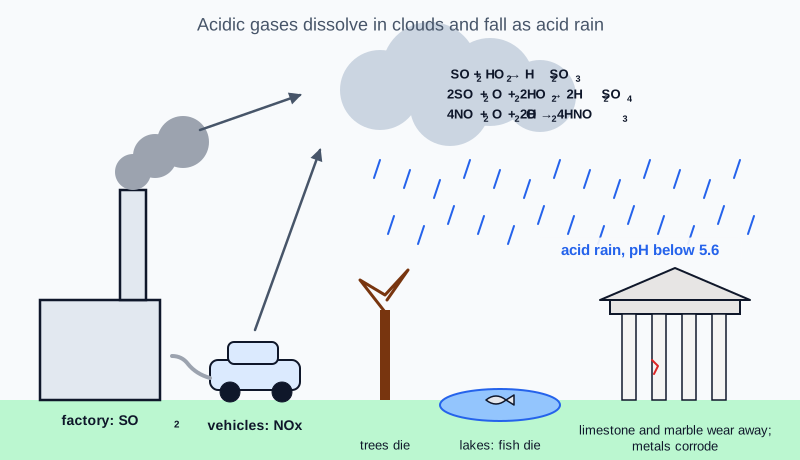
Figure 2. How acid rain forms and what it damages. WASSCE Tutor diagram.
Normal rain is slightly acidic (pH about 5.6) because CO₂ dissolves in it. Acid rain has a lower pH because of sulphur and nitrogen oxides:
Effects:
- lakes and rivers become too acidic for fish and other animals
- trees are damaged; nutrients are washed out of the soil and poisonous aluminium ions are released
- buildings and statues made of limestone or marble are worn away: CaCO₃ + H₂SO₄ → CaSO₄ + H₂O + CO₂
- metal structures (bridges, roofs) corrode faster
Reducing acid rain:
- remove sulphur from fuels at the refinery
- flue-gas desulphurisation: pass power-station waste gases through powdered limestone or lime, which absorbs SO₂: CaO + SO₂ → CaSO₃
- catalytic converters in car exhausts: 2CO + 2NO → 2CO₂ + N₂
- add lime to acidic lakes and soils (a temporary fix)
The ozone layer
Ozone, O₃, in the upper atmosphere (stratosphere) absorbs most of the Sun's harmful ultraviolet (UV) radiation.
CFCs (chlorofluorocarbons, such as CCl₂F₂) are very stable, so they drift up to the stratosphere. There, UV light breaks them down to release chlorine atoms, which destroy ozone in a chain reaction; one chlorine atom can destroy thousands of ozone molecules:
Effects of ozone depletion: more UV reaches the ground, causing skin cancer, eye cataracts and damage to crops and plankton.
Action: the Montreal Protocol (1987) phased out CFCs worldwide; they have been replaced by less harmful gases. The ozone layer is slowly recovering.
Explaining an observation. People have died in closed rooms where a charcoal stove or generator was left running overnight. Explain.
- With little fresh air, the fuel undergoes incomplete combustion: 2C + O₂ → 2CO.
- Carbon(II) oxide is colourless and odourless, so it is not noticed.
- It combines with haemoglobin about 200 times more strongly than oxygen, forming carboxyhaemoglobin, so the blood cannot carry oxygen to the body. The victims become drowsy, lose consciousness and die.
Most Sierra Leonean households cook with firewood or charcoal. Smoke indoors exposes women and children to particulates and carbon(II) oxide, causing lung and eye disease. Generators, which many homes and businesses run during power cuts, are another source of CO and should never be used indoors. Improved cookstoves, LPG and solar power reduce both indoor pollution and the cutting of trees for charcoal.
Do not confuse the greenhouse effect with ozone depletion. The greenhouse effect traps infrared (heat) and causes warming; ozone depletion lets in more ultraviolet and causes skin cancer. CFCs contribute to both, but the processes are different.
Key points
- CO (incomplete combustion) stops blood carrying oxygen; SO₂ and NOₓ cause acid rain and lung problems; particulates cause lung disease; lead harms the nervous system.
- Greenhouse gases (CO₂, CH₄, H₂O, N₂O, CFCs) trap infrared; extra CO₂ from fossil fuels and deforestation causes global warming.
- Acid rain (H₂SO₃, H₂SO₄, HNO₃) harms lakes, trees, buildings and metals; reduce it by removing sulphur, desulphurising flue gases with lime and catalytic converters.
- CFCs release chlorine atoms that destroy ozone, letting in harmful UV.
WASSCE examination focus
Expect to name air pollutants with their sources and effects, to explain the greenhouse effect and acid rain with equations, to describe ways of reducing pollution, and to explain why CO is poisonous. Questions often ask you to distinguish global warming from ozone depletion.
Quick check
- Why is carbon(II) oxide poisonous?
- Name two greenhouse gases.
- Write an equation for the formation of sulphuric(VI) acid in acid rain.
- How do CFCs damage the ozone layer?
Answers:
- It combines strongly with haemoglobin, so the blood cannot carry oxygen.
- Any two: carbon(IV) oxide, methane, water vapour, nitrogen(I) oxide, CFCs.
- 2SO₂ + O₂ + 2H₂O → 2H₂SO₄.
- In the stratosphere, UV light breaks CFCs down to chlorine atoms, which destroy ozone molecules in a chain reaction.
Keep going with chemistry and the environment
This is one of 2 lessons in Chemistry and the Environment. Start free with the first lesson of every topic, then unlock them all, plus exam-style practice marked instantly and guided learning tools, from 25 NLe.
- Free account, no card needed
- Everything from 25 NLe
- No automatic renewal
More lessons in Chemistry and the Environment
- Water and land pollution and waste management🔒