WASSCE Chemistry · Chemical Equilibrium
Reversible reactions and dynamic equilibrium
By the WASSCE Tutor team
Updated 12 November 2026 · 7 min read · Prepared against the WASSCE syllabus.
Most reactions you have met so far go one way: once wood has burned, it cannot "unburn". But many reactions can run both forwards and backwards. In a closed container they settle into a balance where both directions continue at the same rate. Understanding this dynamic equilibrium is the key to making ammonia, sulphuric acid and many other industrial chemicals efficiently.
Learning objectives
By the end of this lesson you should be able to:
- distinguish reversible from irreversible reactions, with examples
- explain what is meant by dynamic equilibrium
- state the characteristics of a system at equilibrium
- interpret graphs of concentration and rate against time as equilibrium is reached
- describe simple reversible reactions that show colour changes
Reversible and irreversible reactions
A reversible reaction is one that can go in both directions: the products can react to re-form the reactants. It is shown by the sign ⇌.
| Irreversible (one way) | Reversible |
|---|---|
| Burning charcoal, cooking an egg, rusting | Heating hydrated copper(II) sulphate |
| Neutralisation of a strong acid by a strong alkali | Thermal decomposition of ammonium chloride |
| Most precipitation reactions | Haber process (ammonia), Contact process (SO₃) |
Examples of reversible reactions:
- Hydrated copper(II) sulphate:
Heating drives off water: blue → white. Adding water reverses it: white → blue, with heat given out.
- Ammonium chloride:
On heating it decomposes; the gases recombine as white solid on the cool upper part of the test tube.
- Making ammonia:
Dynamic equilibrium
When a reversible reaction takes place in a closed system (nothing can enter or leave):
- At first, only the forward reaction occurs, quickly.
- As products build up, the backward reaction starts and speeds up, while the forward reaction slows (reactants are used up).
- Eventually the forward and backward rates become equal. From then on, the concentrations stay constant.
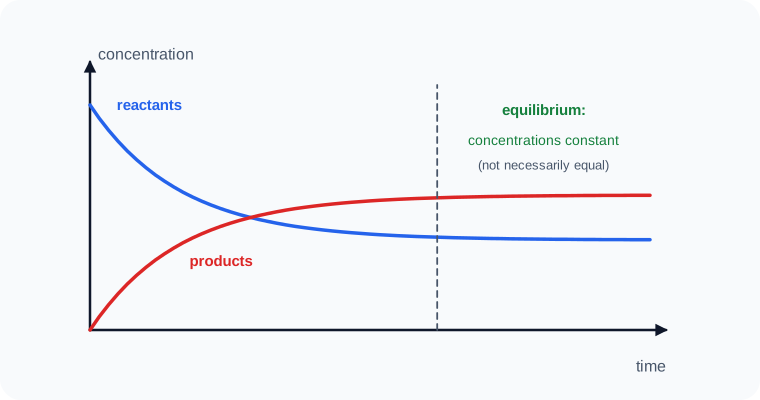
Figure 1. Concentrations level off when equilibrium is reached. WASSCE Tutor diagram.
Dynamic equilibrium is the state of a reversible reaction in a closed system in which the rate of the forward reaction equals the rate of the backward reaction, so the concentrations of reactants and products remain constant.
It is called dynamic because both reactions are still happening; they simply cancel each other out. Think of someone walking up a downward-moving escalator at the same speed: they stay in one place, but are still moving.
Characteristics of a system at equilibrium
| Characteristic | Meaning |
|---|---|
| Closed system | Equilibrium can be set up only if no substance escapes |
| Rates equal | Forward rate = backward rate |
| Concentrations constant | But not necessarily equal; there may be much more reactant than product, or the reverse |
| Dynamic | Particles keep reacting in both directions |
| Reached from either side | The same equilibrium mixture forms whether you start with reactants or with products (same conditions) |
| Macroscopic properties constant | Colour, pressure and density stop changing |
| Affected by conditions | Changing concentration, pressure or temperature shifts the position (next lesson) |
Seeing equilibrium: colour changes
Chromate and dichromate. In solution:
The left side (CrO₄²⁻) is yellow and the right side (Cr₂O₇²⁻) is orange.
- Add acid (more H⁺): the solution turns orange, as the equilibrium shifts to the right.
- Add alkali (which removes H⁺): it turns yellow, as the equilibrium shifts to the left.
The change can be reversed again and again, which shows the reaction is reversible.
Another example: brown nitrogen(IV) oxide, NO₂, is in equilibrium with colourless dinitrogen tetroxide, N₂O₄:
A sealed tube of the mixture is darker brown when hot and paler when cold.
A bottle of soft drink is a closed system at equilibrium. Carbon(IV) oxide gas above the drink is in equilibrium with CO₂ dissolved in it. While the cap is on, the dissolving and escaping happen at equal rates and the drink stays fizzy. Opening the bottle breaks the closed system: gas escapes, the equilibrium can no longer hold, and the drink slowly goes flat.
At equilibrium the concentrations are constant, not equal. An equilibrium mixture may contain mostly products, mostly reactants, or anything between.
Key points
- Reversible reactions (⇌) can go in both directions; examples: CuSO₄·5H₂O ⇌ CuSO₄ + 5H₂O, NH₄Cl ⇌ NH₃ + HCl, N₂ + 3H₂ ⇌ 2NH₃.
- In a closed system, a reversible reaction reaches dynamic equilibrium: forward rate = backward rate.
- At equilibrium, concentrations are constant but not necessarily equal; reactions continue in both directions.
- Equilibrium can be reached from either side.
- Colour changes (chromate/dichromate, NO₂/N₂O₄) show equilibria shifting.
WASSCE examination focus
Expect to define dynamic equilibrium, to state its characteristics, to give examples of reversible reactions, and to sketch or interpret concentration–time or rate–time graphs. Explain why equilibrium is called "dynamic".
Quick check
- What does the sign ⇌ mean in an equation?
- Why is chemical equilibrium described as dynamic?
- State two characteristics of a system at equilibrium.
- What colour change is seen when acid is added to potassium chromate solution?
Answers:
- The reaction is reversible: it can go forwards and backwards.
- Both the forward and backward reactions continue to happen, at equal rates.
- Any two: closed system; forward and backward rates equal; concentrations constant; reachable from either side; macroscopic properties constant.
- Yellow to orange.
Keep going with chemical equilibrium
This is one of 2 lessons in Chemical Equilibrium. Start free with the first lesson of every topic, then unlock them all, plus exam-style practice marked instantly and guided learning tools, from 25 NLe.
- Free account, no card needed
- Everything from 25 NLe
- No automatic renewal
More lessons in Chemical Equilibrium
- Le Chatelier's principle and the equilibrium constant🔒