WASSCE Chemistry · Chemical Bonding
Ionic, covalent and dative bonding
By the WASSCE Tutor team
Updated 12 November 2026 · 7 min read · Prepared against the WASSCE syllabus.
Table salt melts at 801 °C and conducts electricity when molten; candle wax melts in your hand and never conducts. The difference comes from how their atoms are held together. This lesson explains why atoms bond and the three ways they do it: by transferring electrons, by sharing them, and by one atom donating a whole pair.
Learning objectives
By the end of this lesson you should be able to:
- explain why atoms form bonds (the octet rule)
- describe ionic bonding with dot-and-cross diagrams and work out ionic formulas
- describe covalent bonding, including single, double and triple bonds
- describe dative (coordinate) bonding, as in the ammonium ion
- compare the properties of ionic and covalent compounds
- explain polar covalent bonds
Why atoms bond
The noble gases are unreactive because their outer shells are full: 2 electrons for helium (a duplet) and 8 for the others (an octet). Other atoms bond to reach a stable noble-gas arrangement by losing, gaining or sharing electrons. This is the octet rule.
Ionic (electrovalent) bonding
An ionic bond is the electrostatic attraction between oppositely charged ions, formed when electrons are transferred from a metal atom to a non-metal atom.
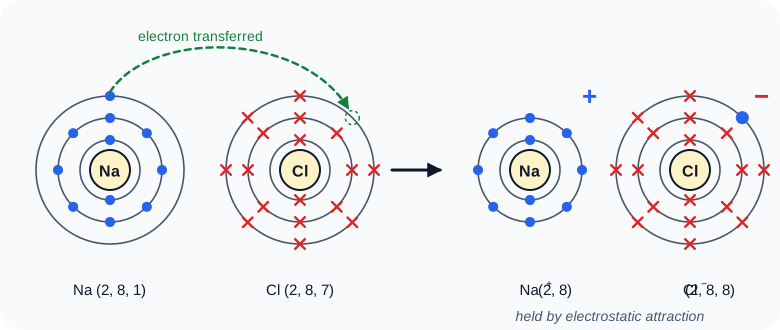
Figure 1. Electron transfer in sodium chloride. WASSCE Tutor diagram.
- Metals lose electrons to form positive ions (cations): Na → Na⁺ + e⁻.
- Non-metals gain electrons to form negative ions (anions): Cl + e⁻ → Cl⁻.
- In the solid, millions of ions pack into a giant ionic lattice, each ion surrounded by ions of opposite charge.
Ionic formulas from charges. The total positive and negative charges must balance.
| Ions | Formula |
|---|---|
| Na⁺ and Cl⁻ | NaCl |
| Mg²⁺ and O²⁻ | MgO |
| Ca²⁺ and Cl⁻ | CaCl₂ (one Ca²⁺ balances two Cl⁻) |
| Al³⁺ and O²⁻ | Al₂O₃ (2 × 3+ = 6+; 3 × 2− = 6−) |
| Na⁺ and SO₄²⁻ | Na₂SO₄ |
Covalent bonding
A covalent bond is a shared pair of electrons between two atoms, usually two non-metals. Each atom contributes one electron to the pair.
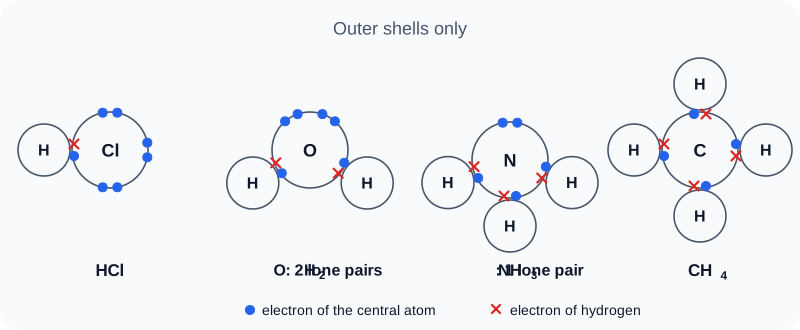
Figure 2. Covalent molecules: outer shells only. WASSCE Tutor diagram.
| Bond | Shared pairs | Example | Structural formula |
|---|---|---|---|
| Single | 1 | Cl₂, H₂O, CH₄ | Cl–Cl |
| Double | 2 | O₂, CO₂ | O=C=O |
| Triple | 3 | N₂ | N≡N |
Lone pairs are pairs of outer electrons not used in bonding: water has two, ammonia one, methane none.
Simple molecules and giant covalent structures
| Simple molecular | Giant covalent (macromolecular) |
|---|---|
| Small molecules held by weak forces between molecules | Millions of atoms joined by strong covalent bonds throughout |
| Low melting and boiling points; often gases or liquids | Very high melting points; hard |
| Examples: H₂O, CO₂, CH₄, I₂ | Examples: diamond, graphite, silicon(IV) oxide (sand) |
Dative (coordinate) bonding
A dative (coordinate) bond is a covalent bond in which both shared electrons come from the same atom. That atom donates a lone pair to an atom or ion that needs a pair.
The ammonium ion, NH₄⁺. Ammonia's nitrogen has a lone pair. A hydrogen ion, H⁺, has no electrons at all.
Nitrogen donates its lone pair to H⁺, forming the fourth N–H bond. Once formed, all four N–H bonds are identical.
The hydroxonium ion, H₃O⁺, forms in the same way when water's oxygen donates a lone pair to H⁺.
Comparing ionic and covalent compounds
| Property | Ionic compounds | Covalent (simple molecular) compounds |
|---|---|---|
| Formed between | Metal and non-metal | Non-metals |
| Particles | Ions | Molecules |
| Melting and boiling points | High | Low |
| State at room temperature | Crystalline solids | Often gases or liquids |
| Electrical conductivity | Conduct when molten or dissolved (ions free to move); not when solid | Do not conduct (no ions) |
| Solubility | Usually soluble in water | Usually soluble in organic solvents (kerosene, ethanol) |
| Examples | NaCl, MgO, CaCl₂ | H₂O, CO₂, CH₄, sugar |
Polar covalent bonds
When two different atoms share electrons, the more electronegative atom pulls the shared pair closer. It becomes slightly negative (δ−) and the other atom slightly positive (δ+).
- H–Cl is polar: Hᵟ⁺–Clᵟ⁻.
- Cl–Cl is non-polar: both atoms pull equally.
The larger the electronegativity difference, the more polar the bond; a very large difference gives ionic bonding.
Sea salt dried in salt pans along the Sierra Leone coast is mainly sodium chloride, an ionic compound. That is why brine conducts electricity and why salt has to be heated strongly before it melts. Kerosene, a mixture of covalent hydrocarbons, does not conduct and does not dissolve salt.
Ionic solids do not conduct electricity: their ions are fixed in the lattice. They conduct only when molten or dissolved, when the ions can move.
Key points
- Atoms bond to reach a noble-gas arrangement (octet or duplet).
- Ionic bonding: electron transfer from metal to non-metal; ions held by electrostatic attraction; formulas balance the charges.
- Covalent bonding: shared pairs between non-metals; single, double and triple bonds; lone pairs.
- Dative bonding: both electrons from one atom (NH₄⁺, H₃O⁺).
- Ionic compounds: high melting points, conduct when molten or dissolved. Simple covalent compounds: low melting points, non-conductors.
WASSCE examination focus
Expect to draw dot-and-cross diagrams (NaCl, MgO, H₂O, NH₃, CH₄, NH₄⁺), to write formulas from ion charges, to explain the formation of a dative bond, and to compare the properties of ionic and covalent compounds. Show only outer shells unless asked for all.
Quick check
- What type of bond forms between calcium and chlorine? Give the formula.
- How many lone pairs are on the oxygen atom in water?
- Explain how the ammonium ion forms.
- Why does molten sodium chloride conduct electricity but solid sodium chloride does not?
Answers:
- Ionic; CaCl₂.
- Two.
- The nitrogen of ammonia donates its lone pair to a hydrogen ion, forming a dative bond: NH₃ + H⁺ → NH₄⁺.
- In the molten state the ions are free to move and carry charge; in the solid they are fixed in the lattice.
Keep going with chemical bonding
This is one of 2 lessons in Chemical Bonding. Start free with the first lesson of every topic, then unlock them all, plus exam-style practice marked instantly and guided learning tools, from 25 NLe.
- Free account, no card needed
- Everything from 25 NLe
- No automatic renewal
More lessons in Chemical Bonding
- Metallic bonding, intermolecular forces and shapes of molecules🔒