WASSCE Chemistry · Carbon and Its Inorganic Compounds
Carbon: allotropes and oxides
By the WASSCE Tutor team
Updated 12 November 2026 · 10 min read · Prepared against the WASSCE syllabus.
The diamonds dug from the gravels of Kono and the charcoal burned in every coal pot are the same element: carbon. Its atoms can join in different ways, giving the hardest natural substance and a soft, black, slippery one. This lesson covers the allotropes of carbon and its two oxides, carbon(IV) oxide and the poisonous carbon(II) oxide.
Learning objectives
By the end of this lesson you should be able to:
- describe the structures and properties of diamond and graphite and relate them to their uses
- describe the amorphous forms of carbon and their uses
- state the chemical properties of carbon
- describe the laboratory preparation, test, properties and uses of carbon(IV) oxide
- describe the preparation, properties and dangers of carbon(II) oxide
- compare carbon(IV) oxide and carbon(II) oxide
Allotropes of carbon
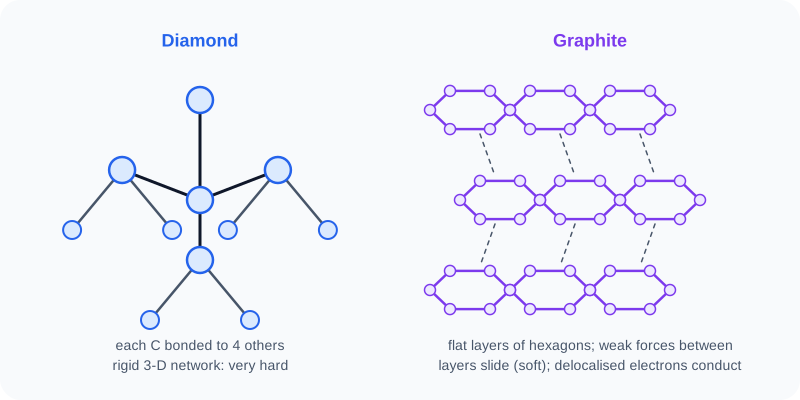
Figure 1. The structures of diamond and graphite. WASSCE Tutor diagram.
| Property | Diamond | Graphite |
|---|---|---|
| Structure | Each C bonded to 4 others; tetrahedral 3-D giant covalent network | Each C bonded to 3 others in flat hexagonal layers; layers held by weak forces |
| Hardness | Hardest natural substance | Soft and slippery: layers slide |
| Appearance | Transparent, sparkling crystals | Black, shiny, greasy |
| Electrical conductivity | Does not conduct: all electrons in bonds | Conducts: one delocalised electron per atom moves along the layers |
| Density | 3.5 g/cm³ | 2.3 g/cm³ |
| Melting point | Very high (about 3550 °C) | Very high |
| Uses | Jewellery; cutting, drilling and grinding tools | Pencil "lead" (with clay); lubricant; electrodes in electrolysis and dry cells; moderator in nuclear reactors |
Both are giant covalent structures, so both have very high melting points and are insoluble in water. Burning either in excess oxygen gives only carbon(IV) oxide, which proves both are pure carbon.
Newer allotropes: fullerenes (such as C₆₀, "buckyballs") and graphene (a single graphite layer, very strong and highly conducting).
Amorphous carbon
Forms of carbon with no regular crystal structure (actually tiny graphite crystals):
| Form | Made by | Use |
|---|---|---|
| Charcoal (wood charcoal) | Heating wood with little air | Cooking fuel; adsorbs gases and colours |
| Activated charcoal | Charcoal treated to give a huge surface area | Water filters; gas masks; removing colour from sugar; treating poisoning |
| Coke | Heating coal without air | Fuel and reducing agent in the blast furnace |
| Soot (lampblack) | Incomplete burning of oils | Printing ink, shoe polish, car tyres |
| Animal charcoal | Heating bones | Decolourising raw sugar |
Chemical properties of carbon
1. Burns in oxygen: in plenty of oxygen it forms carbon(IV) oxide; in limited oxygen, carbon(II) oxide.
2. Reducing agent: carbon removes oxygen from the oxides of metals below it in the reactivity series (zinc, iron, lead, copper). This is the basis of metal extraction:
3. With steam at white heat, it forms water gas: C + H₂O → CO + H₂.
4. Oxidised by hot concentrated acids (nitric and sulphuric) to CO₂.
Carbon(IV) oxide, CO₂
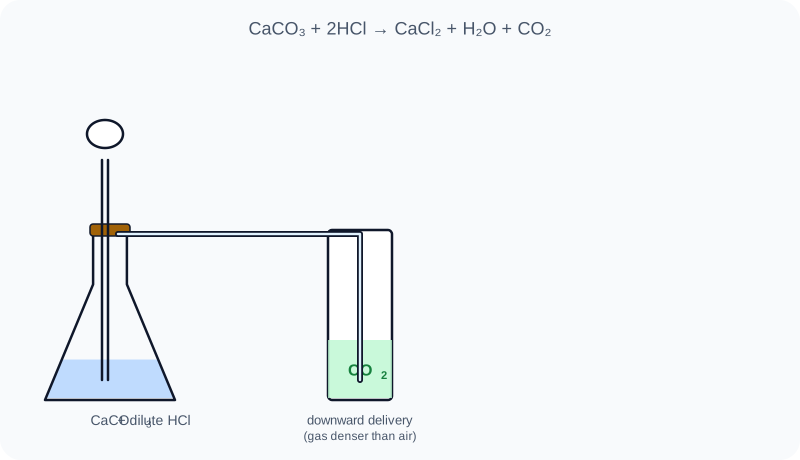
Figure 2. Preparing carbon(IV) oxide. WASSCE Tutor diagram.
Laboratory preparation: dilute hydrochloric acid on marble chips (calcium carbonate):
Dilute sulphuric acid is not used: it forms insoluble calcium sulphate, which coats the marble and stops the reaction.
Collection: by downward delivery (denser than air), or over water (it is only fairly soluble).
Test: it turns lime water (calcium hydroxide solution) milky, because insoluble calcium carbonate forms. With excess CO₂, the milkiness clears, because soluble calcium hydrogencarbonate forms:
Properties:
- colourless, odourless gas, about 1.5 times denser than air
- fairly soluble in water, forming weak carbonic acid (H₂CO₃), which turns blue litmus faintly red
- acidic oxide: reacts with alkalis, CO₂ + 2NaOH → Na₂CO₃ + H₂O
- does not burn and does not support combustion of most substances. But burning magnesium continues to burn in it, leaving black specks of carbon: 2Mg + CO₂ → 2MgO + C
- solid CO₂ ("dry ice") sublimes at −78 °C
Uses:
- fire extinguishers (dense, does not support burning)
- fizzy drinks (dissolved under pressure)
- dry ice for refrigeration and stage "smoke"
- baking: CO₂ from baking powder or yeast makes bread and cakes rise
- photosynthesis: the source of carbon in all plant material
Carbon(II) oxide, CO
Preparation: pass carbon(IV) oxide over red-hot coke (CO₂ + C → 2CO), or warm methanoic acid with concentrated sulphuric acid (which removes water).
Properties:
- colourless, odourless, very poisonous gas; about the same density as air
- almost insoluble in water; neutral oxide
- burns with a blue flame: 2CO + O₂ → 2CO₂
- reducing agent: reduces metal oxides, as in the blast furnace: Fe₂O₃ + 3CO → 2Fe + 3CO₂
Why it is so dangerous: CO combines with haemoglobin in red blood cells about 200 times more strongly than oxygen does, forming carboxyhaemoglobin. Blood can then no longer carry oxygen. Because CO has no smell, victims do not notice, become drowsy and may die. It is produced by incomplete combustion in charcoal stoves, generators and car engines in enclosed spaces.
CO₂ and CO compared
| Property | Carbon(IV) oxide, CO₂ | Carbon(II) oxide, CO |
|---|---|---|
| Smell | Odourless | Odourless |
| Toxicity | Not poisonous (suffocates only at high levels) | Very poisonous |
| Density compared with air | Denser | About the same |
| Solubility in water | Fairly soluble | Almost insoluble |
| Nature | Acidic oxide | Neutral oxide |
| Burning | Does not burn | Burns with a blue flame |
| Lime water | Turns milky | No effect |
| Reducing agent? | No | Yes |
Sierra Leone's diamonds, mined in Kono and along rivers in the east, formed from carbon under enormous pressure deep in the earth and were brought up in volcanic rock. The charcoal sold at roadsides is made by burning wood with limited air in earth-covered kilns. It burns hotter and with less smoke than wood, but its large-scale production cuts down forests.
Graphite conducts electricity because of its delocalised electrons, not because it is a metal. Diamond, with every electron held in a bond, does not conduct.
Key points
- Diamond: each C bonded to 4, 3-D network: hardest, non-conductor; used for jewellery and cutting.
- Graphite: layers of hexagons with weak forces and delocalised electrons: soft, slippery, conducts; used for pencils, lubricants and electrodes.
- Amorphous carbon: charcoal, activated charcoal, coke, soot.
- Carbon is a reducing agent, used to extract zinc, iron, lead and copper.
- CO₂: CaCO₃ + 2HCl; turns lime water milky; dense, acidic, does not support burning; extinguishers, drinks, baking.
- CO: poisonous, odourless, burns with a blue flame, a reducing agent; forms by incomplete combustion.
WASSCE examination focus
Expect to compare diamond and graphite, relating structure to properties and uses, to describe the preparation and test of CO₂ (and why H₂SO₄ is not used), to explain the lime water test with excess CO₂, and to compare CO and CO₂, including why CO is poisonous.
Quick check
- Why does graphite conduct electricity but diamond does not?
- Why is dilute sulphuric acid not used with marble chips to prepare CO₂?
- What happens when excess CO₂ is bubbled through lime water?
- Why is carbon(II) oxide poisonous?
Answers:
- Graphite has one delocalised electron per atom, free to move along its layers; in diamond all electrons are held in bonds.
- It forms insoluble calcium sulphate, which coats the chips and stops the reaction.
- It first turns milky (CaCO₃), then clears as soluble calcium hydrogencarbonate forms.
- It combines with haemoglobin and stops the blood carrying oxygen.
Keep going with carbon and its inorganic compounds
This is one of 2 lessons in Carbon and Its Inorganic Compounds. Start free with the first lesson of every topic, then unlock them all, plus exam-style practice marked instantly and guided learning tools, from 25 NLe.
- Free account, no card needed
- Everything from 25 NLe
- No automatic renewal
More lessons in Carbon and Its Inorganic Compounds
- Carbonates, hydrogencarbonates and the carbon cycle🔒