WASSCE Chemistry · Carbohydrates
Carbohydrates: sugars, starch and cellulose
By the WASSCE Tutor team
Updated 12 November 2026 · 7 min read · Prepared against the WASSCE syllabus.
Rice, cassava, yams, bananas, sugar cane and the cotton in your uniform are all made largely of carbohydrates. Plants build them by photosynthesis, and we break them down for energy. This lesson covers what carbohydrates are, how they are classified into sugars and polysaccharides, and the properties and uses of the main ones.
Learning objectives
By the end of this lesson you should be able to:
- define carbohydrates and state their general formula
- describe how carbohydrates are formed in plants
- classify carbohydrates as monosaccharides, disaccharides and polysaccharides, with examples
- compare the properties of sugars and polysaccharides
- describe starch, cellulose and glycogen and their uses
What carbohydrates are
Carbohydrates are compounds of carbon, hydrogen and oxygen in which hydrogen and oxygen are usually in the ratio 2 : 1, as in water. General formula: Cₓ(H₂O)ᵧ.
Examples: glucose C₆H₁₂O₆ = C₆(H₂O)₆; sucrose C₁₂H₂₂O₁₁ = C₁₂(H₂O)₁₁. (They are not really "hydrates of carbon"; the name comes from the formula.)
Photosynthesis: green plants make glucose from carbon(IV) oxide and water, using energy from sunlight absorbed by chlorophyll:
Plants then join glucose units into starch (for storage) and cellulose (for cell walls).
Classification
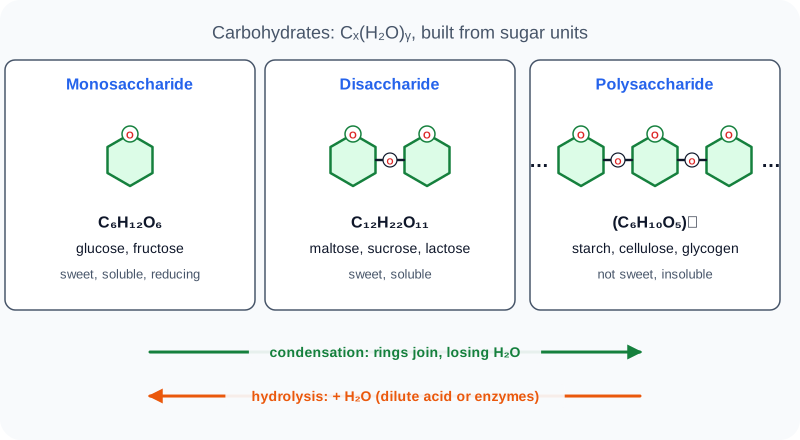
Figure 1. Carbohydrates are built from sugar units. WASSCE Tutor diagram.
Monosaccharides (simple sugars)
- Glucose, C₆H₁₂O₆ (grape sugar): in ripe fruits, honey and blood; the main fuel for respiration.
- Fructose, C₆H₁₂O₆ (fruit sugar): in fruits and honey; the sweetest sugar. Glucose and fructose are isomers.
- Galactose, C₆H₁₂O₆: part of milk sugar.
Disaccharides
Two monosaccharide units joined by condensation, with loss of water:
| Disaccharide | Made of | Found in |
|---|---|---|
| Sucrose (cane sugar) | Glucose + fructose | Sugar cane, table sugar, many fruits |
| Maltose (malt sugar) | Glucose + glucose | Germinating grain (malt) |
| Lactose (milk sugar) | Glucose + galactose | Milk |
Polysaccharides
Hundreds or thousands of glucose units joined by condensation: (C₆H₁₀O₅)ₙ.
| Polysaccharide | Where found | Role |
|---|---|---|
| Starch | Cassava, rice, maize, yams, potatoes, wheat | Energy store in plants; main food carbohydrate |
| Cellulose | Plant cell walls; cotton, wood, paper | Structure; dietary fibre (roughage) |
| Glycogen | Liver and muscles of animals | Energy store in animals ("animal starch") |
Humans cannot digest cellulose (we lack the enzyme cellulase), but it helps food move through the gut. Cattle and goats digest it with the help of bacteria in their stomachs.
Properties of sugars and polysaccharides
| Property | Sugars (mono- and disaccharides) | Polysaccharides |
|---|---|---|
| Taste | Sweet | Not sweet |
| Solubility in water | Soluble | Insoluble (starch forms a colloid in hot water) |
| Appearance | Crystalline solids | Powders or fibres; not crystalline |
| Molecular size | Small | Very large (macromolecules) |
| Reducing power | Glucose, fructose, maltose and lactose are reducing sugars; sucrose is not | Non-reducing |
Uses of carbohydrates
- Food and energy: respiration releases energy from glucose:
- Glucose: drips for patients, energy drinks, sweets
- Sucrose: sweetening, preserving jams
- Starch: food; laundry starch for stiffening clothes; adhesives; making glucose syrup and ethanol by fermentation
- Cellulose: cotton cloth, paper, timber; making rayon fibres and cellulose ethanoate film
Percentage of carbon in glucose. (C = 12, H = 1, O = 16)
- Mᵣ of C₆H₁₂O₆
- % C
Most of the energy in a Sierra Leonean diet comes from starch: rice at almost every meal, and cassava eaten as gari, fufu or boiled roots. Sugar cane is grown and chewed fresh; its juice is mostly sucrose. Near Makeni, a large plantation has grown sugar cane to ferment into fuel ethanol, turning a carbohydrate into a fuel.
Sucrose is not a reducing sugar, even though both of its units (glucose and fructose) are. The groups that would do the reducing are used up in the link between the two units.
Key points
- Carbohydrates, Cₓ(H₂O)ᵧ, contain C, H and O; plants make them by photosynthesis.
- Monosaccharides (glucose, fructose), disaccharides (sucrose, maltose, lactose) and polysaccharides (starch, cellulose, glycogen).
- Units join by condensation (losing water); hydrolysis splits them.
- Sugars are sweet, soluble and crystalline; polysaccharides are not sweet and insoluble.
- Starch stores energy in plants; cellulose builds cell walls; glycogen stores energy in animals.
WASSCE examination focus
Expect to define carbohydrates and classify them with examples and formulas, to compare sugars with starch, to name the units that make up sucrose, maltose and starch, and to state uses of starch and cellulose. Objective questions often ask which sugar is not reducing (sucrose).
Quick check
- Give the general formula of carbohydrates.
- Name the two monosaccharides that make up sucrose.
- State two differences between glucose and starch.
- Why can cattle digest grass, but humans cannot digest cellulose?
Answers:
- Cₓ(H₂O)ᵧ.
- Glucose and fructose.
- Any two: glucose is sweet, starch is not; glucose is soluble, starch is insoluble; glucose is crystalline, starch is not; glucose is a small molecule, starch a macromolecule; glucose is a reducing sugar, starch is not.
- Bacteria in the stomachs of cattle produce cellulase, the enzyme that breaks down cellulose; humans do not produce it.
Keep going with carbohydrates
This is one of 2 lessons in Carbohydrates. Start free with the first lesson of every topic, then unlock them all, plus exam-style practice marked instantly and guided learning tools, from 25 NLe.
- Free account, no card needed
- Everything from 25 NLe
- No automatic renewal
More lessons in Carbohydrates
- Tests for carbohydrates, hydrolysis and fermentation🔒