WASSCE Chemistry · Atomic Structure
Inside the atom: particles, atomic number and isotopes
By the WASSCE Tutor team
Updated 12 November 2026 · 8 min read · Prepared against the WASSCE syllabus.
For over two thousand years people argued about whether matter could be cut up forever. John Dalton's atomic theory (1808) said no: there are indivisible atoms. A century of experiments then showed that atoms themselves contain smaller particles. This lesson traces that story and teaches you to read the numbers that describe every atom.
Learning objectives
By the end of this lesson you should be able to:
- state Dalton's atomic theory and the modifications made to it
- describe the discoveries of the electron, nucleus and neutron
- state the relative masses and charges of protons, neutrons and electrons
- define atomic number and mass number and use nuclide notation
- work out the numbers of particles in atoms and ions
- define isotopes and give examples
Dalton's atomic theory
- All matter is made of tiny, indivisible particles called atoms.
- Atoms can be neither created nor destroyed.
- Atoms of the same element are identical in mass and properties; atoms of different elements differ.
- Atoms combine in simple whole-number ratios to form compounds.
- Chemical reactions rearrange atoms.
Modifications to the theory
| Dalton said | We now know |
|---|---|
| Atoms are indivisible | Atoms contain protons, neutrons and electrons |
| Atoms of an element are identical | Isotopes of an element have different masses |
| Atoms cannot be created or destroyed | True in chemical reactions, but nuclear reactions change atoms into other atoms |
| Atoms combine in simple ratios | Large organic molecules have complex ratios (e.g. C₁₂H₂₂O₁₁) |
The theory still explains the law of conservation of mass and the law of constant composition: atoms are rearranged, not lost, in reactions.
Discovering the particles
| Scientist | Experiment | Discovery |
|---|---|---|
| J. J. Thomson (1897) | Cathode rays bent by electric and magnetic fields | The electron, a negative particle in all atoms; "plum pudding" model |
| Ernest Rutherford (1911) | Alpha particles fired at gold foil | A tiny, dense, positive nucleus |
| Niels Bohr (1913) | Spectra of hydrogen | Electrons move in fixed energy levels (shells) |
| James Chadwick (1932) | Bombarding beryllium with alpha particles | The neutron, a neutral particle in the nucleus |
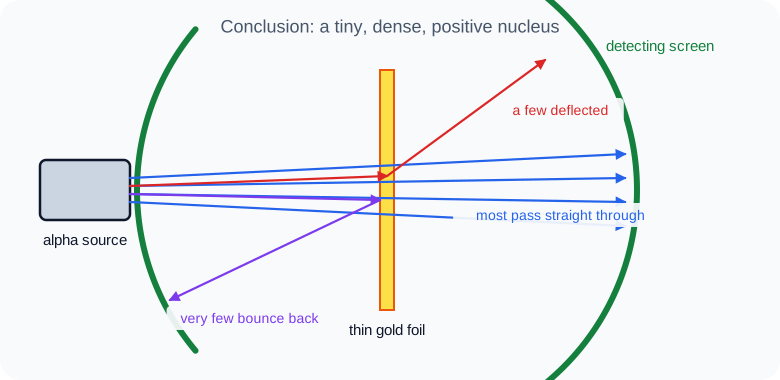
Figure 1. Rutherford's gold foil experiment. WASSCE Tutor diagram.
What the gold foil results showed:
- Most alpha particles passed straight through, so the atom is mostly empty space.
- A few were deflected, so there is a positive centre that repels the positive alpha particles.
- A very few bounced back, so this centre, the nucleus, is very small but holds almost all the mass.
The structure of the atom
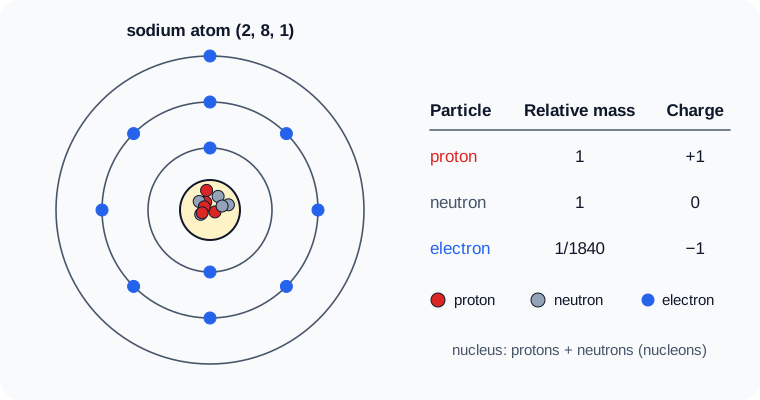
Figure 2. The particles in an atom. WASSCE Tutor diagram.
| Particle | Location | Relative mass | Relative charge |
|---|---|---|---|
| Proton | Nucleus | 1 | +1 |
| Neutron | Nucleus | 1 | 0 |
| Electron | Shells around the nucleus | (almost 0) | −1 |
A neutral atom has equal numbers of protons and electrons, so its charges cancel.
Atomic number and mass number
- Atomic number (Z): the number of protons in the nucleus of an atom. It identifies the element.
- Mass number (A): the total number of protons + neutrons (nucleons) in the nucleus.
- Number of neutrons .
Nuclide notation writes the mass number at the top left and the atomic number at the bottom left of the symbol:
Counting particles.
| Species | Protons | Neutrons | Electrons |
|---|---|---|---|
| atom | 11 | 23 − 11 = 12 | 11 (neutral atom) |
| ion | 11 | 12 | 11 − 1 = 10 (lost one) |
| ion | 8 | 16 − 8 = 8 | 8 + 2 = 10 (gained two) |
| ion | 13 | 27 − 13 = 14 | 13 − 3 = 10 (lost three) |
A positive ion has lost electrons; a negative ion has gained electrons. The protons never change in a chemical reaction.
Isotopes
Isotopes are atoms of the same element with the same atomic number (same number of protons) but different mass numbers (different numbers of neutrons).
| Element | Isotopes |
|---|---|
| Hydrogen | ¹H (protium, 0 neutrons), ²H (deuterium, 1 neutron), ³H (tritium, 2 neutrons) |
| Carbon | ¹²C (6 neutrons), ¹³C (7), ¹⁴C (8, radioactive) |
| Chlorine | ³⁵Cl (18 neutrons), ³⁷Cl (20 neutrons) |
| Oxygen | ¹⁶O, ¹⁷O, ¹⁸O |
- Isotopes have the same chemical properties, because chemistry depends on electrons, and isotopes have the same number of electrons.
- They differ in physical properties that depend on mass, such as density and rate of diffusion.
- Some isotopes, such as carbon-14, are radioactive (next lesson).
Isotopes differ in the number of neutrons, not protons. If the number of protons changes, the atom becomes a different element.
The diamonds mined in Kono are pure carbon, made mostly of carbon-12 atoms with about 1% carbon-13. Every carbon atom, in a diamond, in charcoal or in your body, has exactly 6 protons.
Key points
- Dalton's theory pictured indivisible atoms; it was modified after the discovery of subatomic particles, isotopes and nuclear reactions.
- Thomson found the electron, Rutherford the nucleus, Chadwick the neutron.
- Protons (+1, mass 1) and neutrons (0, mass 1) are in the nucleus; electrons (−1, mass 1/1840) are in shells.
- Atomic number = protons; mass number = protons + neutrons; neutrons = A − Z.
- Isotopes: same protons, different neutrons; same chemical properties.
WASSCE examination focus
Expect to state Dalton's postulates and their modifications, to explain the gold foil results, to calculate protons, neutrons and electrons in atoms and ions from nuclide notation, and to define isotopes with examples. Show A − Z working for neutrons.
Quick check
- State two postulates of Dalton's atomic theory that have been modified.
- Which observation in the gold foil experiment showed that the atom is mostly empty space?
- How many protons, neutrons and electrons are in ?
- Why do isotopes of an element have the same chemical properties?
Answers:
- Any two: atoms are indivisible; atoms of the same element are identical; atoms cannot be created or destroyed; atoms combine in simple ratios.
- Most alpha particles passed straight through the foil.
- 19 protons, 39 − 19 = 20 neutrons, 19 − 1 = 18 electrons.
- They have the same number of electrons, and chemical properties depend on electrons.
Keep going with atomic structure
This is one of 2 lessons in Atomic Structure. Start free with the first lesson of every topic, then unlock them all, plus exam-style practice marked instantly and guided learning tools, from 25 NLe.
- Free account, no card needed
- Everything from 25 NLe
- No automatic renewal
More lessons in Atomic Structure
- Relative atomic mass and radioactivity🔒