WASSCE Chemistry · Aluminium and Group III Metals
Aluminium: extraction from bauxite
By the WASSCE Tutor team
Updated 12 November 2026 · 7 min read · Prepared against the WASSCE syllabus.
Aluminium is the most abundant metal in the earth's crust, yet 200 years ago it was more precious than gold, because nobody could extract it cheaply. Electrolysis changed that. This lesson covers how aluminium is extracted from bauxite: first purifying the ore, then electrolysing it. It shows why the process needs so much electricity.
Learning objectives
By the end of this lesson you should be able to:
- state the occurrence of aluminium and name its main ore
- explain why aluminium is extracted by electrolysis
- describe the purification of bauxite (the Bayer process)
- describe the electrolytic extraction of aluminium, including the role of cryolite
- write the electrode equations and explain why the anodes are replaced
- calculate the mass of aluminium produced using Faraday's laws
Occurrence
- About 8% of the earth's crust: the most abundant metal.
- Never found free, because it is too reactive.
- Main ore: bauxite, impure hydrated aluminium oxide, Al₂O₃·2H₂O. Its main impurities are iron(III) oxide (which colours it red-brown) and silica (sand).
- Also in clays and many rocks, but extraction from these is not economic.
Why electrolysis?
Aluminium is above carbon in the reactivity series, so carbon cannot reduce aluminium oxide at a practical temperature. Its oxide is very stable. It must be extracted by electrolysis.
Stage 1: purifying bauxite (Bayer process)
The electrolysis needs pure aluminium oxide (alumina). Bauxite is purified using the amphoteric nature of aluminium oxide:
- Crushed bauxite is heated under pressure with concentrated sodium hydroxide solution. Aluminium oxide dissolves (it is amphoteric), forming sodium aluminate:
- Iron(III) oxide does not dissolve (it is basic). It is filtered off as "red mud".
- The solution is cooled and seeded with crystals of aluminium hydroxide, which precipitates:
- The aluminium hydroxide is filtered, washed and heated to give pure alumina:
Stage 2: electrolysis (Hall–Héroult process)
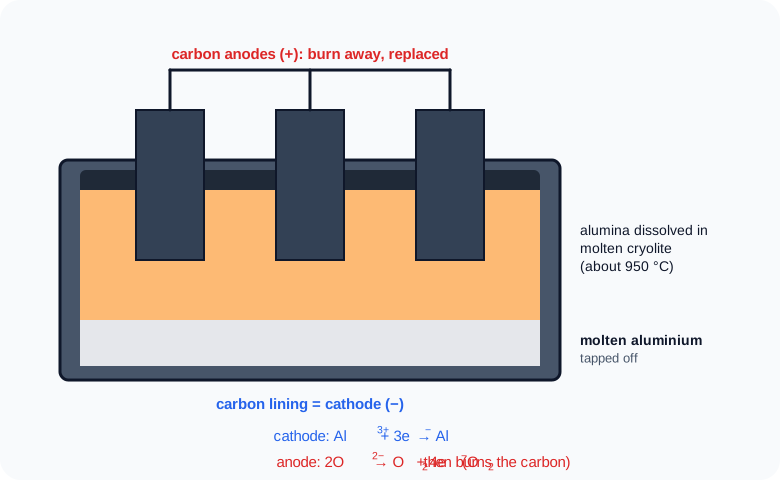
Figure 1. Extracting aluminium by electrolysis. WASSCE Tutor diagram.
| Feature | Detail and reason |
|---|---|
| Electrolyte | Alumina dissolved in molten cryolite (Na₃AlF₆) |
| Why cryolite? | Pure alumina melts at about 2050 °C. Dissolved in cryolite, it can be electrolysed at about 950 °C, saving a great deal of energy, and the molten mixture conducts better |
| Cathode (−) | Carbon lining of the steel tank |
| Anodes (+) | Large carbon (graphite) blocks |
| Product | Molten aluminium sinks to the bottom and is tapped off |
Electrode reactions:
- Cathode (reduction): Al³⁺ + 3e⁻ → Al
- Anode (oxidation): 2O²⁻ → O₂ + 4e⁻
Overall: 2Al₂O₃ → 4Al + 3O₂
Why the anodes must be replaced: at about 950 °C, the oxygen formed at the anodes reacts with the carbon, burning them away as carbon(IV) oxide (C + O₂ → CO₂). The anodes become thinner and are replaced regularly.
Energy and cost
Each mole of aluminium (27 g) needs 3 moles of electrons (3 faradays), and the cell must be kept molten. The process uses enormous amounts of electricity, so aluminium smelters are built near cheap electricity, especially hydroelectric power stations.
What mass of aluminium is produced by a current of 100 000 A flowing for 1 hour? (Al = 27, F = 96 500 C/mol)
- C
- Moles of electrons mol
- Al³⁺ + 3e⁻ → Al, so moles of Al mol
- Mass g kg
One cell running for an hour makes only about 34 kg of aluminium.
Recycling aluminium needs only about 5% of the energy used to extract it from bauxite, which is why collecting old cans and scrap pays.
Sierra Leone mines bauxite in the Moyamba district, and the ore is exported for processing. Building a smelter would need a very large and reliable electricity supply, far more than the country now generates, which is why the value-adding step happens abroad. The red-brown colour of the ore comes from its iron(III) oxide impurity, the "red mud" removed in the Bayer process.
Cryolite is not the ore of aluminium, and it is not used up. It is a solvent that lowers the working temperature from about 2050 °C to about 950 °C.
Key points
- Aluminium is the most abundant metal in the crust; its ore is bauxite, Al₂O₃·2H₂O.
- It is above carbon in the reactivity series, so it is extracted by electrolysis.
- Bayer process: bauxite + hot conc. NaOH → sodium aluminate; Fe₂O₃ filtered off; Al(OH)₃ precipitated and heated to pure Al₂O₃.
- Electrolysis: Al₂O₃ in molten cryolite at about 950 °C; carbon anodes and cathode lining. Cathode: Al³⁺ + 3e⁻ → Al. Anode: 2O²⁻ → O₂ + 4e⁻.
- Anodes burn away (C + O₂ → CO₂) and must be replaced.
- The process uses huge amounts of electricity; recycling saves about 95% of the energy.
WASSCE examination focus
Expect to describe the extraction of aluminium (purification and electrolysis) with equations, to explain the role of cryolite and why the anodes are replaced, and to calculate the mass of aluminium produced using Faraday's laws. Questions often ask why aluminium is not extracted with carbon.
Quick check
- Why is aluminium not extracted by heating its oxide with carbon?
- What is the purpose of cryolite in the extraction?
- Write the equation for the reaction at the cathode.
- Why must the carbon anodes be replaced regularly?
Answers:
- Aluminium is more reactive than carbon (above it in the reactivity series), so carbon cannot reduce its oxide.
- It dissolves the alumina and lowers the working temperature from about 2050 °C to about 950 °C, saving energy.
- Al³⁺ + 3e⁻ → Al.
- The oxygen formed at the anodes reacts with the hot carbon and burns it away as CO₂.
Keep going with aluminium and group iii metals
This is one of 2 lessons in Aluminium and Group III Metals. Start free with the first lesson of every topic, then unlock them all, plus exam-style practice marked instantly and guided learning tools, from 25 NLe.
- Free account, no card needed
- Everything from 25 NLe
- No automatic renewal
More lessons in Aluminium and Group III Metals
- Aluminium: properties, compounds and uses🔒