WASSCE Chemistry · Alkynes
Alkynes: ethyne, its preparation and properties
By the WASSCE Tutor team
Updated 12 November 2026 · 7 min read · Prepared against the WASSCE syllabus.
A welder cutting steel uses a flame hot enough to melt it: around 3,000 °C. The fuel is ethyne (acetylene), the simplest alkyne, burned in pure oxygen. Alkynes contain a carbon–carbon triple bond. This lesson covers their structure and the preparation and properties of ethyne.
Learning objectives
By the end of this lesson you should be able to:
- state the general formula of the alkynes and name the first members
- describe the structure and shape of the C≡C triple bond
- describe the laboratory preparation of ethyne from calcium carbide
- explain how calcium carbide is manufactured
- describe the physical properties and combustion of ethyne
- state the uses of ethyne
Structure and names
Alkynes are unsaturated hydrocarbons that contain one carbon–carbon triple bond (C≡C). General formula: CₙH₂ₙ₋₂.
| Name | Molecular formula | Condensed formula | Boiling point |
|---|---|---|---|
| Ethyne (acetylene) | C₂H₂ | HC≡CH | −84 °C (sublimes) |
| Propyne | C₃H₄ | CH₃C≡CH | −23 °C |
| But-1-yne | C₄H₆ | HC≡CCH₂CH₃ | 8 °C |
| But-2-yne | C₄H₆ | CH₃C≡CCH₃ | 27 °C |
The triple bond is made of one σ bond and two π bonds. The two π bonds make alkynes highly unsaturated: they can add two molecules of hydrogen or bromine.
Shape. The two carbons of the triple bond and the atoms attached to them lie in a straight line: ethyne is a linear molecule with bond angles of 180° (sp hybridisation).
The C≡C bond (0.120 nm) is shorter and stronger than C=C (0.134 nm), which is shorter and stronger than C–C (0.154 nm).
Laboratory preparation of ethyne
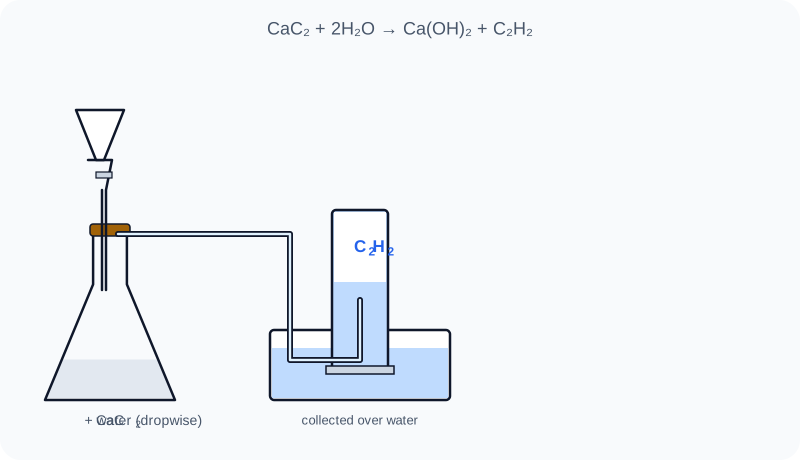
Figure 1. Preparing ethyne from calcium carbide and water. WASSCE Tutor diagram.
Drip water from a dropping funnel onto lumps of calcium carbide (CaC₂) in a flask. No heating is needed:
- Water is added drop by drop because the reaction is vigorous and exothermic.
- Ethyne is collected over water.
- Gas made from commercial carbide smells of garlic because of impurities such as phosphine (PH₃) and hydrogen sulphide; these can be removed by passing the gas through acidified copper(II) sulphate solution.
- Pure ethyne is odourless.
Manufacture of calcium carbide
Calcium carbide is made by heating calcium oxide (quicklime) with coke in an electric furnace at about 2,000 °C:
The calcium oxide comes from heating limestone. Ethyne can also be made industrially by heating methane strongly for a very short time.
Physical properties of ethyne
- Colourless gas, odourless when pure
- Slightly less dense than air
- Slightly soluble in water, very soluble in acetone (propanone)
- Explosive under pressure: it is stored in cylinders dissolved in propanone and soaked into a porous material
Combustion
In plenty of oxygen, ethyne burns with an extremely hot flame:
In air, ethyne burns with a very luminous, very sooty flame, because it has a very high proportion of carbon (92.3% by mass).
| Hydrocarbon | % carbon by mass | Flame in air |
|---|---|---|
| Ethane, C₂H₆ | 80.0% | Blue, non-luminous, clean |
| Ethene, C₂H₄ | 85.7% | Luminous, slightly smoky |
| Ethyne, C₂H₂ | 92.3% | Very luminous, very sooty |
Uses of ethyne
- Oxy-acetylene flame (about 3,000 °C) for welding and cutting metals
- Carbide lamps: once used by miners and fishermen, burning ethyne from carbide and water
- Making chloroethene (for PVC), ethanal and ethanoic acid
- Ripening fruit (calcium carbide is misused for this; see below)
Volume of ethyne from carbide. What volume of ethyne at s.t.p. is produced when 16 g of calcium carbide reacts with excess water? (CaC₂ = 64; molar volume = 22.4 dm³)
- Moles of CaC₂ mol
- 1 mol CaC₂ gives 1 mol C₂H₂, so moles of ethyne mol
- Volume dm³
Some fruit sellers in West Africa use calcium carbide ("carbide") to ripen mangoes and bananas quickly. Moisture turns it into ethyne, which acts like ethene. But commercial carbide contains arsenic and phosphorus impurities, and its use on food is banned in many countries. Fruit ripened this way can look ripe outside but taste unripe inside. Natural ripening, or ripening with controlled ethene, is safer.
Ethyne is made from calcium carbide, CaC₂, not calcium carbonate, CaCO₃. Read the formula carefully.
Key points
- Alkynes, CₙH₂ₙ₋₂, contain a C≡C triple bond (one σ and two π bonds) and are linear around it (180°).
- Ethyne is prepared by dripping water onto calcium carbide: CaC₂ + 2H₂O → Ca(OH)₂ + C₂H₂; collected over water.
- CaC₂ is made from CaO and coke in an electric furnace.
- Ethyne burns in air with a very sooty flame (92.3% C) and in oxygen at about 3,000 °C (welding).
- It is stored dissolved in propanone because it explodes under pressure.
WASSCE examination focus
Expect to describe the laboratory preparation of ethyne with an equation and a labelled diagram, to give the general formula and structure of the alkynes, to state uses of ethyne (especially the oxy-acetylene flame) and to calculate gas volumes from the mass of calcium carbide.
Quick check
- Write the general formula of the alkynes.
- Write the equation for the preparation of ethyne.
- What is the shape of the ethyne molecule, and what are its bond angles?
- Why does ethyne burn with a sootier flame than ethane?
Answers:
- CₙH₂ₙ₋₂.
- CaC₂ + 2H₂O → Ca(OH)₂ + C₂H₂.
- Linear; 180°.
- Ethyne has a much higher proportion of carbon (92.3% against 80%), so some carbon is not completely burned in air.
Keep going with alkynes
This is one of 2 lessons in Alkynes. Start free with the first lesson of every topic, then unlock them all, plus exam-style practice marked instantly and guided learning tools, from 25 NLe.
- Free account, no card needed
- Everything from 25 NLe
- No automatic renewal
More lessons in Alkynes
- Reactions of ethyne; comparing alkanes, alkenes and alkynes🔒