WASSCE Chemistry · Alkenes
Alkenes: structure, preparation and properties
By the WASSCE Tutor team
Updated 12 November 2026 · 7 min read · Prepared against the WASSCE syllabus.
Put an unripe banana in a closed bag with a ripe one and it ripens faster. The ripe fruit gives off ethene, the simplest alkene. Alkenes contain a carbon–carbon double bond, which makes them far more reactive than alkanes and makes them the starting point for plastics, ethanol and many other products.
Learning objectives
By the end of this lesson you should be able to:
- state the general formula of the alkenes and name the first members
- describe the structure and shape of the C=C double bond
- draw and name the isomers of butene, including cis–trans isomers
- describe the laboratory preparation of ethene
- state the sources of alkenes and the physical properties of ethene
Structure and names
Alkenes are unsaturated hydrocarbons that contain one carbon–carbon double bond (C=C). General formula: CₙH₂ₙ.
| Name | Molecular formula | Condensed formula | Boiling point |
|---|---|---|---|
| Ethene | C₂H₄ | CH₂=CH₂ | −104 °C |
| Propene | C₃H₆ | CH₃CH=CH₂ | −48 °C |
| But-1-ene | C₄H₈ | CH₂=CHCH₂CH₃ | −6 °C |
| But-2-ene | C₄H₈ | CH₃CH=CHCH₃ | 1–4 °C (cis and trans) |
| Pent-1-ene | C₅H₁₀ | CH₂=CH(CH₂)₂CH₃ | 30 °C |
There is no "methene": a double bond needs at least two carbon atoms.
The C=C bond. The double bond is made of one strong σ (sigma) bond and one weaker π (pi) bond. The π bond breaks easily, which is why alkenes undergo addition reactions.
Shape. The two carbons of the double bond and the four atoms attached to them all lie in one plane, with bond angles of about 120° (sp² hybridisation). The π bond prevents rotation about the C=C bond.
Isomerism in alkenes
C₄H₈ has these alkene isomers:
| Structure | Name | Type of isomerism |
|---|---|---|
| CH₂=CHCH₂CH₃ | But-1-ene | Position isomer of but-2-ene |
| CH₃CH=CHCH₃ (both CH₃ on the same side) | cis-But-2-ene | Geometric (cis) |
| CH₃CH=CHCH₃ (CH₃ groups on opposite sides) | trans-But-2-ene | Geometric (trans) |
| CH₂=C(CH₃)CH₃ | 2-Methylpropene | Chain isomer |
Cis–trans isomerism needs two different groups on each carbon of the double bond. Propene (CH₃CH=CH₂) has two H atoms on one carbon, so it has no cis–trans isomers.
Laboratory preparation of ethene
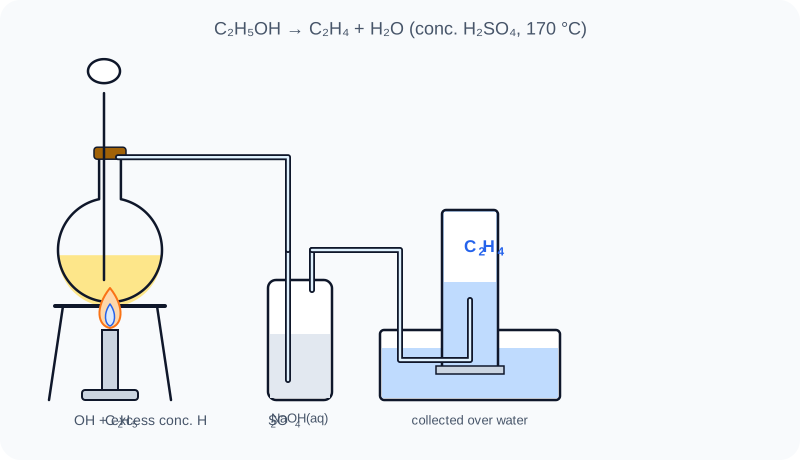
Figure 1. Preparing ethene by dehydrating ethanol. WASSCE Tutor diagram.
Heat ethanol with excess concentrated sulphuric acid at about 170 °C. The acid acts as a dehydrating agent, removing water from ethanol:
- The gas is passed through sodium hydroxide solution to remove sulphur(IV) oxide and carbon(IV) oxide, formed when the acid oxidises some ethanol.
- Ethene is collected over water, as it is only slightly soluble.
- Broken porcelain (or sand) is added so that the mixture boils smoothly.
- If the temperature is only about 140 °C, the main product is ethoxyethane (an ether), not ethene.
Alternative method: pass ethanol vapour over heated aluminium oxide (or broken porcelain) at about 350 °C:
Industrial source: almost all ethene and propene are made by cracking naphtha or ethane from crude oil and natural gas (see the Petroleum topic).
Physical properties of ethene
- Colourless gas with a faint sweet smell
- Slightly less dense than air
- Almost insoluble in water; soluble in organic solvents
- Burns with a luminous, slightly smoky flame, because it has a higher proportion of carbon than ethane
Percentage of carbon. Compare ethane and ethene (C = 12, H = 1).
- Ethane, C₂H₆ (Mᵣ = 30): % C
- Ethene, C₂H₄ (Mᵣ = 28): % C
The higher carbon content of ethene explains its smokier flame.
Traders at markets such as Dove Cot or Bo's main market sometimes ripen bananas, plantains and mangoes by wrapping them with a ripe fruit or storing them in closed sacks. The ripe fruit releases ethene, a plant hormone, which speeds up ripening of the rest. Commercial ripening rooms use controlled amounts of ethene gas.
The temperature matters in the ethanol and sulphuric acid reaction. At 170 °C (excess acid) ethene is formed; at 140 °C (excess ethanol) ethoxyethane is formed instead.
Key points
- Alkenes, CₙH₂ₙ, contain one C=C (a σ and a π bond); they are unsaturated.
- Atoms around the C=C are planar with angles of about 120°; there is no rotation about the double bond, which allows cis–trans isomerism.
- Ethene is prepared by dehydrating ethanol with excess conc. H₂SO₄ at 170 °C (or over hot Al₂O₃); impurities are removed with NaOH(aq); collected over water.
- Industrially, alkenes come from cracking.
- Ethene burns with a smokier flame than ethane (higher % carbon).
WASSCE examination focus
Expect to describe the laboratory preparation of ethene (reagents, conditions, purification, collection and equation), to name and draw alkenes and their isomers, and to explain why the alkenes are unsaturated. The role of the concentrated sulphuric acid (dehydrating agent) and of the NaOH wash are frequently asked.
Quick check
- Write the general formula of the alkenes.
- What is the role of concentrated sulphuric acid in the preparation of ethene?
- Why is the gas passed through sodium hydroxide solution?
- Why does propene not show cis–trans isomerism?
Answers:
- CₙH₂ₙ.
- It is a dehydrating agent: it removes water from ethanol.
- To remove the acidic impurities sulphur(IV) oxide and carbon(IV) oxide.
- One carbon of its double bond carries two identical groups (two hydrogen atoms).
Keep going with alkenes
This is one of 2 lessons in Alkenes. Start free with the first lesson of every topic, then unlock them all, plus exam-style practice marked instantly and guided learning tools, from 25 NLe.
- Free account, no card needed
- Everything from 25 NLe
- No automatic renewal
More lessons in Alkenes
- Addition reactions and tests for unsaturation🔒