WASSCE Chemistry · Alkanols
Alkanols: classes, naming and making ethanol
By the WASSCE Tutor team
Updated 12 November 2026 · 8 min read · Prepared against the WASSCE syllabus.
Palm wine left in the sun grows stronger by the hour; distilled, it becomes a much stronger local spirit. Both contain ethanol, the best-known member of the alkanols (alcohols). This lesson covers the alkanol family, how alkanols are classified and named, their physical properties, and how ethanol is made.
Learning objectives
By the end of this lesson you should be able to:
- state the general formula and functional group of the alkanols
- name alkanols and classify them as primary, secondary or tertiary
- explain the physical properties of alkanols in terms of hydrogen bonding
- describe the production of ethanol by fermentation, with equations
- describe the industrial production of ethanol from ethene
- explain how ethanol is concentrated by fractional distillation
Structure and names
Alkanols are organic compounds containing the hydroxyl group, –OH, attached to a saturated carbon atom. General formula: CₙH₂ₙ₊₁OH (or ROH).
| Name | Formula | Boiling point |
|---|---|---|
| Methanol | CH₃OH | 65 °C |
| Ethanol | C₂H₅OH | 78 °C |
| Propan-1-ol | CH₃CH₂CH₂OH | 97 °C |
| Propan-2-ol | CH₃CH(OH)CH₃ | 82 °C |
| Butan-1-ol | CH₃(CH₂)₃OH | 118 °C |
The –OH in an alkanol is covalently bonded; it is not a hydroxide ion. Alkanols are neutral to litmus.
Primary, secondary and tertiary alkanols
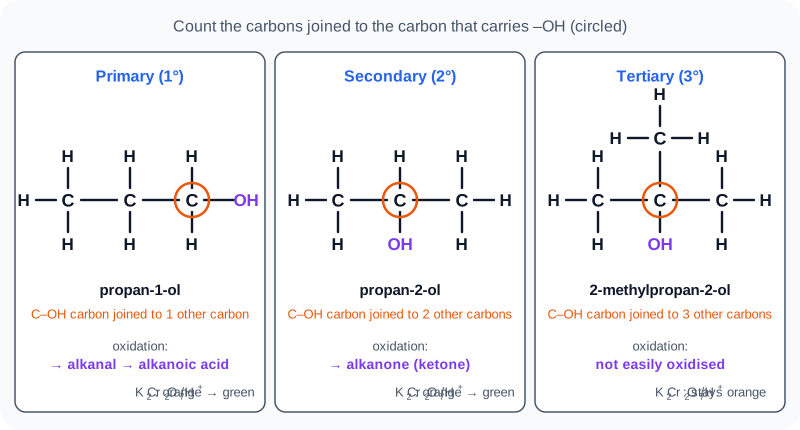
Figure 1. Classifying alkanols by the carbon that carries –OH. WASSCE Tutor diagram.
| Class | The C–OH carbon is joined to | Example | On oxidation |
|---|---|---|---|
| Primary (1°) | One other carbon (or none, in methanol) | Ethanol, propan-1-ol | Alkanal, then alkanoic acid |
| Secondary (2°) | Two other carbons | Propan-2-ol | Alkanone (ketone) |
| Tertiary (3°) | Three other carbons | 2-Methylpropan-2-ol | Not easily oxidised |
Polyhydric alkanols have more than one –OH group: ethane-1,2-diol (antifreeze) has two; propane-1,2,3-triol (glycerol), found in fats and oils, has three.
Physical properties
- Higher boiling points than alkanes of similar relative molecular mass. Ethanol (Mᵣ 46) boils at 78 °C; propane (Mᵣ 44) boils at −42 °C. Alkanol molecules form hydrogen bonds with each other through their –OH groups.
- Soluble in water: methanol, ethanol and propanol mix with water in all proportions, because they form hydrogen bonds with water molecules. Solubility falls as the hydrocarbon chain grows.
- Lower alkanols are colourless, volatile liquids with a characteristic smell.
- Boiling point rises with chain length; branched isomers boil lower.
Making ethanol by fermentation
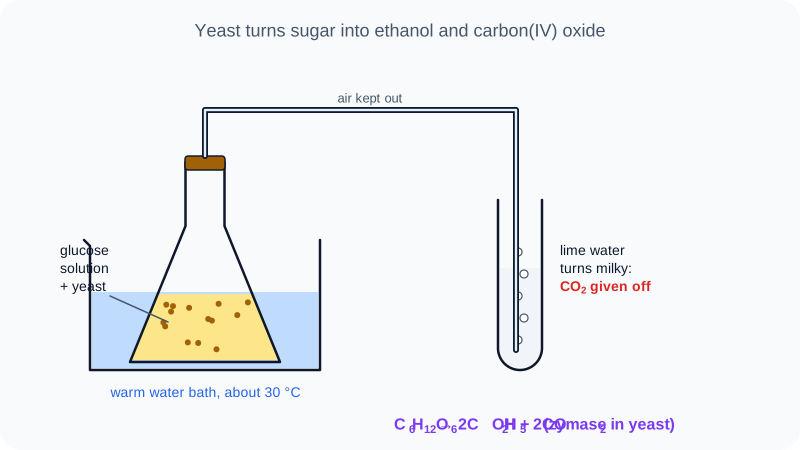
Figure 2. Fermentation of glucose by yeast. WASSCE Tutor diagram.
Fermentation is the breakdown of sugars by enzymes from yeast or other micro-organisms, without air, to form ethanol and carbon(IV) oxide.
Starting from starch (cassava, maize, rice, millet):
- Malt (germinated grain) supplies the enzyme diastase, which turns starch into maltose:
- Maltase (in yeast) turns maltose into glucose:
- Zymase (in yeast) turns glucose into ethanol and carbon(IV) oxide:
Conditions: a temperature of about 25–35 °C (enzymes are destroyed above about 40 °C and work slowly when cold), no air (otherwise the ethanol is oxidised to ethanoic acid), and yeast. Sugar (sucrose) from sugar cane needs only the enzyme invertase to give glucose and fructose.
Concentrating the ethanol: fermentation stops at about 14–15% ethanol, because more ethanol kills the yeast. The mixture is filtered and fractionally distilled to give up to 95% ethanol. Absolute (100%) ethanol is obtained by removing the last water with quicklime (CaO).
Industrial ethanol from ethene
Most industrial ethanol is made by hydrating ethene with steam over phosphoric(V) acid at about 300 °C and 60 atm:
| Fermentation | Hydration of ethene | |
|---|---|---|
| Raw material | Renewable (sugar, starch) | Non-renewable (crude oil) |
| Process | Batch, slow | Continuous, fast |
| Product | Dilute; needs distillation | Pure ethanol |
| Energy and cost | Low temperature; cheap equipment | High temperature and pressure |
Methanol is made industrially from synthesis gas (carbon(II) oxide and hydrogen) over a catalyst:
Mass of ethanol from glucose. What mass of ethanol is formed from 90 g of glucose? (C = 12, H = 1, O = 16)
- Mᵣ of glucose C₆H₁₂O₆ ; moles mol
- Ratio glucose : ethanol , so ethanol mol
- Mᵣ of ethanol ; mass g
Palm wine is tapped from oil palms and raffia palms across Sierra Leone. Natural yeasts in the sap start fermenting it at once, so it becomes stronger during the day, then sour as ethanol is oxidised to ethanoic acid. Distilling fermented palm wine or sugar-cane juice gives the strong local spirit omole. Poorly controlled distillation can also collect methanol, which is poisonous and can cause blindness.
Ethanol's –OH group is not a hydroxide ion. Ethanol does not turn red litmus blue and does not react with acids like an alkali.
Key points
- Alkanols, CₙH₂ₙ₊₁OH, contain the –OH group; they are neutral.
- Primary, secondary, tertiary: the C–OH carbon is joined to one, two or three other carbons.
- Hydrogen bonding gives alkanols high boiling points and water solubility.
- Fermentation: starch → maltose (diastase) → glucose (maltase) → ethanol + CO₂ (zymase), at 25–35 °C without air; distil to concentrate.
- Industrially, ethanol also comes from ethene + steam (H₃PO₄ catalyst).
WASSCE examination focus
Expect to describe the preparation of ethanol by fermentation (enzymes, equations and conditions), to classify and name alkanols, to explain boiling points and solubility using hydrogen bonding, and to calculate masses from fermentation equations. Comparing fermentation with hydration of ethene is a common essay question.
Quick check
- Name the enzyme that converts glucose into ethanol.
- Why must air be kept out during fermentation?
- Classify propan-2-ol and explain your answer.
- Why does ethanol have a much higher boiling point than propane, although their Mᵣ values are similar?
Answers:
- Zymase.
- Oxygen would oxidise the ethanol to ethanoic acid (vinegar).
- Secondary: the carbon carrying –OH is joined to two other carbon atoms.
- Ethanol molecules form hydrogen bonds with each other; propane has only weak van der Waals forces.
Keep going with alkanols
This is one of 2 lessons in Alkanols. Start free with the first lesson of every topic, then unlock them all, plus exam-style practice marked instantly and guided learning tools, from 25 NLe.
- Free account, no card needed
- Everything from 25 NLe
- No automatic renewal
More lessons in Alkanols
- Reactions of alkanols and uses of ethanol🔒