WASSCE Chemistry · Alkanoic Acids
Alkanoic acids: structure, naming and ethanoic acid
By the WASSCE Tutor team
Updated 12 November 2026 · 7 min read · Prepared against the WASSCE syllabus.
The sharp taste of vinegar, the sting of an ant bite and the smell of rancid butter all come from alkanoic acids (carboxylic acids). They contain the carboxyl group, –COOH, and are weak acids. Their best-known member is ethanoic acid, the acid in vinegar.
Learning objectives
By the end of this lesson you should be able to:
- state the general formula and functional group of the alkanoic acids
- name and draw the first members of the series
- explain the physical properties of alkanoic acids
- explain why alkanoic acids are weak acids
- describe the laboratory and industrial preparation of ethanoic acid and the making of vinegar
Structure and names
Alkanoic acids are organic acids containing the carboxyl group, –COOH. General formula: CₙH₂ₙ₊₁COOH (n = 0, 1, 2 …), or RCOOH.
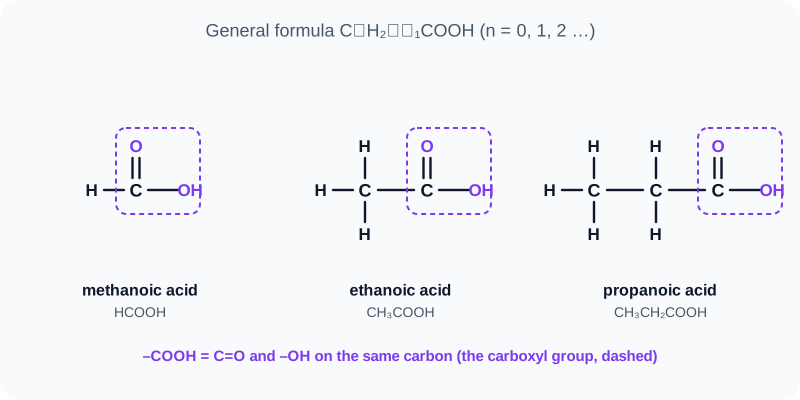
Figure 1. The first three alkanoic acids. WASSCE Tutor diagram.
The carboxyl group combines a carbonyl group (C=O) and a hydroxyl group (–OH) on the same carbon. The carbon of –COOH is counted in the name.
| Name | Formula | Boiling point | Found in |
|---|---|---|---|
| Methanoic acid | HCOOH | 101 °C | Ant stings, nettles |
| Ethanoic acid | CH₃COOH | 118 °C | Vinegar |
| Propanoic acid | C₂H₅COOH | 141 °C | Used as a food preservative |
| Butanoic acid | C₃H₇COOH | 164 °C | Rancid butter, sweat |
Long-chain (fatty) acids such as hexadecanoic (palmitic) acid, C₁₅H₃₁COOH, and octadecanoic (stearic) acid, C₁₇H₃₅COOH, are found combined in fats and oils. Palmitic acid is named after the oil palm.
Physical properties
- High boiling points, higher than alkanols of similar Mᵣ: the molecules form two hydrogen bonds with each other, making pairs (dimers).
- The first four are miscible with water (they hydrogen-bond with water); solubility falls as the chain grows.
- Small acids are colourless liquids with sharp, sour or unpleasant smells; long-chain acids are waxy solids.
- Pure ethanoic acid freezes at about 17 °C into ice-like crystals, so it is called glacial ethanoic acid.
Alkanoic acids are weak acids
In water, only a small fraction of ethanoic acid molecules ionise (about 1% in a 0.1 mol/dm³ solution):
So, compared with a strong acid (such as HCl) of the same concentration, ethanoic acid:
| Property | Hydrochloric acid, 0.1 mol/dm³ | Ethanoic acid, 0.1 mol/dm³ |
|---|---|---|
| Ionisation | Complete | Partial (about 1%) |
| pH | 1 | About 3 |
| Electrical conductivity | High | Low |
| Rate of reaction with magnesium | Fast fizzing | Slower fizzing |
The same amount of each acid still neutralises the same amount of alkali: as H⁺ ions are used up, more ethanoic acid molecules ionise.
Preparing ethanoic acid
Laboratory: oxidation of ethanol. Heat ethanol under reflux with excess acidified potassium dichromate(VI) (orange → green), then distil off the ethanoic acid:
Heating under reflux (with a vertical condenser) stops the volatile ethanol and ethanal escaping before they are fully oxidised.
Vinegar: bacterial oxidation. Bacteria (Acetobacter) in air oxidise dilute ethanol (wine, palm wine, cider) to ethanoic acid:
Vinegar contains about 4–8% ethanoic acid.
Industrial: mainly by reacting methanol with carbon(II) oxide over a rhodium or iridium catalyst:
Finding the formula of an alkanoic acid. An alkanoic acid has Mᵣ = 88. Find its formula and name. (C = 12, H = 1, O = 16)
For CₙH₂ₙ₊₁COOH: .
The acid is C₃H₇COOH, butanoic acid.
Palm wine that stands for a day or two turns sour: bacteria from the air oxidise its ethanol to ethanoic acid, the same change that turns wine into vinegar. Tappers in Sierra Leone sell fresh palm wine early, before it sours. Sour palm wine is sometimes used like vinegar in cooking.
Count every carbon, including the one in –COOH. CH₃COOH has two carbons, so it is ethanoic acid, not methanoic acid.
Key points
- Alkanoic acids, CₙH₂ₙ₊₁COOH, contain the carboxyl group –COOH (C=O plus –OH).
- Methanoic (ants), ethanoic (vinegar), propanoic, butanoic (rancid butter); fatty acids such as palmitic and stearic acid occur in fats.
- Hydrogen bonding (dimers) gives high boiling points; small acids are water-soluble.
- They are weak acids: only partly ionised, so pH is higher and conductivity lower than a strong acid of the same concentration.
- Ethanoic acid is made by oxidising ethanol (acidified K₂Cr₂O₇, reflux) or, as vinegar, by Acetobacter; industrially from methanol + CO.
WASSCE examination focus
Expect to name and draw alkanoic acids, to explain why ethanoic acid is a weak acid and compare it with hydrochloric acid, to describe the preparation of ethanoic acid from ethanol, and to find the formula of an acid from its relative molecular mass.
Quick check
- What is the functional group of the alkanoic acids?
- Name the acid with formula C₂H₅COOH.
- Why does 0.1 mol/dm³ ethanoic acid have a higher pH than 0.1 mol/dm³ hydrochloric acid?
- Why is ethanol heated under reflux when it is oxidised to ethanoic acid?
Answers:
- The carboxyl group, –COOH.
- Propanoic acid.
- Ethanoic acid is a weak acid: only a small fraction of its molecules ionise, so the H⁺ concentration is lower.
- So that volatile ethanol and ethanal condense and return to the flask until they are fully oxidised.
Keep going with alkanoic acids
This is one of 2 lessons in Alkanoic Acids. Start free with the first lesson of every topic, then unlock them all, plus exam-style practice marked instantly and guided learning tools, from 25 NLe.
- Free account, no card needed
- Everything from 25 NLe
- No automatic renewal
More lessons in Alkanoic Acids
- Reactions of alkanoic acids🔒