WASSCE Chemistry · Alkanoates and Esters
Esters: esterification and naming
By the WASSCE Tutor team
Updated 12 November 2026 · 8 min read · Prepared against the WASSCE syllabus.
The smell of a ripe banana, a pineapple or nail-varnish remover comes from esters (alkanoates). Esters form when an alkanoic acid reacts with an alkanol. This lesson covers how esters are made, how to name them, their properties and their uses.
Learning objectives
By the end of this lesson you should be able to:
- describe esterification, with the conditions and the role of concentrated sulphuric acid
- write equations for the formation of esters
- name esters and draw their structures from the parent acid and alkanol
- describe the physical properties and uses of esters
- explain how the yield of an ester can be increased
- identify functional group isomers of esters and acids
Esterification
Esterification is the reaction between an alkanoic acid and an alkanol to form an ester and water. It is slow and reversible, and is catalysed by concentrated sulphuric acid.
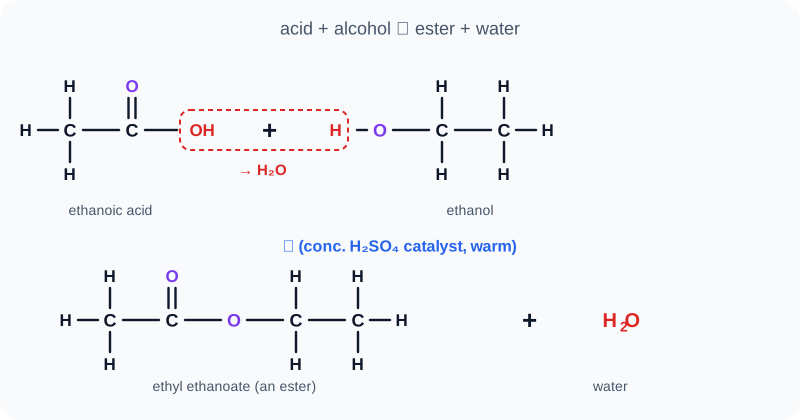
Figure 1. In esterification, water is lost between the acid and the alkanol. WASSCE Tutor diagram.
The –OH comes from the acid and the H from the alkanol's –OH group. The ester link –COO– joins the two parts.
Laboratory preparation of ethyl ethanoate:
- Mix ethanol and glacial ethanoic acid in a boiling tube or flask; add a few drops of concentrated sulphuric acid.
- Warm in a water bath (or heat under reflux) for several minutes.
- Pour into sodium carbonate solution to neutralise unreacted acid.
- An oily layer of ester floats on top, with a sweet, fruity smell.
Role of concentrated sulphuric acid:
- it is a catalyst (speeds up the reaction)
- it is a dehydrating agent: it absorbs the water formed, shifting the equilibrium to the right and increasing the yield
Naming esters
An ester name has two parts:
- the alkyl group from the alkanol, first (methyl, ethyl, propyl …)
- the acid part with -oic acid changed to -oate (methanoate, ethanoate, propanoate …)
So ethanol + ethanoic acid → ethyl ethanoate. When written as a formula, the acid part usually comes first: CH₃COO–C₂H₅.
| Ester | Formula | Made from | Smell or use |
|---|---|---|---|
| Methyl ethanoate | CH₃COOCH₃ | Methanol + ethanoic acid | Solvent |
| Ethyl ethanoate | CH₃COOC₂H₅ | Ethanol + ethanoic acid | Nail-varnish remover, glue solvent; pear drops |
| Ethyl methanoate | HCOOC₂H₅ | Ethanol + methanoic acid | Rum, raspberry flavour |
| Pentyl ethanoate | CH₃COOC₅H₁₁ | Pentan-1-ol + ethanoic acid | Banana |
| Octyl ethanoate | CH₃COOC₈H₁₇ | Octan-1-ol + ethanoic acid | Orange |
| Ethyl butanoate | C₃H₇COOC₂H₅ | Ethanol + butanoic acid | Pineapple |
Naming and drawing.
- Name CH₃CH₂COOCH₃. The acid part, CH₃CH₂COO–, has 3 carbons (propanoate); the alkyl part, –CH₃, is methyl. Name: methyl propanoate.
- Write the ester formed from propan-1-ol and ethanoic acid. Acid part: CH₃COO–; alkyl: –CH₂CH₂CH₃ (propyl). Ester: propyl ethanoate, CH₃COOCH₂CH₂CH₃.
Physical properties
- Colourless, volatile liquids (small esters) with sweet, fruity smells.
- Insoluble (or only slightly soluble) in water; they float on water.
- Lower boiling points than the acids they come from, because esters cannot form hydrogen bonds with each other (no O–H group). Ethyl ethanoate (Mᵣ 88) boils at 77 °C; butanoic acid (Mᵣ 88) boils at 164 °C.
- Good solvents for oils, fats, varnishes and plastics.
Isomerism between acids and esters
Esters and alkanoic acids with the same number of carbons are functional group isomers. For C₃H₆O₂:
| Compound | Formula | Type |
|---|---|---|
| Propanoic acid | CH₃CH₂COOH | Alkanoic acid |
| Methyl ethanoate | CH₃COOCH₃ | Ester |
| Ethyl methanoate | HCOOCH₂CH₃ | Ester |
Only the acid fizzes with sodium hydrogencarbonate.
Increasing the yield
Esterification is an equilibrium: with equal moles of acid and alkanol, only about two-thirds is converted to ester. Following Le Chatelier's principle, the yield is increased by:
- using an excess of the cheaper reactant (usually the alkanol)
- removing water (concentrated H₂SO₄ absorbs it)
- distilling off the ester as it forms
Percentage yield. 6.0 g of ethanoic acid is warmed with excess ethanol and gives 5.28 g of ethyl ethanoate. Calculate the percentage yield. (CH₃COOH = 60; CH₃COOC₂H₅ = 88)
- Moles of acid mol, so the maximum ester is mol
- Theoretical mass g
- Percentage yield
Uses of esters
- Flavourings in sweets, soft drinks and ice cream
- Perfumes and cosmetics
- Solvents for nail varnish, glues, paints and inks (ethyl ethanoate)
- Plasticisers, which make plastics flexible
- Fats and oils are natural esters; polyesters (such as Terylene) are fibres for clothing
The bright fruit flavours of sweets, ice lollies and soft drinks sold in Sierra Leone usually come from synthetic esters, not from real fruit. A banana-flavoured sweet may contain pentyl ethanoate; a pineapple drink may contain ethyl butanoate. Ripe fruits make the same esters naturally as they ripen.
In the name, the alkanol part comes first (ethyl), but in the condensed formula the acid part is usually written first (CH₃COO–). CH₃COOC₂H₅ is ethyl ethanoate, and HCOOCH₃ is methyl methanoate.
Key points
- Acid + alkanol ⇌ ester + water, catalysed by conc. H₂SO₄ (catalyst and dehydrating agent); warm or reflux.
- The ester link is –COO–; the –OH comes from the acid.
- Name = alkyl (from alkanol) + -oate (from acid): ethyl ethanoate, methyl propanoate.
- Esters are volatile, fruity-smelling, insoluble in water, with lower boiling points than acids (no hydrogen bonding).
- Increase yield with excess reactant or by removing water or ester.
- Uses: flavourings, perfumes, solvents, plasticisers.
WASSCE examination focus
Expect to write equations for esterification, to state the role of concentrated sulphuric acid, to name esters from formulas and identify the parent acid and alkanol, to describe the laboratory preparation of ethyl ethanoate, and to calculate yields. Isomers of C₃H₆O₂ or C₄H₈O₂ (acids and esters) are also tested.
Quick check
- Name the ester formed from methanol and ethanoic acid.
- State two roles of concentrated sulphuric acid in esterification.
- Name the ester CH₃COOC₃H₇ and its parent alkanol.
- Why do esters have lower boiling points than alkanoic acids of similar Mᵣ?
Answers:
- Methyl ethanoate, CH₃COOCH₃.
- It acts as a catalyst and as a dehydrating agent that absorbs water, increasing the yield.
- Propyl ethanoate; propan-1-ol.
- Ester molecules have no O–H group, so they cannot form hydrogen bonds with each other.
Keep going with alkanoates and esters
This is one of 2 lessons in Alkanoates and Esters. Start free with the first lesson of every topic, then unlock them all, plus exam-style practice marked instantly and guided learning tools, from 25 NLe.
- Free account, no card needed
- Everything from 25 NLe
- No automatic renewal
More lessons in Alkanoates and Esters
- Hydrolysis of esters; fats and oils as esters🔒