WASSCE Chemistry · Alkanes
Alkanes: structure, naming and physical properties
By the WASSCE Tutor team
Updated 12 November 2026 · 7 min read · Prepared against the WASSCE syllabus.
The gas in a kitchen cylinder, the petrol in a motorbike and the wax of a candle are all alkanes, the simplest family of hydrocarbons. This lesson covers their structure and names, how their physical properties change along the series, where they come from, and the laboratory preparation of methane.
Learning objectives
By the end of this lesson you should be able to:
- state the general formula of the alkanes and name the first ten members
- describe the structure and shape of alkane molecules
- describe and explain the trends in physical properties of alkanes
- state the sources of alkanes, including natural gas and biogas
- describe the laboratory preparation of methane
Structure and names
Alkanes are saturated hydrocarbons: compounds of carbon and hydrogen only, with only single C–C bonds. General formula: CₙH₂ₙ₊₂.
| Name | Molecular formula | Condensed formula |
|---|---|---|
| Methane | CH₄ | CH₄ |
| Ethane | C₂H₆ | CH₃CH₃ |
| Propane | C₃H₈ | CH₃CH₂CH₃ |
| Butane | C₄H₁₀ | CH₃(CH₂)₂CH₃ |
| Pentane | C₅H₁₂ | CH₃(CH₂)₃CH₃ |
| Hexane | C₆H₁₄ | CH₃(CH₂)₄CH₃ |
| Heptane | C₇H₁₆ | CH₃(CH₂)₅CH₃ |
| Octane | C₈H₁₈ | CH₃(CH₂)₆CH₃ |
| Nonane | C₉H₂₀ | CH₃(CH₂)₇CH₃ |
| Decane | C₁₀H₂₂ | CH₃(CH₂)₈CH₃ |
At room temperature, methane to butane are gases, pentane to decane are liquids, and alkanes with more than about 17 carbon atoms are waxy solids (paraffin wax).
Shape: each carbon forms four single bonds arranged tetrahedrally (bond angle 109.5°, sp³ hybridisation). Long chains are therefore zigzag, not straight.
The alkyl group formed by removing one hydrogen is named with -yl: methyl (–CH₃), ethyl (–C₂H₅), propyl (–C₃H₇).
Physical properties
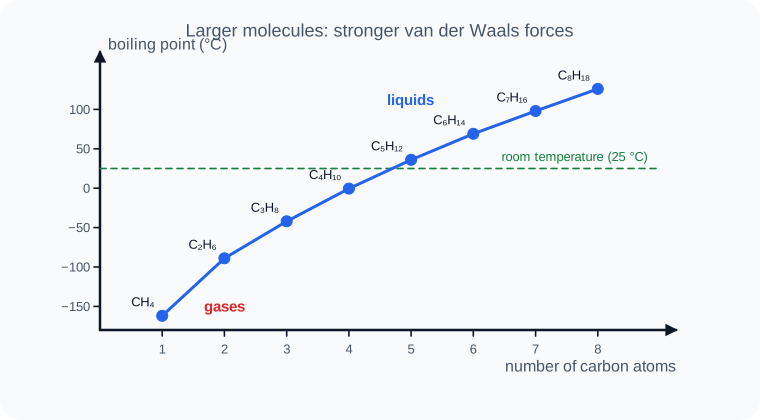
Figure 1. Boiling points rise with chain length. WASSCE Tutor diagram.
| Property | Trend or fact | Reason |
|---|---|---|
| Boiling and melting points | Rise as the chain gets longer | Larger molecules have stronger van der Waals forces between them |
| State | C₁–C₄ gases; C₅–C₁₇ liquids; larger ones solids | As above |
| Branching | Branched isomers boil lower than straight-chain ones | Branched molecules touch less, so forces between them are weaker |
| Solubility | Insoluble in water; soluble in organic solvents | Alkanes are non-polar |
| Density | Less dense than water (they float) | |
| Electrical conductivity | Non-conductors | No ions or free electrons |
Sources of alkanes
- Natural gas: mainly methane (70–95%), with ethane, propane and butane.
- Crude oil (petroleum): a mixture of hundreds of alkanes, separated by fractional distillation.
- Biogas: about 60% methane, made when bacteria break down animal dung, plant waste or sewage without air (anaerobic digestion).
- Marsh gas: methane bubbling from swamps and rice fields, where plant matter decays under water.
- Methane is also released by cattle digestion, landfill sites and coal mines (where it causes explosions).
Laboratory preparation of methane
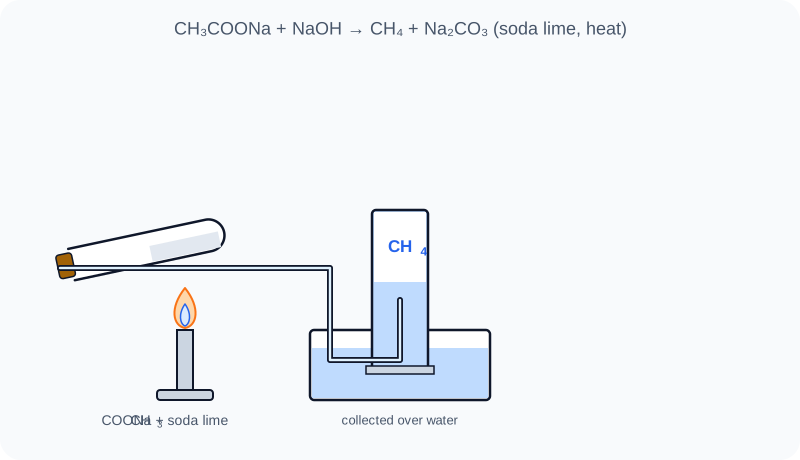
Figure 2. Preparing methane by heating sodium ethanoate with soda lime. WASSCE Tutor diagram.
Heat a mixture of anhydrous sodium ethanoate and soda lime (sodium hydroxide mixed with calcium oxide):
- Soda lime is used rather than sodium hydroxide alone because it is less deliquescent and does not attack the glass as much; the calcium oxide keeps the mixture dry.
- The test tube slopes slightly downwards towards the mouth.
- Methane is collected over water, because it is insoluble.
Properties of methane: colourless, odourless gas; lighter than air; insoluble in water; burns with a pale blue, non-luminous flame; forms explosive mixtures with air.
Identifying an alkane. A hydrocarbon has relative molecular mass 58 and is an alkane. Find its formula.
For an alkane, CₙH₂ₙ₊₂: .
The alkane is C₄H₁₀ (butane or 2-methylpropane).
Some farms and institutions in Sierra Leone have trialled biogas digesters, which turn cow dung and food waste into methane for cooking. The leftover slurry is a good fertiliser. Biogas reduces the need for firewood and charcoal and so helps protect forests.
Alkanes are not soluble in water, even though methane is a small molecule. They are non-polar and cannot form hydrogen bonds with water.
Key points
- Alkanes are saturated hydrocarbons, CₙH₂ₙ₊₂: methane, ethane, propane, butane, pentane …
- Bonds are tetrahedral (109.5°); chains are zigzag.
- Boiling points rise with chain length (stronger van der Waals forces); branching lowers boiling point; C₁–C₄ are gases.
- Alkanes are non-polar, insoluble in water and less dense than water.
- Sources: natural gas, crude oil, biogas.
- Methane: CH₃COONa + NaOH (soda lime) → CH₄ + Na₂CO₃; collected over water.
WASSCE examination focus
Expect to name and draw alkanes, to explain trends in boiling point, to describe the laboratory preparation of methane (reagents, equation, collection), and to find the formula of an alkane from its relative molecular mass using 14n + 2.
Quick check
- State the general formula of the alkanes.
- Why does the boiling point of alkanes rise with chain length?
- Why is soda lime used instead of sodium hydroxide alone in preparing methane?
- An alkane has Mᵣ = 86. Find its molecular formula.
Answers:
- CₙH₂ₙ₊₂.
- Larger molecules have stronger van der Waals forces between them, which need more energy to overcome.
- Soda lime is less deliquescent and attacks the glass less.
- , so n = 6: C₆H₁₄.
Keep going with alkanes
This is one of 2 lessons in Alkanes. Start free with the first lesson of every topic, then unlock them all, plus exam-style practice marked instantly and guided learning tools, from 25 NLe.
- Free account, no card needed
- Everything from 25 NLe
- No automatic renewal
More lessons in Alkanes
- Reactions of alkanes: combustion and substitution🔒