WASSCE Chemistry · Acid-Base Titration
Titration: apparatus, procedure and indicators
By the WASSCE Tutor team
Updated 12 November 2026 · 8 min read · Prepared against the WASSCE syllabus.
Titration is the single most important practical skill in WASSCE Chemistry: the volumetric analysis question carries heavy marks every year. It lets you measure the exact concentration of an acid or alkali by finding the volume needed to neutralise it. This lesson covers the apparatus, the procedure, reading and recording results, and choosing the right indicator.
Learning objectives
By the end of this lesson you should be able to:
- name the apparatus used in titration and describe how each is prepared
- describe the procedure for an acid–alkali titration
- read a burette correctly and record titration results in a table
- calculate an average titre from concordant results
- choose a suitable indicator for different acid–base titrations
- state precautions and sources of error
Apparatus
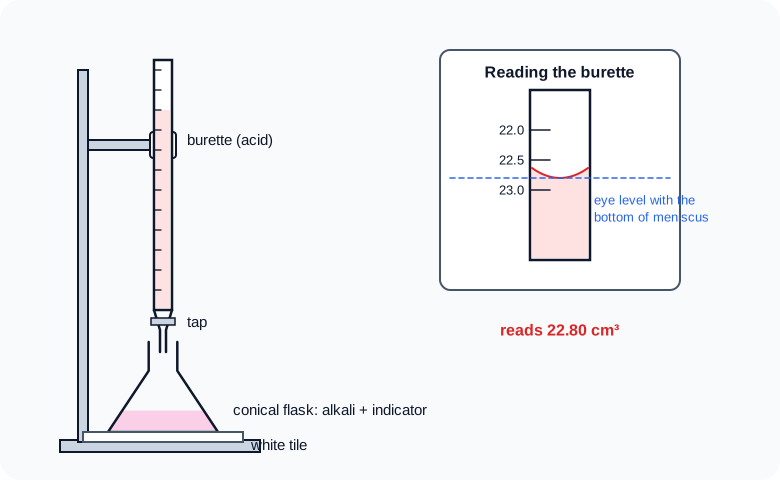
Figure 1. Titration apparatus and reading the burette. WASSCE Tutor diagram.
| Apparatus | Use | Rinse with |
|---|---|---|
| Burette (50 cm³) | Delivers measured, variable volumes of the solution in it (often the acid) | The solution it will hold |
| Pipette (25.0 cm³) | Delivers one exact, fixed volume (often the alkali) | The solution it will deliver |
| Conical flask | Holds the pipetted solution; easy to swirl without splashing | Distilled water only |
| White tile | Makes the colour change easy to see | |
| Retort stand and clamp | Holds the burette vertical | |
| Funnel | Fills the burette; remove it before reading |
Rinsing the burette and pipette with distilled water only would dilute the solution. Rinsing the conical flask with the solution would add extra moles. So the conical flask is rinsed with water, and the burette and pipette with the solutions they hold.
Procedure
- Rinse the burette with the acid, then fill it. Run some acid through the tap to remove air from the jet. Remove the funnel and record the initial reading.
- Rinse the pipette with the alkali. Use a pipette filler to draw the alkali up to the mark and run it into the conical flask.
- Add 2–3 drops of a suitable indicator.
- Place the flask on the white tile. Run in the acid while swirling the flask.
- Near the end point, add the acid drop by drop until the indicator just changes colour permanently. Record the final reading.
- The first run is a rough (trial) titration. Repeat accurately until you have at least two concordant titres, which agree within 0.10 cm³.
Reading and recording
- Read the burette at the bottom of the meniscus, with your eye level with it.
- Record readings to two decimal places, ending in 0 or 5 (e.g. 22.50, 22.45).
Titration of 25.0 cm³ of sodium hydroxide with hydrochloric acid, using methyl orange.
| Burette reading (cm³) | Rough | 1st | 2nd | 3rd |
|---|---|---|---|---|
| Final reading | 23.10 | 45.60 | 22.45 | 44.90 |
| Initial reading | 0.00 | 23.10 | 0.00 | 22.35 |
| Volume of acid used | 23.10 | 22.50 | 22.45 | 22.55 |
The rough titre is not used. The accurate titres 22.50, 22.45 and 22.55 agree within 0.10 cm³.
Choosing an indicator
The pH changes suddenly near the end point. A good indicator changes colour within that steep part of the curve.
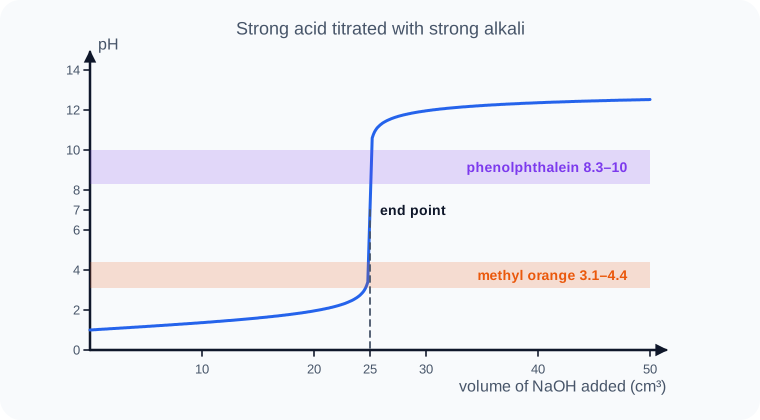
Figure 2. pH change in a strong acid–strong alkali titration. WASSCE Tutor diagram.
| Titration | Example | Suitable indicator |
|---|---|---|
| Strong acid + strong base | HCl + NaOH | Methyl orange or phenolphthalein |
| Strong acid + weak base | HCl + Na₂CO₃ or NH₃ | Methyl orange |
| Weak acid + strong base | CH₃COOH + NaOH | Phenolphthalein |
| Weak acid + weak base | CH₃COOH + NH₃ | No sharp end point; no suitable simple indicator |
| Indicator | Colour in acid | Colour in alkali | End-point colour |
|---|---|---|---|
| Methyl orange | Red | Yellow | Orange |
| Phenolphthalein | Colourless | Pink | Faint pink (alkali in burette) or just colourless (acid in burette) |
Precautions and sources of error
Precautions:
- Remove air bubbles from the burette jet.
- Remove the funnel before reading the burette.
- Read the meniscus at eye level.
- Use only 2–3 drops of indicator: indicators are weak acids or bases themselves.
- Swirl the flask constantly and add acid dropwise near the end point.
- Wash the sides of the flask with distilled water to rinse down splashes.
- Make sure the pipette tip touches the inside of the flask at the end of delivery, and do not blow out the last drop.
Sources of error:
- overshooting the end point
- parallax when reading
- burette or pipette not rinsed with the right solution
- air bubbles in the burette tap
- impure or wet reagents
Pharmacies and food laboratories use titration to check quality. A titration with sodium hydroxide measures how much ethanoic acid is in vinegar sold in Freetown markets, to check it has not been watered down. Another titration measures the acid content of palm oil, which shows how fresh it is.
Do not include the rough titre in the average, and do not average titres that differ by more than 0.10 cm³. Average only the concordant values.
Key points
- Burette and pipette are rinsed with the solutions they hold; the conical flask with distilled water.
- Add indicator (2–3 drops), titrate on a white tile, swirl and add dropwise near the end point.
- Read at the bottom of the meniscus, to 2 decimal places.
- Average concordant titres (within 0.10 cm³), not the rough.
- Strong acid + weak base: methyl orange. Weak acid + strong base: phenolphthalein.
WASSCE examination focus
In the practical paper you will perform a titration, record readings in a table and calculate an average titre. Theory questions ask you to name apparatus, explain rinsing, choose an indicator and state precautions. Your table must show final and initial readings and titres to two decimal places.
Quick check
- Why is the conical flask not rinsed with the alkali before use?
- What is meant by concordant titres?
- Which indicator would you use to titrate sodium carbonate with hydrochloric acid?
- Titres were 24.10 (rough), 23.60, 23.70 and 23.65 cm³. Find the average titre.
Answers:
- Extra alkali would remain in the flask, adding to the measured moles and making the titre too large.
- Titres that agree within 0.10 cm³.
- Methyl orange (strong acid with a weak base).
- cm³.
Keep going with acid-base titration
This is one of 2 lessons in Acid-Base Titration. Start free with the first lesson of every topic, then unlock them all, plus exam-style practice marked instantly and guided learning tools, from 25 NLe.
- Free account, no card needed
- Everything from 25 NLe
- No automatic renewal
More lessons in Acid-Base Titration
- Titration calculations🔒